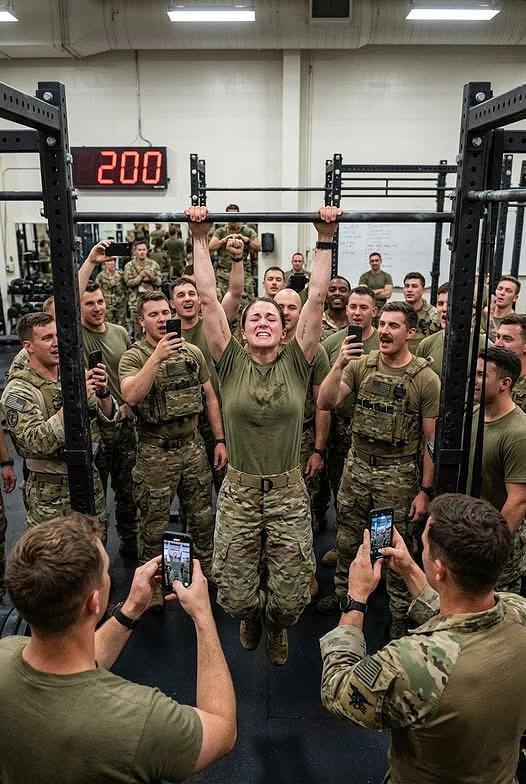
Inside the controlled, pressure-filled halls of the Naval Medical Center in San Diego, Sarah Martinez was known for watching more than she spoke. At twenty-five, she carried an intuitive understanding of the human body that felt almost mechanical in its precision. While many of her peers back in Texas spent their teenage years chasing trends online, Sarah had grown up in her father’s dimly lit garage, sleeves rolled up, learning how engines came apart—and how they worked best when put back together correctly. She learned early that steel and muscle obeyed the same rules: leverage mattered, friction mattered, and efficiency was everything.
As a physical therapist, she brought that mindset to the rehabilitation of elite service members whose bodies had been pushed beyond conventional limits. She guided them through pain most people would never encounter, fully aware that the mind often quit long before the body truly reached its limit.
One unusually humid Wednesday, Sarah was assigned to observe a fitness evaluation in the base gym. Chalk dust hung thick in the air, mixed with the sharp scent of sweat and metal. A group of Navy SEALs were grinding through a pull-up endurance test—men forged by extreme training, conditioned to treat pain as background noise. Sarah stood off to the side in loose scrubs and a lab coat, an unassuming presence amid steel racks and loaded barbells.
She didn’t watch them with admiration or intimidation. She analyzed. She noticed small inefficiencies invisible to exhausted eyes: hips swaying just enough to drain energy, grips positioned too high on the bar, rapid drops that wasted strength instead of conserving it. Where the operators saw brute force, Sarah saw mechanical problems waiting to be solved.
Eventually, she stepped forward and calmly explained what she was seeing. She spoke about hand placement, shoulder engagement, controlled descents—small corrections that could dramatically extend endurance.
The response was immediate laughter. Rodriguez, broad-shouldered and dripping sweat, shook his head with a grin.
“No offense, Doc,” he said, amused, “but there’s a difference between studying pull-ups and doing them. You really think you can outlast guys who train for this every day?”
Sarah didn’t react emotionally. She simply looked at the bar.
“Would it be alright if I demonstrated?”
More laughter followed, louder this time. She was smaller than all of them, a medical professional in a combat gym. But at the back of the room, Commander Thompson said nothing—he’d learned long ago that quiet confidence often mattered more than volume. He gave a single nod.
The gym fell silent as Sarah approached the bar. She accepted a boost, wrapped her hands around it at shoulder width, and inhaled slowly. Her hands weren’t soft; they were conditioned from years of climbing and gymnastics done quietly, without spectators.
Her first pull-up was flawless. No swinging. No wasted motion. Just smooth control—up, then down like a calibrated machine. Ten reps passed. Then twenty. Her form never changed. By thirty, the room was no longer amused. By fifty, disbelief had replaced doubt.
At seventy-five, she matched the base record. At ninety, she broke it. Sweat darkened her scrubs, but her movement stayed precise, her breathing steady. She wasn’t fighting the bar—she was working with it.
The SEALs began counting aloud, not mocking now, but rallying. Rodriguez’s voice was the loudest. At 120 reps, her forearms tightened painfully, but she subtly adjusted her grip and shifted the load through her core. At 150, the gym had filled with spectators—medical staff, trainers, operators—drawn by whispers of something unreal unfolding.
By 180, her entire frame trembled. Commander Thompson paced slowly, recognizing that he wasn’t witnessing a stunt, but a lesson. Sarah’s muscles burned, but her technique held. When she reached 200, she rose inch by inch, jaw clenched, breath ragged—until her chin cleared the bar one final time.
She dropped lightly to the floor, legs shaking.
The gym exploded with cheers. One by one, every man in the room snapped to attention and saluted—not out of obligation, but respect.
In the weeks that followed, the performance became legend. Sarah’s record was officially recognized, and the Navy invited her to help redesign biomechanical training protocols. She accepted quietly, then returned to her clinic as if nothing had changed.
When injured sailors told her an exercise was impossible, she would smile gently and ask the same question that had silenced a room full of elite warriors:
“Would you like me to show you?”
She had proven that strength isn’t always about size or intimidation. Sometimes, it’s about understanding the machine—and refusing to believe it’s done before it truly is.