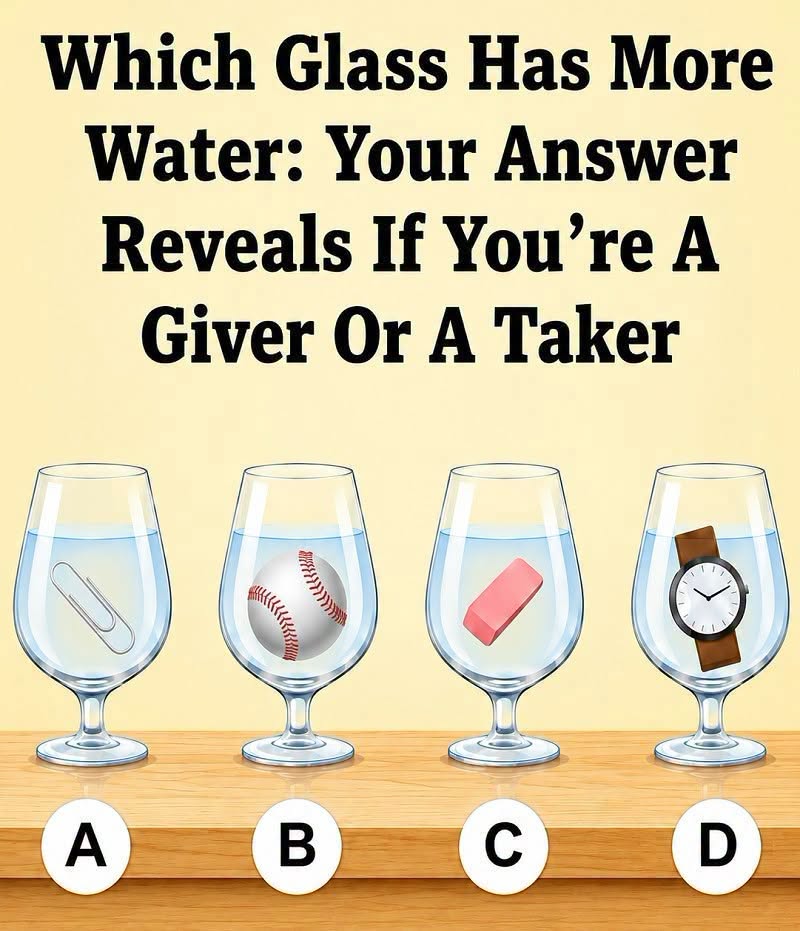
The question is simple:
Which glass contains the most water?
Many people initially focus on the water level because all four glasses appear equally full. However, the puzzle is really about understanding a basic scientific concept rather than relying only on appearance.
The Science Behind the Puzzle
The key principle is water displacement.
When an object is placed in water, it occupies space inside the container. The larger the object, the more water it displaces. If identical glasses are filled to the same level, the glass containing the smallest object has the greatest amount of space available for water.
Since the paperclip occupies far less volume than the baseball, eraser, or wristwatch, Glass A contains the greatest amount of water.
The larger objects leave less room for water because they take up more space inside the glass.
Why Puzzles Like This Are So Popular
Visual puzzles encourage people to think beyond first impressions. They remind us that what we see at a glance isn’t always enough to reach the correct conclusion.
Instead of rushing to an answer, they reward careful observation and logical reasoning.
This type of challenge also illustrates how science applies to everyday situations. Understanding concepts like volume and displacement helps explain why objects behave differently in liquids and why appearances can sometimes be misleading.
A Helpful Reminder
Brain teasers are designed for entertainment and learning rather than measuring intelligence. Different people may approach the same puzzle in different ways, and discussing the solution can be just as enjoyable as solving it.
Whether you answered correctly on your first try or changed your mind after thinking it through, the puzzle offers a useful lesson: taking an extra moment to examine the details can often lead to a better understanding of the problem.
Which glass did you choose before reading the explanation? Share your answer and see how your reasoning compares with others!