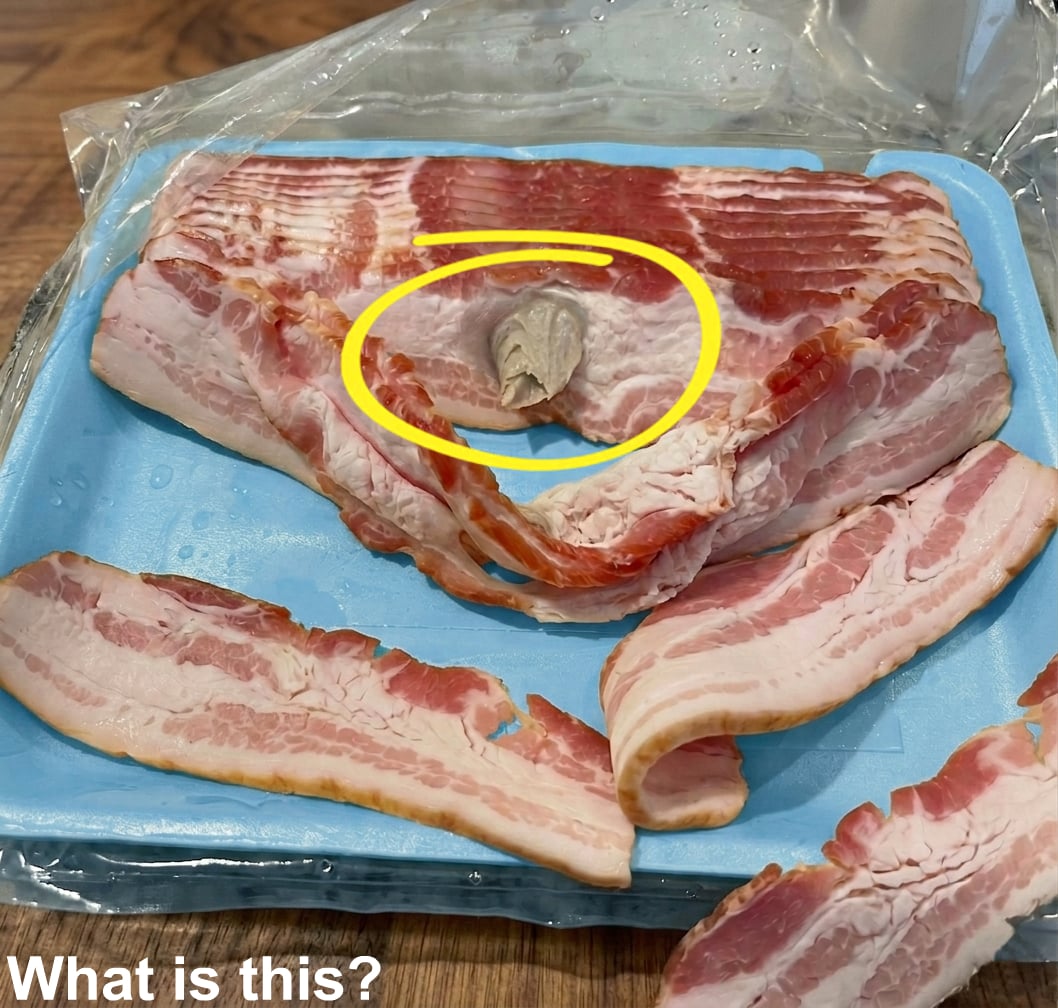
Later, curiosity took over where panic left off.
Instead of breakfast, I found myself searching for answers—looking into food processing methods, comparing images, reading explanations from experts. The internet, as it always does, offered everything at once: reassurance, speculation, and information overload.
And slowly, the truth became less dramatic than the fear.
It wasn’t plastic. It wasn’t something artificial. It wasn’t anything dangerous at all.
It was cartilage—natural connective tissue that occasionally appears in processed meat when small parts slip through standard sorting and trimming.
Nothing sinister.
Just biology.
Just imperfection inside a highly industrial process designed to remove exactly those kinds of surprises.
The relief was immediate—but it wasn’t simple comfort.
Because once the fear faded, something else remained.
Awareness.
That moment in the kitchen wasn’t really about one strange piece of bacon. It was about how distant most of us are from the food we eat every day. Everything arrives neatly packaged, trimmed, labeled, and standardized. Clean edges replace natural forms. Processing removes anything that might remind us it once came from something living.
And that distance changes perception.
We expect perfection, because that’s what we’re shown. Anything outside that expectation—even something completely harmless—can feel unsettling simply because it breaks the illusion of uniformity.
The truth is, modern food systems are designed for consistency, not visibility. What we see in stores is the final, polished version of a much more complex process that most people never interact with directly. And that gap between production and perception is where misunderstanding often begins.
Not everything unfamiliar is dangerous.
Sometimes it’s just unfiltered reality breaking through a very controlled system.
That morning stayed with me—not because of what I found, but because of how quickly my mind filled in the unknown with fear before facts ever arrived.
And maybe that’s the real takeaway.
We don’t just react to what things are.
We react to what we think they might be.
If this story made you think differently about everyday food or how quickly assumptions form, share your thoughts below—have you ever had a moment where something ordinary suddenly felt completely unfamiliar?