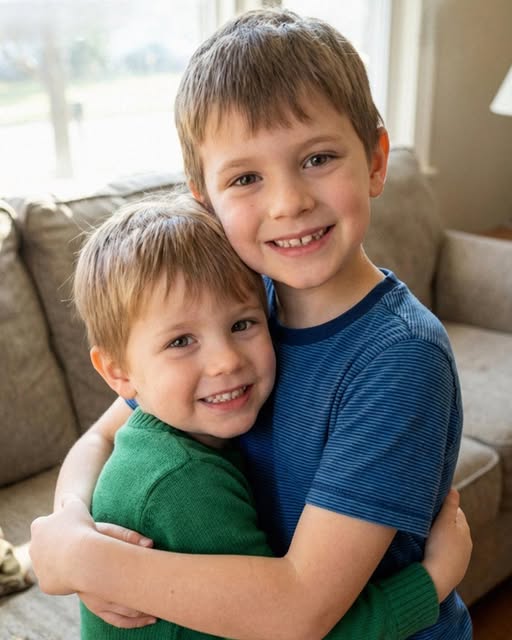
Ethan was eight. Mark was driving him to soccer practice when a truck crossed the line. Mark survived. Ethan didn’t. I never saw his body. A doctor had said I was “too fragile” — as if grief could revoke my right to one last goodbye.
Now Noah — five, still soft with baby curves — was insisting his brother had visited kindergarten.
“What did he say?” I asked, careful.
Noah grinned. “He said you should stop crying.”
Air turned sharp in my lungs. I tightened his seatbelt and drove home, the road flickering into that other road — two lanes, a truck drifting.
That Saturday, I took Noah to the cemetery. White daisies in my hands. Ethan’s headstone gleamed too clean, too new, as if it hadn’t yet earned its place in the earth.
“Say hi to your brother,” I whispered.
Noah didn’t move. He stared at the stone, then past it.
“Mom,” he said softly, “Ethan isn’t there.”
My heart thumped hard. “What do you mean he isn’t there?”
“He told me,” Noah said simply. “He’s not in there.”
A chill crawled over me.
Monday, he said it again.
“He came back. By the fence.”
My fingers froze on the seatbelt. “At school?”
Noah nodded. “He talks to me.”
“What does he say?”
His eyes flicked away. “It’s a secret.”
Every nerve in me lit up.
“Noah,” I said quietly, “we don’t keep secrets from Mom. If anyone tells you to keep a secret from me, you tell me anyway. Okay?”
He nodded slowly.
That night, I called the school. The next morning, I asked for the security footage of the playground.
Ms. Alvarez hesitated. I didn’t.
“My son is being approached,” I said. “I need to see.”
On the screen, children ran across the playground in bright jackets. Then Noah wandered toward the back fence. He stopped. He smiled. He waved.
“Zoom in,” I demanded.
A man crouched on the other side. Work jacket, baseball cap pulled low. He leaned close to the fence. Noah laughed, answering him like it was normal. The man slipped something small through the bars.
“Who is that?” I asked.
Ms. Alvarez swallowed. “One of the contractors. He’s fixing the exterior lights.”
I didn’t hear “contractor.” I saw a crash report I had refused to study.
“That’s him,” I said.
“Who?”
“The truck driver,” I whispered. “The one who hit them.”
Silence.
I called 911.
When officers arrived, they found him near the maintenance shed. He didn’t run. He didn’t resist.
I saw him in a small conference room, hands clasped, red-rimmed eyes. He looked up.
“Mrs. Elana,” he said hoarsely.
Noah pressed against my side. “That’s Ethan’s friend,” he whispered.
I sent Noah out with Ms. Alvarez.
“Why were you talking to my son?” I asked the man.
He flinched. “I didn’t mean to scare him.”
“You told him you were Ethan. You told him to keep secrets.”
His shoulders sank. “I know.”
Officer Haines asked his name.
“Raymond Keller,” he said.
“Why approach a child?”
Raymond’s voice cracked. “I saw him at pickup last week. He looks like Ethan. I got the repair job on purpose.”
“Why?”
“I can’t sleep,” he admitted. “Every time I close my eyes… I’m back in the truck. I have fainting spells. Tests… I didn’t go. I couldn’t lose work.”
“And you drove anyway,” I said.
“Yes.”
“And my son died.”
“Yes.”
The room felt too small for the weight of that truth.
“And you thought talking to Noah would help who?” I demanded.
“Me,” he whispered. “If I could do something… if I could help you stop crying… maybe I could breathe.”
“So you used my living child to soothe your guilt.”
He didn’t argue.
Officer Haines issued a no-contact order. I requested it. The school tightened security.
When Noah returned, clutching a plastic dinosaur, I knelt.
“That man is not Ethan,” I said gently.
“But he said—”
“He lied. Grown-ups don’t put their sadness on children. They don’t ask kids to keep secrets.”
Noah blinked. “So Ethan didn’t tell him?”
“No,” I said. Words felt like shards of glass. “Ethan didn’t.”
Noah cried quietly, the soft devastation of a child losing something invisible. I held him until his breathing evened.
At home, Mark waited, pale and shaken. I told him everything. His face twisted with rage, then guilt.
“I should’ve been the one,” he whispered.
“Don’t,” I said. “We don’t get to drown. We have Noah.”
Two days later, I went to the cemetery alone. The wind bit through my coat. Ethan’s name felt small under my fingers.
“Hi, baby,” I whispered. “I’m sorry I couldn’t see you. I’m sorry I couldn’t say goodbye.”
The air felt different — not haunted, just honest.
“I can’t forgive him,” I said. “Maybe never. But I won’t let anyone speak for you. No more borrowed words. No more secrets.”
I pressed my palm to the cold stone.
“I’m going to keep Noah safe,” I told him. “And I’m going to keep you clear.”
The hurt remained.
But now it was clean.
And I could carry it.