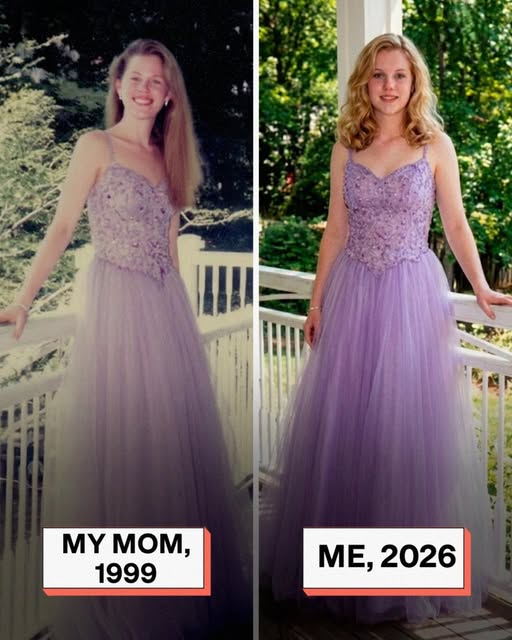
I was six years old when everything seemed to fade into gray. My mother—who always smelled faintly of lavender and spent her evenings surrounded by books—died suddenly, leaving behind a quiet that felt heavier than sound itself. My father did his best to fill the space she left, but our home became a place where memories were carefully avoided, like fragile artifacts behind glass. Among them was one item we never spoke about: a long garment bag hidden deep in the cedar closet, holding my mother’s old prom dress.
The dress was pure 1990s elegance—deep blue silk with hand-sewn beads that shimmered softly, like starlight caught in fabric. As I grew older, I would run my fingers over the plastic covering, imagining her wearing it on a carefree night long before grief entered our lives. It wasn’t just clothing; it was proof she had existed beyond the stories I was slowly forgetting.
When I was seventeen, my father married Brenda. She was loud where my mother had been gentle, flashy where my mother had been subtle. Brenda took over the house immediately, replacing framed paintings with motivational wall quotes and rearranging rooms as if erasing history. My father, desperate for happiness after years of loneliness, didn’t notice how she treated me—or how she resented every reminder of the woman who came before her.
Three weeks before my senior prom, everything came to a head. I had told my father months earlier that I didn’t want a new dress. I wanted to wear my mother’s. He had cried when I asked, calling it a beautiful tribute. We had the dress carefully cleaned and adjusted, and when I saw it afterward, it looked alive again—like it had been waiting for me.
One afternoon, I came home to a sharp chemical smell that burned my nose. Panic set in before I even reached my room. The garment bag was gone.
I found Brenda in the laundry area, casually tossing shredded blue fabric into the trash. The silk was torn beyond recognition, the beadwork ripped away, and bleach stains scarred what was left.
My voice barely worked. “What did you do?”
She smiled thinly, completely unbothered. “That old thing was falling apart,” she said. “You don’t need to live in the past. I helped you move on. I bought you a new dress—pink, very trendy. It’s upstairs.”
I didn’t cry. I couldn’t. The shock was too numbing. I just stood there, staring at what remained of my mother.
When my father arrived home, Brenda intercepted him with rehearsed concern, claiming she had “cleaned up” a hazardous old dress and that I was overreacting. I stayed back, watching.
My father didn’t raise his voice. He just asked one question.
“You went into the cedar closet?”
Brenda waved it off. “I was tidying.”
“You destroyed the one thing our daughter had left of her mother?”
She crossed her arms. “It was just a dress. I’m your wife now. I should matter more.”
That was when my father truly saw her. He noticed me standing silently in the hallway, my hands trembling. Something hardened in his expression.
“You’re right,” he said calmly. “It was just a dress. And things can be replaced.”
Brenda smirked.
“But people can’t.”
The next morning, Brenda discovered her own valuables were missing. She prized her designer handbags—kept in a temperature-controlled case like museum pieces. The case was empty.
She screamed. Accused. Panicked.
My father, sitting quietly at the table, explained he had removed them. “They were holding you back,” he said evenly. “I thought you’d appreciate a fresh start.”
When she shouted about their value, he repeated her words back to her. “It’s just material. Why be dramatic?”
Then he slid an envelope across the table.
He hadn’t destroyed the bags. He’d sold them and placed every dollar into a protected fund for my college education—money my mother would have wanted used for my future. Alongside it were annulment papers.
“You have two hours to pack,” he said. “You wanted us to stop clinging to the past. I agree.”
Brenda’s outrage turned to desperation, but my father was already walking toward me. He placed a hand on my shoulder and apologized—for not seeing sooner.
On prom night, I didn’t wear the pink dress. My father had taken the salvageable pieces of my mother’s gown to a restoration seamstress. She transformed the remaining silk and beadwork into a modern jumpsuit that carried the spirit of the original.
Standing in front of the mirror, wrapped in that deep blue fabric, I didn’t feel like someone who had lost her mother. I felt like someone protected by her memory—and by a father who finally chose to defend it. The house was quiet again, but this time, it felt peaceful. And for the first time in years, it truly felt like home.