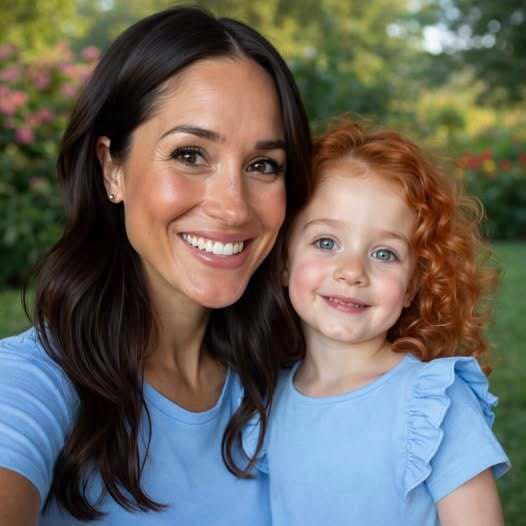
As often happens with high-profile figures, a private family moment became a public canvas.
People debated what the image “meant,” what it signaled about the Sussexes’ evolving relationship with the public, and whether it represented a new chapter in how they choose to share their lives. Some saw it as a gentle gesture of openness. Others viewed it as a controlled, intentional step in their ongoing approach to privacy and media boundaries.
And through all of it, the actual subject—the child at the center of the image—remained exactly what she was in the frame: a young girl enjoying a quiet moment in a garden.
Observers also noted familiar features that invited comparisons to family members across generations, a pattern that has long followed public royal photographs. In moments like these, the public often reads history into appearance, turning resemblance into narrative and narrative into debate.
But beneath the noise, the reality is more grounded.
A family chose to share a moment.
The public responded with interpretation.
And the internet did what it always does—it amplified everything.
What makes this story persist isn’t the photograph itself, but what it represents in the modern media age: the tension between private life and public fascination, especially for people who exist at the intersection of both.
For Meghan and Harry, every shared image becomes more than memory—it becomes commentary, conversation, and sometimes controversy, regardless of intent. For the public, every glimpse feels like access to a story that has never fully stopped unfolding.
And yet, when the speculation fades and the headlines move on, what remains is something far simpler than the discourse around it.
A family choosing what to share.
A child growing up in the middle of attention she did not choose.
And a world still learning where the line is between interest and intrusion.
In the end, the image didn’t change history or rewrite anything.
It just reminded everyone how quickly a quiet moment can become a global story—and how important it is to look at it for what it actually is, not what everyone rushes to imagine it might be.