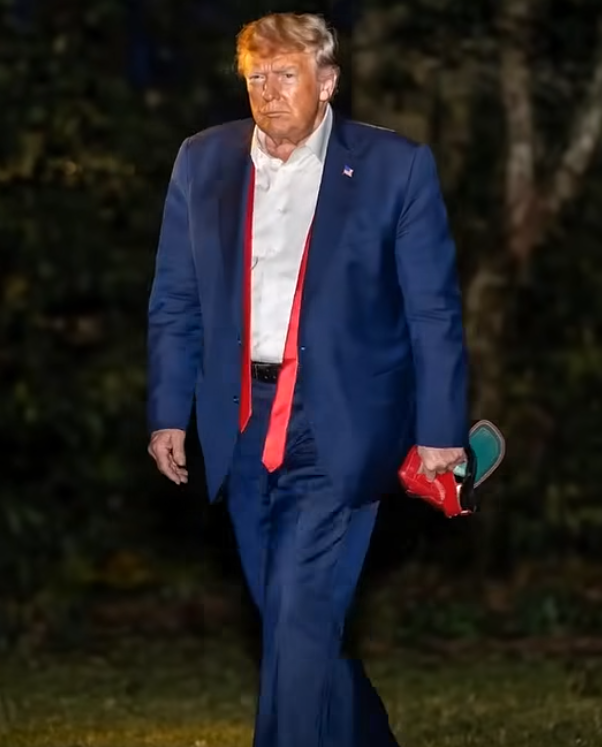
In the absence of clear information, interpretation rushed in to fill every gap. Social media threads expanded the clip into theories. Commentary cycles turned speculation into certainty. Even silence from official sources was treated as confirmation of hidden meaning. The original event became less important than the ecosystem of reaction it triggered.
At the heart of it was a familiar dynamic: the need to make ambiguity disappear. A public figure walking alone at night should have been an ordinary, unremarkable scene. Instead, it became a canvas for collective assumption, shaped by preexisting beliefs and amplified by constant digital repetition.
Over time, the figure at the center of the clip was no longer treated as a person moving through a private moment, but as a symbol—something that could be decoded, explained, and ultimately controlled through interpretation. The more unclear the reality became, the more confident the commentary grew.
And yet, when the noise eventually settles, what remains is not clarity but reflection.
The event itself offers no final answer. No confirmed explanation. No satisfying resolution. Instead, it leaves behind something more uncomfortable: the realization that modern attention often reveals more about the audience than the subject.
In the end, the clip did not fully explain him. It exposed us—our impatience with uncertainty, our hunger for meaning, and our willingness to turn incomplete moments into complete stories.
If this kind of viral moment caught your attention, share your thoughts—do we interpret too much, too quickly, or is this just the new reality of living in a constantly watched world?