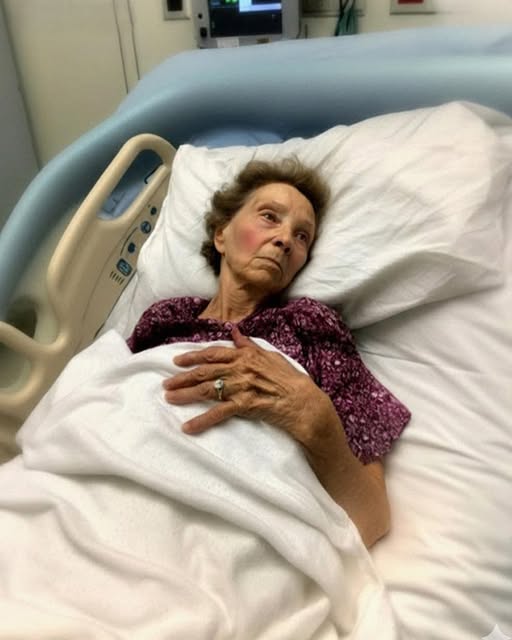
Grandma was still drawing breath when Aunt Linda reached for the ring. It happened so smoothly that anyone who glanced away for a second would have missed it entirely.
The hospice room carried the faint bite of disinfectant mixed with the gentle lavender lotion Grandma always dabbed on her wrists. Overhead lights buzzed softly, washing everything in a pale glow. I sat near her feet, rubbing her heel through the thin blanket, whispering that I loved her and that she didn’t have to worry anymore.
At first, I barely registered Linda stepping closer. She leaned down to “say goodbye,” her face arranged in tenderness. But her hand moved with quiet calculation as it drifted across Grandma’s left hand.
For a split second, the diamond caught the light. Then it disappeared—slid from Grandma’s finger and tucked neatly into Linda’s sweater pocket as if it had never belonged anywhere else.
Grandma’s eyes opened right then. Not wide with alarm—just aware. She looked at me first, then at Linda. A faint, almost weary smile crossed her lips before her eyes closed again.
That expression said everything: she knew, she understood, and she chose silence.
Twenty minutes later, she was gone. Her hand rested empty against the sheets.
At the funeral, Linda wept louder than anyone. She clung to relatives, declared herself “Mom’s favorite,” and dabbed at dry cheeks with lace. Her sorrow seemed rehearsed, carefully projected to draw sympathy.
But I knew what rested in her pocket.
Two days later, the doorbell rang. A delivery required a signature. Linda hurried to answer it, smoothing her hair like someone stepping onstage. She carried the small box into the living room with deliberate care. A note taped to the top read: Open in front of everyone.
Inside was a velvet pouch and a folded letter.
Linda’s smile faltered as she read the first line.
Color drained from her face. “No… Mom, that’s not fair,” she murmured.
“Read it,” I said evenly.
“It’s private,” she insisted weakly.
“It says to open it in front of everyone,” my mother replied, her voice firm for once.
Uncle Ray leaned forward. “Out loud.”
Linda swallowed and began, her voice unsteady. “Linda… if you’re holding this, then you’ve done exactly what I expected.”
The air tightened.
“I saw you take my ring in hospice. I chose not to stop you. I didn’t want an argument at my bedside. And I didn’t want Kate blamed for telling the truth.”
Hearing my name made my chest tighten.
Linda hesitated, then continued. “I sold the real diamond ten years ago.”
My mother gasped. Ray stood abruptly. “Read that again.”
I reached into the box and pulled out a faded pawn receipt—dated, signed, undeniable.
Linda kept reading, her voice cracking. “I used the money to pay for your rehab. You called me crying. You promised it would be different.”
The silence that followed felt heavy enough to press against our ribs.
“She sold her diamond for you,” my mother whispered.
“I never asked her to,” Linda shot back.
“Yes,” I said quietly. “You did.”
Ray’s eyes dropped toward Linda’s pocket. “So that ring—”
Linda pulled it out and threw it on the table. The stone sparkled under the light—too clear, too flawless.
Glass.
Grandma had replaced the diamond years ago.
But there was another envelope in the box, clearly marked: FOR KATE — OPEN IN FRONT OF EVERYONE.
Linda reached for it, but Ray stepped between us. I unfolded it carefully.
“Kate,” it began, “you’re the only one I trust to handle what comes next. There is a small account for funeral costs and for cleaning your grandfather’s headstone. This is not a gift. It’s a duty.”
Linda’s eyes sharpened. “So there is money.”
I kept reading. “Linda will try to turn this into a prize. She will cry. She may threaten. Do not give it to her.”
Linda shot to her feet. “This is unbelievable.”
“Sit down,” my mother said calmly.
The letter continued: “Within twenty-four hours, at Sunday dinner, you will read both letters aloud. Not to humiliate her, but to end the lies.”
When Sunday arrived, Linda came dressed in black, eyes rimmed red, posture stiff as if awaiting judgment. I read everything again—slowly, clearly. The hospice room. The pawn receipt. The rehab payment. The glass stone.
Each detail peeled away years of carefully maintained illusion.
When I finished, the room stayed quiet.
“You all hate me,” Linda finally said.
My mother shook her head. “No. We’re just done saving you.”
That seemed to land harder than anything else.
“I needed help,” Linda whispered.
“You got help,” Ray replied. “You just didn’t change.”
For the first time, Linda dropped the performance. “I took the ring,” she admitted. “I thought it should be mine.”
There was no shouting. No dramatic exit. She left quietly.
The next morning, my mother and I went to the bank and set the funeral account under both our names, just as Grandma instructed. Boundaries were finally in place.
That night, I sat at the kitchen table with the letters spread before me. Grandma hadn’t written them out of anger. She’d written them with clarity. Her goal wasn’t to shame Linda—it was to stop a cycle.
The following Sunday, I cooked dinner. Grandma’s candle flickered at the center of the table. Linda’s chair stayed empty.
We ate anyway.
Not because everything was repaired, but because we were finally honest.
No one pretended the glass was a diamond. No one pretended the past hadn’t happened. And no one pretended peace could be stolen without consequence.
Grandma’s final gift wasn’t jewelry or money. It was discernment. It was the courage to name what’s true and to protect the boundaries that keep love from turning into manipulation.
Sometimes healing doesn’t begin with an apology.
Sometimes it begins with the simple act of telling the truth—and refusing to pretend anymore.