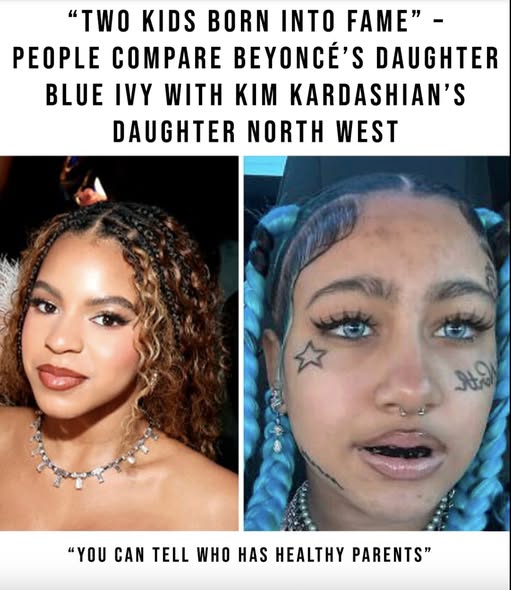
The post immediately drew backlash. Commenters were quick to point out the obvious: context matters. “It was a Halloween costume. Y’all are reaching,” wrote one. Another reminded viewers, “Different people have different personalities,” urging the audience to resist comparisons.
Some comments went further, challenging the assumptions embedded in the post. “Children raised in two-parent households can become broken, just as children raised in single-parent households can be perfectly fine,” one person noted. Another echoed the sentiment, emphasizing that appearances or a single photograph cannot define a child’s upbringing.
Despite these corrections, some social media users continued the discussion, critiquing the parenting choices of Kim Kardashian and implicitly of Beyoncé and Jay-Z. Comments like, “You can tell who has healthy parents,” or “When there’s no father in the house, that’s what you see,” attempted to assign moral judgment based on incomplete information, framing childhood experiences as a product of family structure alone.
Several commenters reminded readers of a crucial point: these are children. They are exploring identity, play, and creativity. Halloween costumes, dress-up, and even temporary tattoos are part of normal childhood experimentation. “Those with negative comments should remember that these are kids,” one person wrote. “They are allowed to play with makeup, have tattoos, and mimic anyone—they are just kids.”
This viral debate is more than just about Blue Ivy and North. It reflects a larger societal fascination with celebrity lives and parenting norms, as well as the quickness with which assumptions can turn into judgment. Social media amplifies opinions, sometimes without regard for nuance or context. What begins as a comparison of two children can quickly escalate into moral commentary, cultural debate, and public shaming—all based on a snapshot, a costume, or a fleeting moment.
In the end, the conversation reminds us how easily public perception can be shaped by visuals and assumptions. It also underscores the need for empathy, especially when it comes to children. Every child, whether born into fame or ordinary life, deserves space to play, explore, and make mistakes without being labeled or criticized.
The strong opinions surrounding celebrity parenting reveal more about our societal attitudes than the children themselves. The focus on family structure, appearances, and perceived morality highlights ongoing cultural debates about what defines a “healthy” upbringing. Yet at its core, the discussion should center on love, support, and safety—things that cannot be measured in photos or video clips alone.
For now, the story of Blue Ivy and North West serves as a reminder: the childhoods of famous children are often used as mirrors for society’s anxieties, values, and judgments. But as adults, it is worth pausing before commenting—recognizing that behind the headlines and viral videos, these are just kids, discovering the world, trying on different faces, and imagining themselves in playful ways.
What do you think? Are we too quick to judge celebrity parenting, or is it natural to be curious about lives so unlike our own? Let us know in the comment section on Facebook.