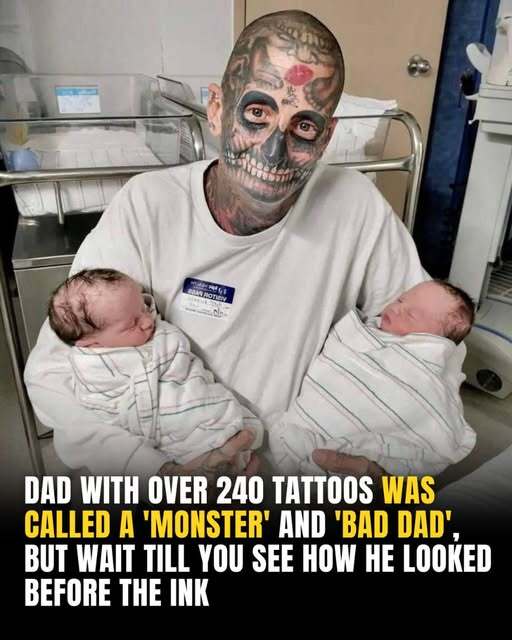
That is the problem with surface-level judgment.
It creates a story before the facts are known.
Richard’s appearance may be unusual to some, but it does not explain his character. It does not show his patience, his love for his children, his role at home, or the effort he puts into being present as a father.
Tattoos as Personal Expression
For Richard, tattoos are not about trying to shock people.
They are a form of self-expression.
What began as an interest slowly became a major part of his identity. Each tattoo became part of how he chose to present himself to the world. For him, the ink represents individuality, confidence, and the freedom to live honestly rather than fit into other people’s expectations.
That choice has brought criticism, especially online.
But Richard has not allowed public opinion to decide who he should be.
He understands that not everyone will like his look. He knows some people will judge him instantly. Still, he continues to live as himself because authenticity matters more to him than approval from strangers.
That kind of confidence is not always easy.
Standing out means accepting that people will stare, comment, and misunderstand.
His Wife Saw Past the First Impression
Richard’s wife, Marita, has been honest about the fact that even she had assumptions at first.
His appearance stood out. Like many people, she initially reacted to what she saw before fully understanding who he was.
But that changed when she got to know him.
Behind the tattoos, she discovered someone kind, thoughtful, loyal, and deeply committed to his family. The image that outsiders often focus on did not match the reality of the man she came to know.
That is the part people miss.
A first impression can be powerful, but it is not always accurate.
Today, Marita sees Richard through his actions. She sees the husband who supports her. She sees the father who shows up for his children. She sees the man behind the tattoos, not just the tattoos themselves.
Fatherhood Is About Presence, Not Appearance
The strongest part of Richard’s story is his role as a father.
He and Marita are raising five children together in a home built around love, support, and respect. His daily life is not defined by outside criticism. It is defined by family responsibilities.
Richard is involved in his children’s lives.
He attends school functions. He participates in PTA meetings. He supports his children in their activities. He shows up in the moments that matter, not just for big events, but in the regular daily work of parenting.
That is what fatherhood really is.
It is not about looking a certain way.
It is about being present.
It is about helping, guiding, listening, protecting, and making sure children feel loved and safe.
His children understand that better than any stranger ever could. To them, he is not “the tattooed dad.” He is simply Dad.
One of his daughters has even defended him by saying he is a great father who just happens to have tattoos. That simple statement cuts through all the outside noise.
The Difference Between Assumption and Reality
Richard’s life highlights a common problem.
People often connect appearance with character, even when there is no real reason to do so.
A heavily tattooed person may be judged as irresponsible. A person with a different style may be labeled before they ever speak. A parent who does not fit the traditional image may face unfair questions about their ability to raise children.
But appearance is not evidence.
It is just appearance.
The real measure of a person is how they live. How they treat others. How they show up when people depend on them. How they handle responsibility. How they care for their family.
By that standard, Richard’s family says the truth is clear.
He is loving. He is present. He is committed.
Those qualities matter far more than ink on skin.
Handling Criticism Without Letting It Win
Living under constant judgment is not easy.
Every public outing can bring stares. Every photo can attract comments. Every online post can become a place where strangers feel entitled to criticize.
Richard could respond with anger.
Instead, he focuses on what actually matters.
His family.
His children.
His own self-respect.
That does not mean criticism never affects him. It means he refuses to let it control his life. He does not change himself to make strangers more comfortable. He does not hide who he is to avoid judgment.
Instead, he lets his actions speak.
That may be the strongest response of all.
Teaching His Children a Bigger Lesson
Richard’s appearance has also created an important teaching opportunity for his children.
By living confidently, he shows them that being different is not something to fear. He teaches them that people should not be reduced to how they look.
That lesson matters.
Children grow up in a world where people are judged quickly for clothing, tattoos, body type, background, income, and countless other surface details. Richard’s family life gives his children a different message.
Look deeper.
Pay attention to actions.
Judge people by kindness, honesty, loyalty, and respect.
Those are the values he wants his children to understand.
In that way, his tattoos have become part of a larger lesson about acceptance. Not because everyone needs to like the same style, but because everyone should understand that appearance alone does not define worth.
Challenging What People Think a Parent Should Look Like
Society often has a narrow image of what a “good parent” is supposed to look like.
Clean. Simple. Traditional. Predictable.
But real families do not always look like that.
Good parents can have tattoos. Good parents can have piercings. Good parents can dress differently, live creatively, or stand outside the usual image people expect.
Parenting is not measured by appearance.
It is measured by love, patience, consistency, sacrifice, and daily effort.
Richard’s story challenges the idea that a father has to look a certain way to be taken seriously. His family sees the truth because they live it every day.
They know who wakes up for them.
They know who supports them.
They know who shows up.
That matters more than public opinion.
Family Support Makes the Difference
One reason Richard remains strong is the support he receives at home.
Marita and the children do not allow outside judgment to define their family. They know the man behind the appearance, and their bond is stronger than the opinions of strangers.
That support gives Richard a foundation.
It reminds him that the people who truly know him are the ones whose opinions matter most.
This is something many families can relate to. The outside world may judge, question, or misunderstand, but a strong family knows its own truth.
For Richard, that truth is simple: he is loved, accepted, and valued by the people closest to him.
A Story About More Than Tattoos
Richard Huff’s story is not really about tattoos.
It is about judgment.
It is about how quickly people create stories about others based on appearance. It is about the gap between what strangers assume and what families actually know.
His life reminds us that people are complicated. A person’s body may tell part of a story, but it never tells the whole story.
Tattoos do not show how someone comforts their child.
They do not show how someone supports their spouse.
They do not show patience, loyalty, kindness, or responsibility.
Those things are revealed through daily action.
The Real Message Behind Richard’s Story
Richard’s experience leaves a clear message: stop reducing people to what they look like.
A heavily tattooed father can be loving.
A person who looks different can be responsible.
Someone who does not fit the traditional image can still build a home filled with care, structure, and respect.
Richard’s family knows who he is, and their view matters more than the judgment of strangers.
His story is a reminder that character is not found on the surface. It is found in how a person lives, loves, and treats the people who depend on them.
Before judging someone by their appearance, it is worth asking a simple question:
Do you actually know their story?
What do you think — are people too quick to judge parents by appearance? Share your thoughts in the comments and pass this story along to someone who believes character matters more than looks.