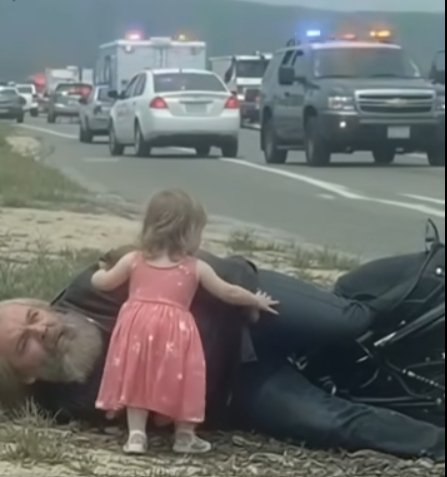
The sun was dipping low over Route 27, stretching long amber streaks across the pavement. Late autumn had settled in, and the air carried the crisp scent of dry leaves. Cars passed in an easy rhythm, nothing out of the ordinary.
Driving north in her silver sedan, Helen Maren exhaled after a demanding day at work. For once, the road ahead felt calm.
In the back seat, her five-year-old daughter Sophie sat strapped into her booster seat, still dressed in the glittery princess outfit she had refused to change out of after kindergarten. The tiny lights in her sneakers flickered whenever she kicked her feet. It was an ordinary, peaceful ride home.
Then everything changed.
“Stop the car! Mommy, stop!” Sophie suddenly screamed, her voice sharp with panic.
Helen’s pulse spiked as she glanced in the rearview mirror. Sophie’s wide blue eyes were filled with fear, tears spilling down her cheeks.
“The motorcycle man! He’s hurt! He’s down there!” she cried, pointing urgently toward the side of the road.
Helen hadn’t noticed anything unusual — no flashing lights, no stopped vehicles. But there was something unmistakable in Sophie’s tone. It wasn’t imagination. It was alarm.
She slowed the car and eased toward the shoulder, flipping on the hazard lights. Beyond the guardrail, partially concealed by tall grass, something metallic caught the fading sunlight at a strange angle.
Her stomach tightened.
She told Sophie to stay put, but as soon as the car stopped, the little girl scrambled to unbuckle herself. Helen hurried after her, heart pounding.
The slope beyond the guardrail was steeper than it appeared from above. Gravel shifted under their shoes as they carefully made their way down.
That’s when Helen saw him.
A man lay several yards away from a black motorcycle that had clearly left the roadway. The bike’s handlebars were bent, the windshield shattered, and flattened grass marked where it had skidded.
He was alive — but barely conscious. Blood darkened his shirt, and his breathing was uneven. One leg lay at an unnatural angle.
Helen immediately dialed emergency services, forcing her voice to remain steady as she described their location on Route 27. The dispatcher calmly instructed her on what to do until help arrived.
She knelt beside the injured rider, using her scarf to apply firm pressure to the bleeding wound while taking care not to move his head or neck.
Sophie quietly knelt on the other side and gently took the man’s hand.
“You’re going to be okay,” she whispered, her voice soft but steady.
The minutes dragged on until the sound of sirens finally pierced the air. Paramedics arrived swiftly, stabilizing the man’s neck, administering oxygen, and securing him to a stretcher.
One responder glanced at Helen. “You acted quickly. That helped more than you know.”
As they loaded him into the ambulance, the man’s eyes fluttered open. He looked toward Sophie and murmured a faint “Thank you” before the doors closed.
Soon after the ambulance left, several motorcycles pulled onto the shoulder. The riders had been traveling earlier with the injured man and realized he had fallen behind.
One of them, a tall rider named Jack, approached Helen with concern etched across his face. The injured man, he explained, was Jonas Keller, a longtime member of their group.
When Helen described how Sophie had spotted him, Jack knelt slightly to meet the child’s eyes.
“That was brave,” he told her gently.
Sophie shrugged. “He needed help.”
Jonas survived but required surgery and a lengthy recovery. Doctors later said the immediate pressure applied to his wound likely reduced severe blood loss.
Two weeks later, Helen and Sophie visited him at a rehabilitation center. His leg was in a cast, and he looked pale but alert. When Sophie walked in, his face brightened.
“There’s my hero,” he said with a warm smile.
“I just helped,” she replied shyly.
During their visit, Helen learned that Jonas had lost his young daughter, Isla, to leukemia years earlier. His motorcycle group, known as the Black Hounds, honored her memory by raising funds for pediatric cancer research.
Deeply moved by what had happened, the club organized a small community fundraiser celebrating Isla’s legacy and Sophie’s courage. They created the “Route 27 Scholarship,” supporting children recognized for compassion and bravery.
Over time, a natural bond formed. The bikers showed up to Sophie’s winter school recital, quietly filling the back row in leather jackets. From the stage, Sophie waved before beginning her performance. Jonas, walking with a cane but steadily regaining strength, applauded proudly.
Months later, during a spring visit to Jonas’s home, Sophie played beneath an old chestnut tree in the yard. Jonas shared that Isla once buried small notes there for him to discover.
Curious, Sophie asked if they could search for one. Together, they gently uncovered a small tin near the roots. Inside was a faded note in a child’s handwriting:
“Daddy, don’t be sad when I’m not here. I’ll always love riding with you.”
Jonas sat down quietly, overwhelmed. Sophie wrapped her arms around him.
“She still loves you,” she said softly.
“I know,” he answered through tears.
In time, the story of that autumn afternoon became well known locally — not as something mysterious, but as an example of attentiveness and compassion.
Sophie later chose to take certified first-aid classes, inspired by the experience. Jonas eventually returned to riding, though he never forgot mile marker 14 on Route 27.
When asked what saved him, he always gave the same reply:
“A little girl who cared enough to stop.”
Each time he passed that stretch of road at sunset, with the sky glowing gold and crimson, he felt gratitude above all else.
It wasn’t chance that changed his life that day. It was awareness, quick action, and a child’s instinct to help.
Sometimes hope doesn’t arrive with fanfare. Sometimes it appears quietly — in a sparkling princess dress and blinking sneakers — choosing to act when others might keep driving.
And sometimes, that simple choice is enough to alter a life forever.