The truth came out in fragments that didn’t make sense at first.
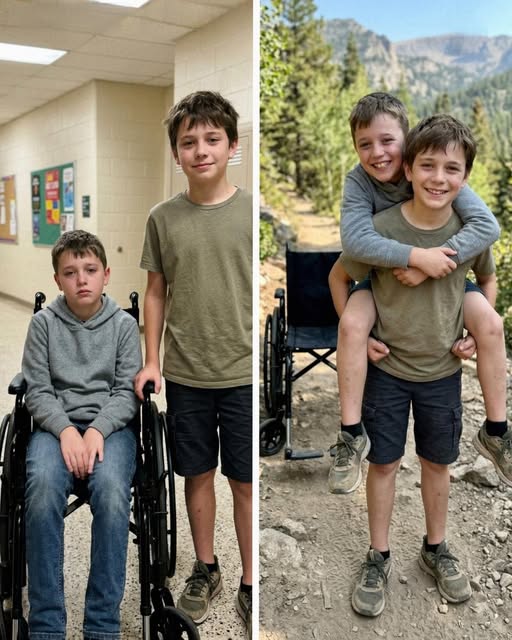
When teachers told Sam he couldn’t continue, Leo refused to accept it. Instead, he lifted his friend onto his back and kept going.
Six miles. Steep climbs, uneven ground, and dangerous terrain.
Every time Sam told him to stop, Leo simply said, “I’ve got you,” and kept moving.
He didn’t take the easy route. He didn’t turn back. He made sure Sam reached the summit—because in his mind, leaving him behind was never an option.
By the next morning, the situation had escalated.
The school called me in urgently, their tone tense and uncertain. When I arrived, I was met with an unexpected sight—five military officers standing outside the office, composed and silent, like they had stepped out of another world entirely.
Inside, Leo stood pale and frightened, convinced he was in trouble for breaking the rules. His voice shook as he apologized over and over, saying he only wanted his friend to be included.
My heart broke watching him stand there—brave, exhausted, and still thinking he had done something wrong.
Then one of the officers stepped forward.
Lieutenant Carlson didn’t speak like someone delivering punishment. He spoke like someone recognizing something rare.
“We’re not here to discipline him,” he said. “We’re here because of what he did for his friend.”
The truth unfolded in a way none of us expected.
Sam’s mother explained that Sam’s father had been a military man who believed deeply in the principle of never leaving someone behind. After his passing, Sam had withdrawn from the world, watching life from the sidelines, slowly accepting exclusion as normal.
But that hike changed everything.
For the first time in years, Sam saw the world from the top of a mountain—not as someone left behind, but as someone carried forward.
The officers weren’t strangers. They were part of his father’s unit. And what Leo had done reached them in a way no one could ignore.
One of them stepped forward with a scholarship fund—full support for Leo’s future, a recognition of character rather than achievement.
Another gently placed a military patch on Leo’s shoulder.
“You earned this,” he said. “Not because you followed rules—but because you understood something deeper.”
As we left the school that day, everything felt different. The rules, the judgment, the tension—it all faded into the background.
In the hallway, Sam waited in his wheelchair. When he saw Leo, both boys broke into exhausted laughter, instantly reconnecting over the only thing that mattered: they had made it to the top together.
No awards. No speeches. Just friendship, strengthened by effort and loyalty.
That night, as I watched Leo finally sleep, I understood something I had been afraid to see.
We spend so much of parenting trying to keep our children safe, contained, and protected from difficulty. But sometimes, who they become is revealed only when they step beyond what we think they’re capable of.
Leo hadn’t just carried his friend up a mountain.
He had carried something far bigger—courage, loyalty, and a kind of compassion that doesn’t ask for permission.
And in doing so, he showed me that growing up isn’t about becoming distant from others.
It’s about learning how to carry them when it matters most.
What do you think defines true courage—following the rules, or standing up for someone when it matters most? Share your thoughts below.