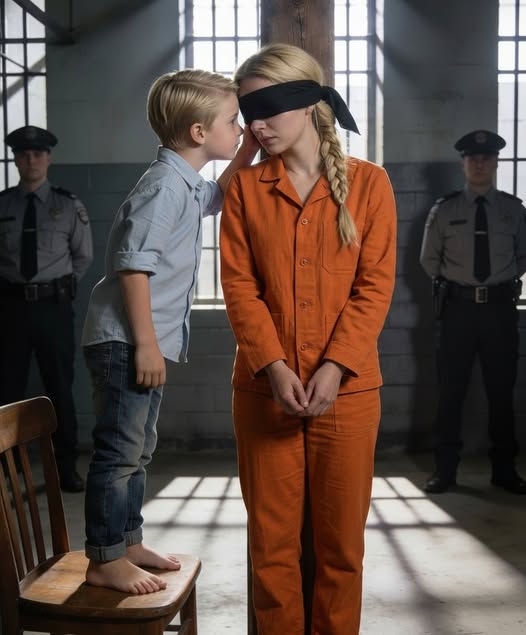
“Step away from him,” a guard ordered, moving between Mateo and Rubén.
But Rubén didn’t step back fast enough.
Because someone in the room had already reacted.
The prison director lifted his hand. “Lock the exit. Now.”
A sharp alarm sounded in the hallway.
My uncle turned his head toward the door, and for the first time in my life, I saw something in his face break—something close to panic.
“That child doesn’t know what he’s saying,” he repeated, but his voice had lost its strength. “This is ridiculous. He’s been influenced—”
“By who?” I cut in.
My voice surprised even me. It came out steady. Cold.
Rubén looked at me like he was trying to decide whether I still belonged to him.
Then Mateo stepped forward.
“I remember everything,” he said through tears. “That night you came to the house. Dad let you in. You said you needed to talk about money.”
The room tightened.
My mother’s chains clinked softly as she leaned forward.
Rubén shook his head. “Enough. This is insane.”
But Mateo continued, faster now, as if he had been holding it in for six years.
“You went into the kitchen with Dad. I saw you through the hallway door. You were arguing. Dad told you no. Then you got angry.”
My mother’s breathing changed.
I felt something shift inside me—something heavy, buried, waking up.
Rubén took one step toward the door again.
“Stop him,” the director said.
Two guards moved in.
That’s when Mateo lifted the key again.
“My dad made me promise,” he said. “If anything ever happened to him, I had to open the drawer.”
I frowned. “What drawer?”
Mateo wiped his face. “The one behind the wardrobe panel.”
My mother suddenly stood up as far as her restraints allowed.
“No…” she whispered. “Arturo never told me about that.”
Rubén’s face changed instantly.
That was all I needed to see.
Because guilt doesn’t always panic.
Sometimes it freezes.
The guards hesitated as the director signaled them to stay alert but not interfere yet.
“Where is the key for?” the director asked.
Mateo looked at me.
“I have it.”
He walked slowly toward me, and I took it from his small shaking hand.
It was old. Heavy. Real.
And it didn’t belong to a child’s imagination.
The director turned to an officer. “Search warrant for the Ramírez residence. Now.”
Rubén snapped.
“You have no right—this is a child’s fantasy!”
But Mateo shook his head again, more firmly this time.
“It’s not fantasy. I heard him. After… after Dad fell. I heard Uncle Rubén on the phone. He said, ‘It’s done. She’ll take the blame.’”
Silence dropped like a stone.
My mother began to tremble.
And in that moment, everything I had suppressed for six years came back in pieces—small details I had ignored because believing them was too painful.
Rubén always arrived first.
Rubén always “helped” too much.
Rubén always pushed my mother away from the investigation.
The guards suddenly received a radio message.
“Search team en route to Ramírez residence. ETA twelve minutes.”
Rubén tried one last time.
“You’re destroying this family over a child’s confusion.”
But no one was listening anymore.
Not even me.
Because I was already thinking about the wardrobe.
The drawer.
The key in my hand.
And what my father had been trying to protect.
My mother turned her head toward me, tears finally falling freely.
“Sofía… I didn’t kill him,” she said, voice breaking. “But I stopped fighting because I thought you believed I did.”
That hit harder than anything else.
Because she wasn’t asking for freedom anymore.
She was asking for forgiveness.
Mateo grabbed my sleeve.
“Open it,” he whispered. “Please.”
Outside, sirens began to approach the prison.
Inside, everything held its breath.
And as I looked at my uncle Rubén—standing too still, too pale, too silent—
I realized something terrifying.
Whatever was inside that drawer…
wasn’t just proof.
It was the beginning of the truth no one in our family had survived facing.
And now, there was no way to stop it from coming out.