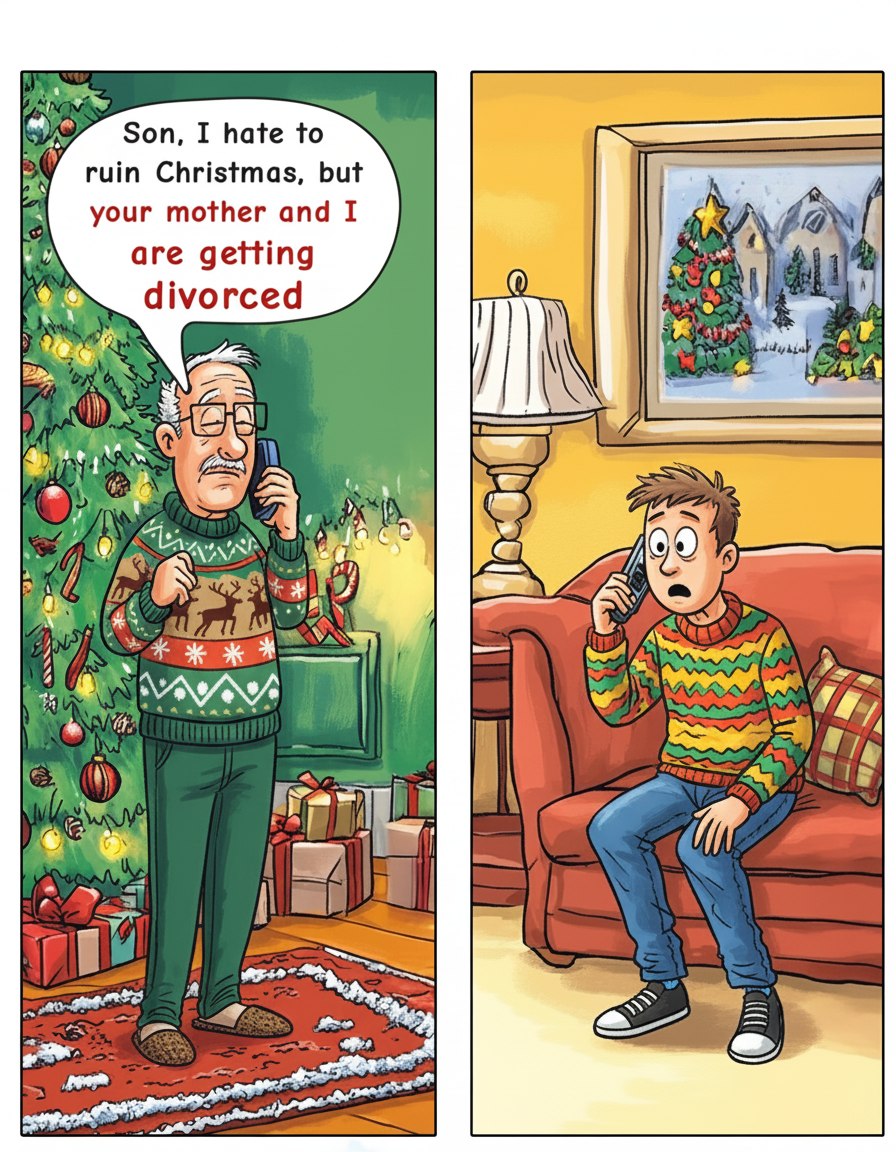
For the past three years, their children had spent Christmas elsewhere. One year it was a ski trip in Switzerland. The next, a tropical cruise. Last year, they had split the holiday between in-laws, work obligations, and a last-minute excuse involving airline prices and a very important office project that somehow could not survive a single week without them.
The couple understood, of course. Their children were adults with lives of their own. But understanding it didn’t make the house feel any less empty.
This year, they had decided enough was enough.
“I still can’t believe you actually said we were getting divorced,” his wife said, setting a tray of freshly baked cookies on the counter.
“Well, to be fair,” he replied, reaching for one, “I only said we couldn’t stand each other anymore. The divorce part was merely implied.”
She swatted his hand away from the cookies. “Save those for tomorrow. We’ll need them.”
The next evening, the doorbell rang precisely at 7:14 p.m.
Their son arrived first, dragging two suitcases, still wearing the expression of a man who had mentally prepared for a family crisis somewhere over the Atlantic. Their daughter arrived fifteen minutes later, storming through the front door with the determined energy of someone ready to mediate a courtroom battle.
They barely had time to set down their bags before both started talking at once.
“Dad, this is insane—”
“Mom, are you okay?”
“Have you called a lawyer?”
“Where’s the paperwork?”
The old couple exchanged a glance.
Then the father cleared his throat.
“Before either of you launches into a full legal intervention,” he said, “we have an announcement.”
The room fell silent.
He smiled.
“Your mother and I are not getting divorced.”
There was a long pause.
Their son blinked. “What?”
Their daughter narrowed her eyes. “Then why on earth—”
“Because,” their mother interrupted, unable to hide her amusement, “it was the only way to guarantee you’d both come home for Christmas.”
Silence.
Then realization.
Then outrage.
Then laughter.
“You tricked us?” their son asked, though he was already grinning.
“Manipulated,” their father said. “A much more elegant word.”
Their daughter crossed her arms, trying—and failing—to look angry. “I booked the first flight out. I had to sit next to a man who spent six hours explaining cryptocurrency to me.”
“Then our plan worked even better than expected,” her father said.
That night, the house was filled with noise again—laughter in the kitchen, wrapping paper scattered across the living room, and the comforting chaos that only family can create.
At dinner, their son raised a glass.
“To Mom and Dad,” he said, smiling. “For proving that emotional blackmail is apparently hereditary.”
“And highly effective,” their father added.
The following morning, as snow fell softly outside and the smell of cinnamon rolls drifted through the house, everyone agreed on one thing:
It was the most unforgettable Christmas they had shared in years.
And though the children insisted they would never forgive their parents for the deception, they also quietly promised they’d never miss another Christmas at home again.