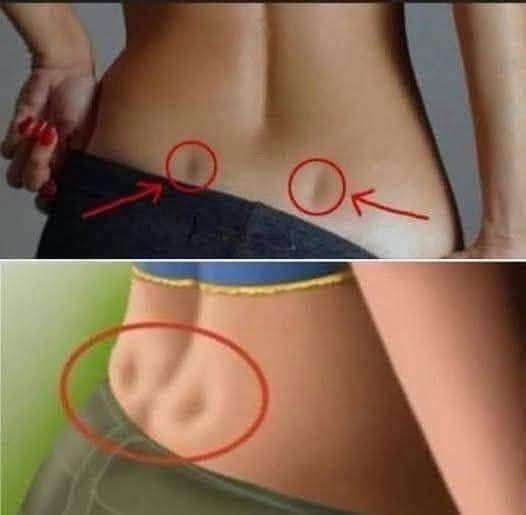
What They Actually Are
These small indentations are located near the sacroiliac joint, where the pelvis connects to the lower spine. They appear due to natural variations in:
- Bone structure
- Ligament placement
- Genetics
In simple terms, they are part of normal human anatomy.
Some people have them clearly visible. Others do not.
Both are completely normal.
Why Some People Have Them and Others Don’t
Whether these dimples appear depends mostly on inherited body structure rather than lifestyle alone.
While lower body fat or muscle tone can make them more noticeable, they are not created by exercise, nor are they an indicator of fitness level.
This is why two people with similar routines can look completely different in that area.
It comes down to anatomy, not effort.
Why People Find Them Interesting
Over time, these small indentations have become associated with beauty standards in some cultures. Their symmetry and placement often make them stand out visually, especially in certain lighting or body positions.
However, this perception is cultural rather than scientific.
From a medical standpoint, they do not indicate:
- Strength
- Health status
- Athletic ability
- Physical condition
They are simply a natural variation in body structure.
The Online Curiosity Effect
Like many physical traits discussed online, lower back dimples often become the subject of curiosity-driven posts and viral articles.
Headlines sometimes imply hidden meanings or personality traits, but these claims are not supported by medical evidence.
In reality, the fascination comes from something simpler: people naturally notice patterns and symmetry in the human body, and the brain tends to assign meaning to features that look uncommon or distinctive.
What Experts Actually Say
Medical and anatomical references consistently describe these dimples as harmless and purely structural.
They are formed where skin attaches more tightly over specific pelvic points, creating a slight indentation.
There is no function, advantage, or hidden significance beyond normal human variation.
A Simple but Interesting Feature
While often highlighted in fitness discussions or aesthetic trends, these dimples are just one of many small differences in human anatomy.
Just like eye color, height, or hand shape, they vary widely from person to person.
Some people have them. Some don’t.
Neither is better.
The Real Takeaway
The idea that these dimples reveal anything meaningful about personality or health is a myth created by internet trends and oversimplified interpretations.
What they actually represent is something much simpler—and more interesting in its own way:
The natural diversity of the human body.
Because sometimes, the features that get the most attention are not signs of hidden meaning…
but just reminders that no two bodies are exactly the same.