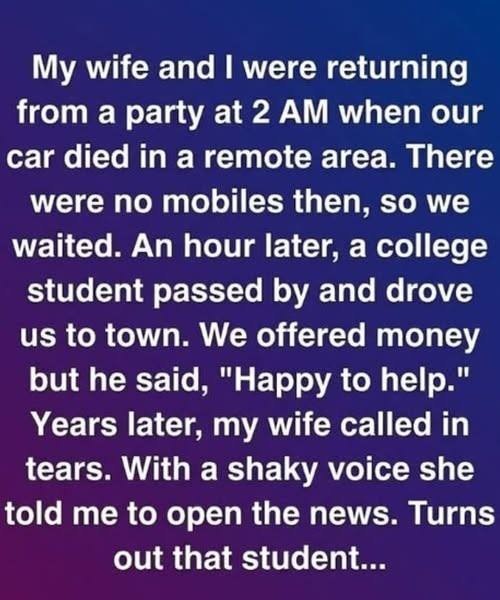
One evening, while watching a televised segment on leadership and community reform, a familiar presence appeared on screen. It wasn’t just the face—it was the voice, the calm confidence, the quiet intensity behind every word. The man speaking about empathy, opportunity, and rebuilding trust in society was Zayd. But he wasn’t a stranger anymore; he was a respected public figure, recognized for work that had impacted thousands.
Seeing him in that setting triggered something unexpected. Memory, once distant and softened by time, became sharp again. And with it came another memory—one far less comfortable. Years before the highway night, we had once encountered a struggling student seeking guidance. At the time, we had been impatient, distracted, and dismissive. Nothing overtly cruel—just indifferent enough not to matter to us, but possibly enough to matter deeply to him.
The realization settled heavily: the man we had once brushed aside had later been the same person who stopped for us in our moment of need.
Unable to let it rest, we arranged a meeting.
When we finally sat across from him in his office, we carried an apology that felt rehearsed even before it was spoken. We tried to explain, to acknowledge the past, to somehow balance the weight of what we now understood. But Zayd listened quietly, without interruption, without judgment.
Then he smiled—not in superiority, but in calm recognition.
He told us he remembered both moments clearly. The dismissal from years ago. And the stranded night on the highway. But what stayed with him most wasn’t the contrast between them—it was what he chose to build from it.
He said something that stayed with us long after we left:
“People think their smallest actions disappear. They don’t. They either wound or they strengthen. I chose not to be defined by what I received, but by what I decided to become.”
There was no resentment in his voice. No need for validation. Only clarity.
In that moment, the full weight of the experience shifted. We had gone expecting to offer closure, but instead we received perspective. Life had looped back on itself in a way we never could have predicted—our forgotten indifference had shaped a man who later extended us unexpected grace.
We left his office quieter than when we arrived. Not ashamed, not excused—just aware. Aware that human lives are built from echoes, and that even the smallest interactions can travel farther than we ever imagine.
Zayd’s story wasn’t just one of success. It was a reminder that character is often forged in the very places where recognition is absent. And sometimes, the people we overlook are the same ones who will one day redefine what kindness means.
If this story made you reflect on your own moments of impact—big or small—share it with someone and join the conversation. You never really know which moment will come back to find you.