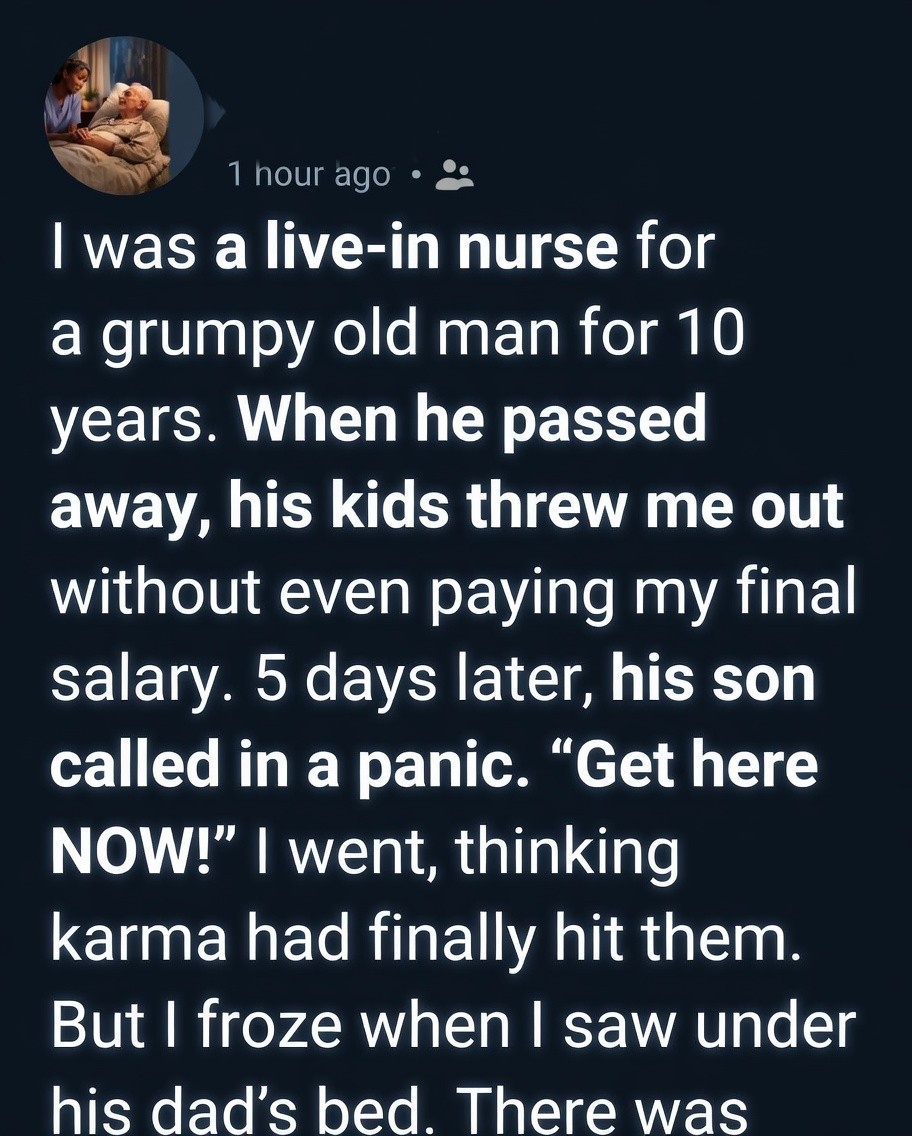
But it was enough.
The End That Changes Everything
When the end came, it was not gentle.
Illness strips people of everything unnecessary—leaving only what is real.
One night, as rain tapped against the windows, he looked at me differently.
Not as staff.
Not as someone passing through.
But as someone who had stayed.
“You didn’t have to do all this,” he said quietly.
“I know,” I replied.
And that was the end of our conversations.
Three days later, he was gone.
The House Without Me
His children arrived quickly after his death.
The atmosphere shifted immediately—rooms filled with movement, voices, decisions. Everything that had once been quiet became structured and efficient.
And I was removed from it just as quickly.
“You’ve done your job,” his son told me. “We won’t need you anymore.”
Ten years reduced to a sentence.
An envelope was placed in my hands. My belongings were already packed.
And just like that, I left.
The Call That Changed Everything
Five days later, my phone rang.
His son’s name appeared on the screen.
I almost didn’t answer.
“Come back,” he said. “Now.”
No explanation. No apology.
Just urgency.
So I went.
What Was Hidden All Along
The house felt different when I returned. Not physically—but in its silence. Heavier. Expectant.
His son led me upstairs to the room I knew better than anyone.
Then he pointed under the bed.
Taped to the frame was an envelope.
My name was written on it.
And beside it—a set of keys.
My hands shook as I opened it.
Inside was a letter.
And another key.
The Cabin by the Lake
I read slowly.
He wrote about the nights I stayed when no one else did. About the way I treated him like a person, not a burden. About the presence I gave him when everything else in his life had become transactional or distant.
Then came the final lines.
The cabin is yours.
I knew the place immediately. A small home by a lake he had once described as peaceful. Somewhere he said he felt “less like a patient, and more like himself.”
He had transferred it legally.
Quietly.
Completely.
His children had no way to reverse it.
What Was Really Left Behind
His son confirmed it in silence more than words. The realization settled into the room slowly—that this had been planned long before the end came.
Not announced.
Not discussed.
But decided.
I held the key in my hand and felt something I didn’t expect.
Not triumph.
Not anger.
Just understanding.
Walking Away
I turned toward the door.
“Wait,” his son said.
But I didn’t stop for long.
Because there was nothing left to argue about.
No anger to carry. No need for recognition. No desire to prove anything.
Just clarity.
Final Thought
Some people never express gratitude loudly. Some don’t know how to.
But it doesn’t mean it isn’t there.
Sometimes appreciation arrives late, quietly, and in ways no one expects—hidden in places only revealed when everything else has already been said.
And sometimes, the most meaningful “thank you” isn’t spoken at all.
It’s left behind.