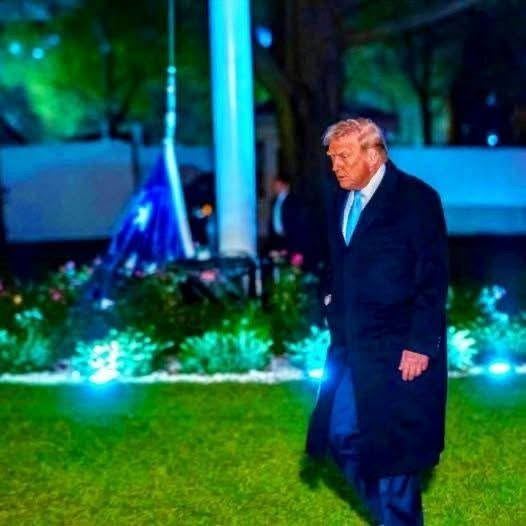
Yet even those who ignored the photo somehow became part of the larger debate.
In today’s digital culture, ambiguity rarely stays unresolved for long.
Social Media Filled the Gaps Before Facts Could Arrive
Before experts, journalists, or official sources could provide context, online users had already created countless competing explanations.
People zoomed into blurry pixels, adjusted lighting, enhanced screenshots, and reposted cropped versions of the image across platforms. Comment sections quickly transformed into ideological battlefields where speculation spread faster than verified information.
For many users, the mystery object became whatever they already wanted it to be.
And that reaction says something important about modern internet behavior.
The Photo Became a Reflection of Public Division
Rather than revealing objective truth, the image acted like a mirror reflecting political fears, frustrations, and personal biases.
Supporters and critics interpreted the exact same photograph in completely opposite ways depending on what they already believed about Trump.
Some viewers saw danger.
Others saw strength.
Some saw conspiracy.
Others saw nothing at all.
The image itself barely changed — but the emotional reactions surrounding it grew rapidly.
Cable News and Viral Accounts Amplified the Chaos
As the story spread, media outlets and political commentators quickly joined the frenzy.
Television panels debated the image for hours while influencers and viral accounts treated speculation as breaking news. Every new theory gained momentum through reposts, reaction videos, and emotionally charged headlines designed to maximize engagement.
The result was a perfect example of how modern viral culture operates.
A single unclear moment became national conversation overnight.
The Real Story May Be Bigger Than the Photo
For many observers, the situation revealed something deeper and more concerning than the image itself.
It exposed how quickly public discussion can shift from facts to assumptions in the age of instant digital reaction.
Rather than waiting for clarity, people increasingly rush to build narratives that confirm what they already believe. Once those narratives gain traction online, they often feel emotionally true — even when evidence remains limited or unclear.
That cycle is becoming more common across politics, entertainment, and breaking news.
Why Ambiguous Images Spread So Fast Online
Psychologists and media analysts often point to uncertainty as a major driver of viral behavior.
When people encounter something unclear, the brain naturally tries to complete the story. Social media accelerates that instinct by rewarding emotional reactions, strong opinions, and rapid engagement.
The louder the interpretation becomes, the more legitimate it can appear — regardless of whether the facts fully support it.
In this environment, speculation often travels farther than confirmation.
A Powerful Reminder About Digital Culture
Long after the mystery surrounding the image fades, the viral reaction surrounding it may remain the most important takeaway.
The incident serves as another reminder that modern internet culture is increasingly driven by perception, emotion, and narrative rather than patience and verification.
And in a world where millions can instantly shape public discourse with a single post, blurry moments often become much bigger than reality itself.
Because sometimes, the internet isn’t reacting to what’s actually visible in the photo.
It’s reacting to what people fear, hope, or expect to see.
What do you think — was the internet reading too much into the image, or are viral moments like this impossible to ignore today? Share your opinion in the comments and follow for more trending political stories, viral internet debates, and media analysis.