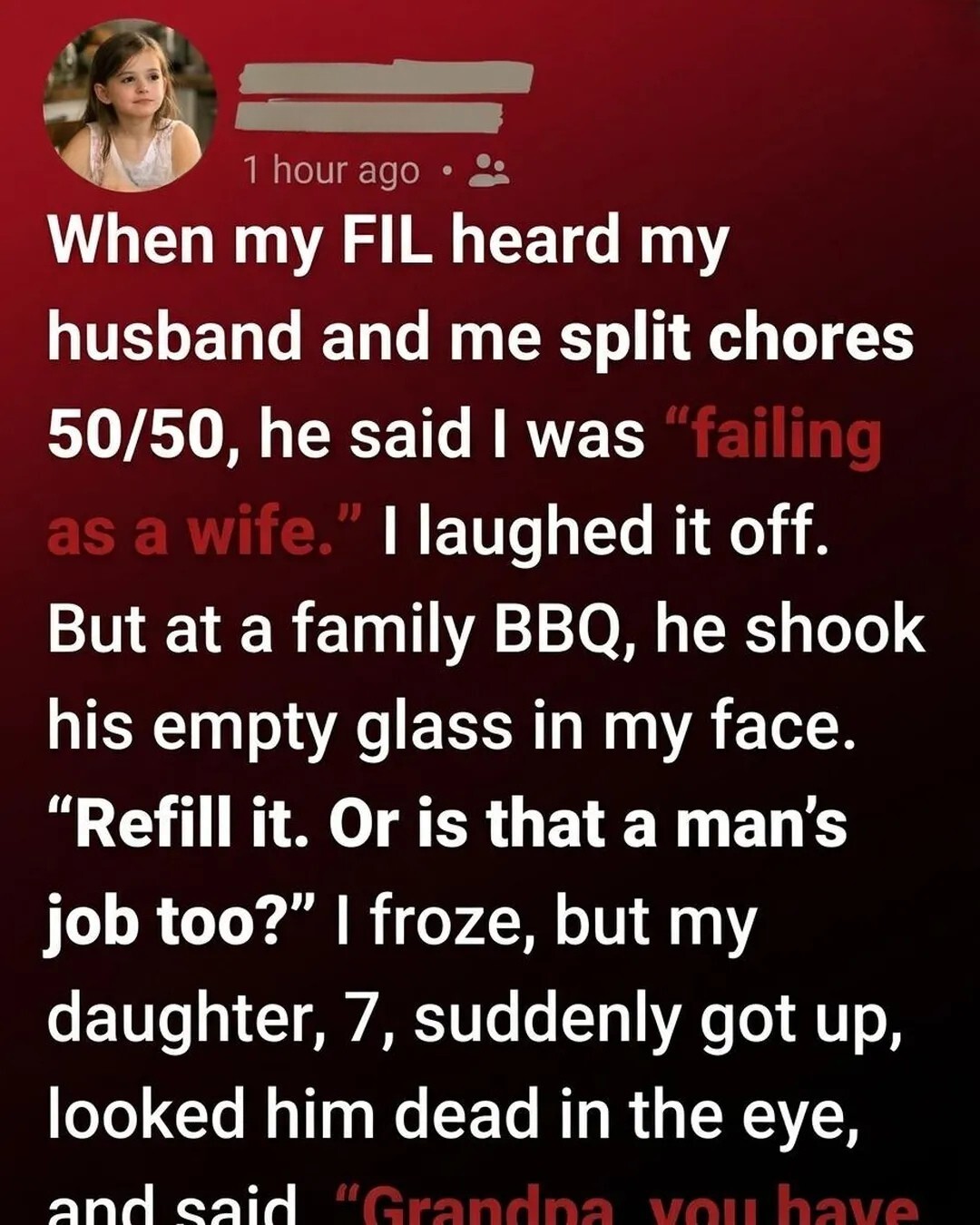
Some nights, he cooked dinner. Other nights, I did. Sometimes I handled the laundry, sometimes he folded clothes while helping our daughter with homework. If the kitchen was messy, whoever had time cleaned it. If our daughter needed something, we responded as parents, not as people trapped in old roles.
It was not perfect. No household is.
But it was fair.
And more importantly, it was respectful.
My husband never treated helping at home as a favor to me. He treated it as part of being a husband and father. That mattered.
To me, that was not a sign that I had failed as a wife. It was proof that we were doing something right as a family.
Then Came the Family Barbecue
About a week later, we went to a family barbecue.
It was one of those warm afternoons that looked peaceful from the outside. Food on the grill, kids running around the yard, relatives laughing, people holding drinks and moving between conversations.
I told myself to relax.
I did not want to carry tension into the day. I did not want one comment from the previous week to sit between us. I wanted to enjoy the afternoon, keep things light, and move on.
For a while, that worked.
I talked with relatives. I watched my daughter play. I helped set out some food. Everything felt normal enough.
Then my father-in-law walked over.
He was holding an empty glass.
He stopped in front of me, held it out, and said, “Refill it.”
Then, with a small smirk, he added, “Or is that a man’s job too?”
The Whole Yard Went Quiet
The comment was not shouted, but it landed hard.
A few people nearby heard it. Conversations slowed. Someone looked away. Someone else pretended to be busy with a plate of food.
You know that strange silence that happens when people hear something uncomfortable but do not know whether to react?
That was exactly what happened.
I stood there for a second, looking at him.
Part of me wanted to answer immediately. Another part of me wanted to keep the peace. I had spent years learning how to choose my battles, and usually, I was good at walking away from unnecessary conflict.
But this felt different.
It was not just a private opinion anymore. It was a public jab. A little performance. A way to put me in my place in front of other people.
I opened my mouth, ready to say something.
But before I could, I heard a chair scrape against the ground.
My Daughter Stood Up
I turned and saw my daughter.
She was seven years old.
Small, quiet, and usually more observant than outspoken. She was not the kind of child who interrupted adults or tried to become the center of attention.
But that day, she stood up calmly.
She looked at her grandfather with a steady expression, the kind of seriousness that only children can have when they know something is wrong but do not understand why everyone else is pretending it is fine.
Then she said one sentence.
“Grandpa, in our house, everyone helps. That’s what makes it fair.”
That was all.
No anger.
No shouting.
No disrespect.
Just a simple truth from a child who had been paying attention.
And somehow, it was more powerful than anything I could have said.
Nobody Knew What to Say
The silence after her words was different from the silence before.
Before, people had been uncomfortable.
After, they were thinking.
My father-in-law lowered the glass slightly. His expression changed, not dramatically, but enough for everyone to notice. The smirk disappeared. The confidence behind the joke seemed to fade.
No one laughed.
No one corrected her.
No one told her to stay out of adult conversations.
Because there was nothing to correct.
She had said the truth in the cleanest, clearest way possible.
In our house, everyone helps.
That is what makes it fair.
It was so simple that it cut through every excuse, every outdated belief, and every sarcastic comment.
After a few seconds, people slowly returned to their conversations. But the energy had changed. The afternoon continued, but it felt softer. More careful. Like everyone had witnessed something small but meaningful.
My father-in-law did not bring it up again.
He did not argue.
He simply stepped away.
Children Notice More Than We Think
Later that evening, as we walked home, I held my daughter’s hand a little tighter than usual.
She walked beside me like nothing major had happened.
That is the thing about children. Sometimes they say something powerful without realizing how powerful it is. They are not trying to win an argument. They are not trying to embarrass anyone. They are just repeating what they know to be true.
And that hit me deeply.
My daughter had not learned fairness from a speech.
She had learned it from watching us.
She had seen her father cook dinner without acting like he deserved applause. She had seen me fix things around the house without anyone calling it unusual. She had seen both of us clean, work, care, comfort, and show up.
To her, that was normal.
And that meant everything.
We Were Teaching Her Without Realizing It
That moment made me understand something important.
The way we live at home becomes our child’s first lesson about the world.
Children learn what love looks like by watching how people treat each other. They learn what respect looks like by seeing whether one parent is expected to serve while the other relaxes. They learn what fairness looks like from the daily patterns we create.
My daughter did not see her father helping as strange.
She did not see shared responsibility as weakness.
She did not see me as less of a wife because I was not carrying the entire household alone.
She saw balance.
She saw teamwork.
She saw fairness.
And when someone challenged that, even casually, she recognized it immediately.
The Real Meaning of Partnership
Marriage is not supposed to be one person carrying the invisible weight while the other receives credit for “helping” occasionally.
A healthy home is not built on one person being exhausted and the other being served.
It is built on teamwork.
It is built on noticing what needs to be done and doing it.
It is built on respect that shows up in ordinary moments — washing dishes, packing lunches, cleaning spills, folding laundry, making appointments, comforting a child, cooking dinner after a long day.
Those things may seem small, but they shape the entire emotional atmosphere of a home.
And children feel that.
They may not understand every adult conversation, but they understand fairness. They understand kindness. They understand when something feels wrong.
My Father-in-Law’s Comment Taught Me Something Too
At first, his words made me angry.
But later, I realized they also revealed something important.
Some people still believe that a woman proves her value by doing everything quietly. They believe a man helping at home is somehow unusual, generous, or even embarrassing.
But that mindset does not build strong families. It builds resentment.
A marriage should not be a stage where one person performs sacrifice while the other receives comfort. It should be a partnership where both people contribute, because both people live there.
My daughter understood that better at seven than some adults do after decades.
The Moment I Will Never Forget
I will always remember the way she stood there.
Not loud.
Not rude.
Not dramatic.
Just calm and certain.
That moment stayed with me because it showed me that our home was teaching her the right things. Not through lectures, but through example.
She saw that love is not control.
She saw that family is not about outdated roles.
She saw that helping is not shameful.
She saw that fairness matters.
And when the moment came, she said it plainly.
Final Thoughts
My father-in-law thought he was making a joke at my expense. Maybe he expected me to laugh it off again. Maybe he expected everyone else to ignore it.
But he did not expect a seven-year-old girl to answer with more clarity than any adult in the room.
Her words reminded me that children are always watching. They notice how we speak, how we share responsibilities, how we treat each other, and what we allow.
That day, my daughter did not just defend me. She reflected the values we had built inside our home.
And honestly, that mattered more than winning any argument.
A fair home does not happen by accident. It is created every day, through small choices, shared effort, and mutual respect.
What do you think about the way the little girl responded? Was she right to speak up, or should adults handle those moments themselves? Share your thoughts and join the conversation.