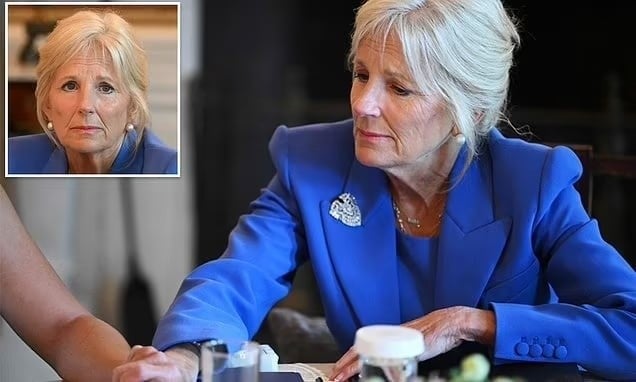
Jill Biden’s continued presence in Kyiv has added a new layer to the role of First Lady—one that blends traditional public service with the realities of an ongoing war. What was once largely a ceremonial position, focused on advocacy, education, and cultural initiatives, is now being viewed through a more complex geopolitical lens as she steps into environments shaped directly by conflict.
Her visits to Ukraine, including moments spent in cities under air-raid alerts, have come to symbolize more than diplomatic solidarity. They reflect a sustained commitment to showing presence in places where uncertainty has become part of daily life. Rather than functioning as brief symbolic appearances, these trips are increasingly interpreted as part of a broader effort to reinforce support for a nation navigating the pressures of war.
The announcement of her continued engagement in Ukraine has drawn attention across political and international circles. Supporters view her actions as a steady extension of humanitarian diplomacy—an approach rooted in visibility, empathy, and consistency. In that sense, her role is being recognized not just as supportive, but as actively reinforcing the United States’ broader message of alignment with Ukraine during a prolonged and evolving conflict.
At the same time, reactions have not been uniform. In some international capitals, her presence is seen as a stabilizing signal, reinforcing commitments and maintaining morale in a region under strain. In others, particularly from opposing geopolitical perspectives, it is viewed through a more critical lens, as an extension of U.S. influence in an already highly charged environment. These contrasting interpretations underscore how even non-military figures can become part of the symbolic landscape of modern conflict.
Keep reading…