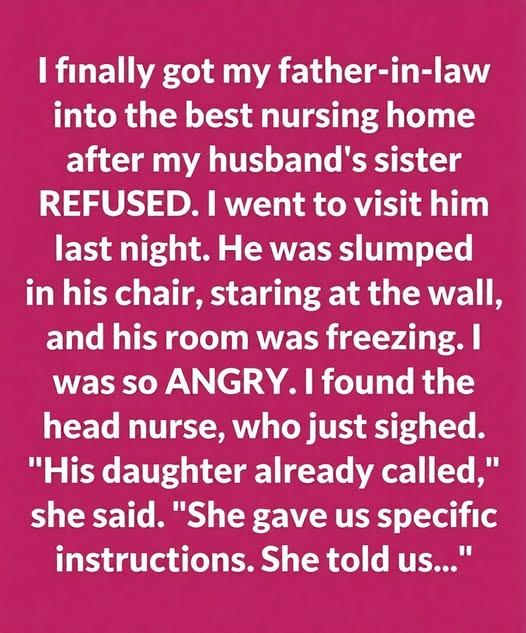
I looked at her in disbelief. “He has severe arthritis. He complains if it’s under seventy.”
The nurse shrugged apologetically. “She’s listed as his medical proxy. Those are the documented instructions.”
And unfortunately, she was right.
My husband had passed away three years earlier. Legally, his daughter Diane was the only immediate family left. And Diane had always put spa trips and wine tastings ahead of anything resembling responsibility.
I went back into his room and wrapped another blanket around him.
“You okay, Pop?” I asked softly.
He blinked slowly. “Cold,” he whispered.
There was no way I was leaving him like that.
I called the front desk to say I’d be staying overnight, drove home, and grabbed a small heater, his thick wool socks, a heated blanket he loved, and a framed photo of his late wife.
Back at the home, I made him tea, rubbed warming balm into his hands, and stayed with him until he fell asleep.
The next morning, I asked to meet with the director.
“I understand rules and paperwork,” I said calmly, “but this borders on neglect. There’s no justification for leaving an elderly man freezing because someone wants to save on utilities.”
The director looked uncomfortable. “You’re not on his legal file. Our authority is limited.”
That’s when something clicked for me.
At home, I began digging through old boxes. I found letters my father-in-law had written to my husband years ago. One line stood out:
Diane doesn’t want the house. If anything happens, I trust you and Anne to make decisions for me.
That mattered.
The house had already been sold to help cover his care, and Diane had handled everything, insisting she had it under control. Before my husband passed, we’d offered to help—but she dismissed us.
I called a lawyer friend, Colin, a calm, experienced man.
“It’s possible to challenge her proxy status,” he told me, “but we need proof of neglect—or evidence your father-in-law wants someone else.”
“He still has good days,” I said. “Not many, but enough.”
“Then we move quickly.”
From that point on, I visited every single day. I documented everything—room temperature, his condition, meals, everything. I even brought my own thermometer.
One afternoon, I found him curled up, shivering. The room was fifty-eight degrees.
He squeezed my hand. “Is it me… or is it always this cold?”
“It’s cold,” I said gently.
He sighed. “Diane never forgave me. I remind her too much of her mother.”
Then he added quietly, “She called last week. Told them not to let you visit.”
My heart dropped. “Did they listen?”
He shook his head slightly. “The young nurse said no. She likes your cookies.”
That nurse—Maggie—confirmed it later and logged the call word for word.
That note became crucial.
Two weeks later, we filed the petition.
Diane exploded.
She stormed into the director’s office shouting, “You let her challenge me? She’s not even family!”
I was sitting there calmly with a cup of tea.
“You failed him,” I said. “And he’s not something you discard when it’s inconvenient.”
She scoffed. “You were married in for five years and now you think you’re a savior?”
“I’m not,” I replied. “I just refuse to let an old man freeze.”
The director stepped in as Diane threatened legal action.
Right on cue, Colin walked in with a file in hand.
The next month was draining—hearings, testimony, depositions. Several nurses spoke up. The director admitted Diane’s instructions had caused discomfort.
Then came the moment that changed everything.
A senior nurse named Brenda produced a voicemail Diane had left.
In it, Diane said,
“If he passes soon, that’s fine. I’m tired of paying.”
The courtroom fell silent.
That day, Pop was lucid. Wrapped in a blanket and holding my hand, he answered the judge clearly.
“I want Anne making decisions,” he said. “She’s the one who shows up.”
The decision came quickly.
I was granted medical proxy. Diane was removed.
Pop was moved into a bright, warm room with sunlight. A companion was hired. The heater stayed on. His wife’s photo stayed by his bedside.
Some days he shared stories—about the Navy, about dancing with his wife. Other days, we simply watched birds together.
He passed peacefully one spring morning, his hand holding that same photograph.
He left a note:
Thank you for keeping me warm. Tell Diane I forgive her—but the coins in the jar are for cookies for the nurses.
I laughed and cried at the same time.
Diane never attended the memorial.
Weeks later, she sent a short letter—no apology, just resentment.
I never responded.
What mattered was that his final months were warm, dignified, and filled with care.
Now, I volunteer at that nursing home—reading to residents, helping families, advocating for those who need a voice.
Because sometimes the worst kind of cruelty isn’t loud.
It’s quiet.
And sometimes, simply showing up can change everything.
Life lesson: Doing what’s right won’t always make you popular—but kindness matters most when no one is watching. Never let someone you love be left out in the cold.