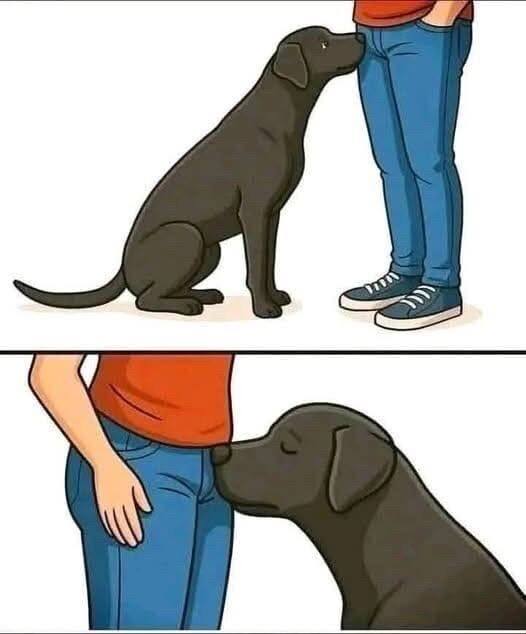
When a dog greets a person by sniffing, it is not acting out of rudeness or disrespect. Instead, it is engaging in natural social behavior—collecting information in the most efficient way it knows.
Dogs do not interpret personal space or privacy the way humans do. Their communication system is built around scent, not social boundaries. What feels uncomfortable to people is, for dogs, simply a normal introduction.
The Human Reaction and the Communication Gap
Because human social norms prioritize visual cues and personal space, these interactions can sometimes feel awkward or embarrassing.
However, dogs are not intentionally crossing boundaries. They are operating within their own instinctive framework of understanding the world.
This difference highlights an important truth: humans and dogs communicate in entirely different ways, and misunderstandings often come from that gap rather than intent.
Reading Emotions Through Scent
One of the most remarkable aspects of a dog’s sense of smell is its ability to detect emotional changes.
Dogs are sensitive to subtle chemical shifts in the human body linked to stress, fear, sadness, or excitement. They often respond to these changes before a person even expresses their emotions outwardly.
This ability helps explain why dogs often provide comfort during difficult moments. They are not simply reacting to behavior—they are responding to biological signals.
From Instinct to Life-Saving Ability
This same sensory ability is the foundation of trained service dogs. With guidance, dogs can learn to recognize specific scent changes associated with medical conditions such as:
- Seizures
- Blood sugar drops
- Panic or anxiety episodes
These responses are not mysterious—they are an extension of natural canine instincts refined through training.
When a service dog detects a change, they adjust their behavior accordingly, offering support, alerting their handler, or providing calm presence in critical moments.
A Different Way of Understanding Connection
From a dog’s perspective, scent is more than information—it is memory, recognition, and familiarity.
When a dog sniffs a person, it is gathering context about who they are and reinforcing a sense of connection. It is a form of greeting built on curiosity and trust rather than social convention.
What may feel like a brief awkward moment in human terms is, for a dog, an important act of social bonding.
Final Thoughts
Dogs experience the world in a way that is deeply rooted in scent and instinct. Their behavior, even when it seems unusual to us, is driven by a natural and highly developed way of understanding people and their environment.
At its core, a dog’s sniff is not just curiosity—it is recognition, communication, and connection all at once.
Have you ever experienced a funny or surprising moment with a dog’s behavior? Share your story in the comments and join the conversation below.