
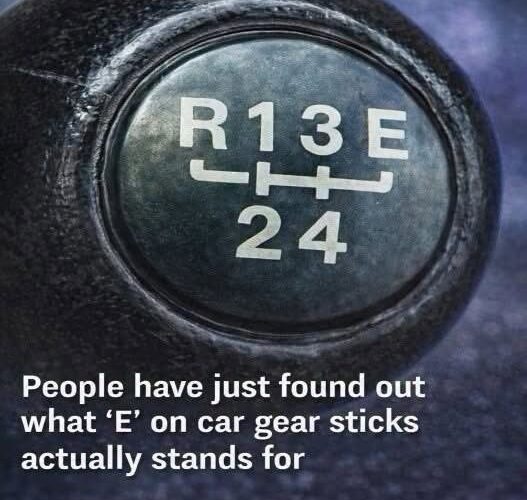

What Did the “E” Mean?
The letter E commonly referred to Economy in applications where that marking was used.
The idea was relatively straightforward. At an appropriate road speed, a higher cruising ratio could allow the engine to operate at lower revolutions per minute than it would in a lower gear.
Lower engine speed during steady cruising could contribute to:
- Reduced engine noise
- More relaxed highway driving
- Improved fuel efficiency under suitable conditions
- Less unnecessary engine speed during long journeys
The exact design and operation depended on the particular vehicle and transmission.
Was It Just Another Gear?
Not exactly.
An economy-oriented high gear was generally intended for situations in which the vehicle was already moving at a suitable speed.
Using a high cruising ratio at low speeds or when the engine needed more power could make the vehicle feel sluggish. Drivers might therefore need to select a lower gear when climbing hills, accelerating, or driving at slower speeds.
The goal was efficiency during appropriate conditions—not maximum performance.
Why Does This Look Strange to Modern Drivers?
Today’s vehicles use transmission designs that are quite different from many older systems.
Modern manual cars commonly have five or six forward gears, while automatic and electronically controlled transmissions can select appropriate ratios without requiring the driver to interpret unusual markings on the gear lever.
As a result, younger drivers may never encounter an E marking at all.
How Is It Similar to Overdrive?
The concept can be broadly compared with an overdrive or high cruising ratio, although the exact terminology and mechanical design varied between vehicles.
A high ratio allows the engine to turn fewer times for a given road speed when conditions are suitable.
This is particularly useful during steady-speed driving, such as cruising on an open road.
Not Every “E” Means Exactly the Same Thing
One important detail is that gear markings aren’t universal.
Manufacturers have used different transmission designs and labels over the years, so an E on one vehicle may not have precisely the same function as an E on another.
Anyone operating an unfamiliar vehicle should check the owner’s manual rather than assuming what a particular gear position does.
A Small Letter With a Practical Purpose
That mysterious E wasn’t simply a decorative marking.
Where it was used to identify an economy-oriented gear, its purpose was to help the vehicle cruise efficiently rather than provide extra acceleration.
It’s a small reminder of how much automotive technology has changed—and how a single unfamiliar letter on an old gear stick can reveal something about the engineering philosophy of its time.
If you come across an unusual gear marking on an older vehicle, the safest way to identify it is to check the manufacturer’s documentation for that specific model and transmission.