
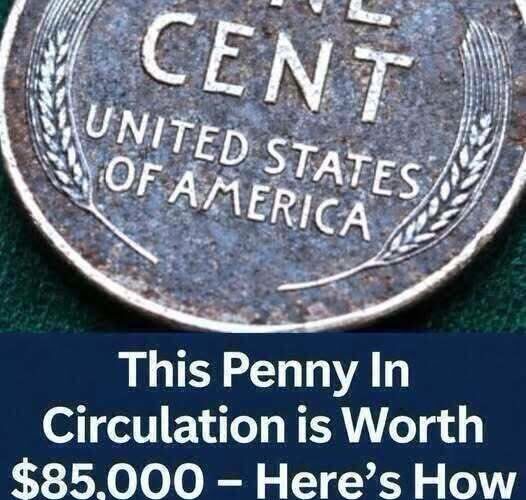

The trick is knowing what to look for—and avoiding the common mistake of assuming that every old-looking coin is valuable.
Why Some Ordinary Coins Become Collectible
Coins are produced in large quantities, but not every example is identical.
Collectors may pay attention to factors such as the coin’s date, mintmark, condition, rarity, historical significance, and whether it contains a recognized minting error or variety.
Professional grading services also emphasize that condition can have a major effect on market value. A coin with the same date and design can have very different values depending on its preservation.
That means the date alone usually isn’t enough.
Two coins that look nearly identical to an inexperienced collector may have very different values.
Wartime Coins Provide a Fascinating Example
One of the best-known examples involves the U.S. penny during World War II.
In 1943, the U.S. Mint changed the composition of the cent because copper was needed for the war effort.
Instead of the usual copper-based composition, the Mint produced zinc-coated steel cents.
The change makes 1943 cents particularly interesting to collectors.
But there’s another reason that year receives so much attention.
The U.S. Mint also accidentally produced a small number of 1943-dated copper cents.
Those pieces are unusual precisely because they weren’t supposed to be part of the regular 1943 production.
That doesn’t mean every 1943 penny is rare.
In fact, most 1943 cents are the steel version.
The interesting part is the possibility of an unusual example—and the need to authenticate it properly.
An Old Coin Isn’t Automatically a Valuable Coin
This is where many online stories become misleading.
A coin can be 50, 75, or even more than 100 years old and still be relatively common.
Millions of older coins survived.
Age is only one part of the equation.
Professional numismatic references distinguish rarity from simple age. PCGS, for example, notes that rarity is based on the estimated number of surviving examples, while value also depends on factors such as condition and demand.
So finding an old penny in a kitchen jar can be interesting without necessarily being financially significant.
Look for Details, Not Just Dates
If you decide to examine your spare change, start with the basics.
Look at the:
- Date
- Mintmark
- Design
- Metal or apparent composition
- Condition
- Unusual features
Mintmarks can help identify where a coin was produced.
On U.S. coins, different letters have historically represented different Mint facilities.
An unusual appearance can also deserve attention—but be careful.
A damaged coin isn’t necessarily an error.
A scratch, discoloration, dent, or altered surface may have happened after the coin left the Mint.
What About Mint Errors?
Genuine mint errors can be collectible because they result from mistakes during the manufacturing process.
Examples can include off-center strikes, unusual planchets, and certain striking errors.
But simply finding something that looks strange doesn’t establish that a coin is a genuine mint error.
PCGS recommends identifying the type of error, considering the coin’s date and mintmark, examining its condition, and comparing it with reliable market information.
In other words, unusual doesn’t automatically mean valuable.
Be Careful With Online Price Claims
One of the easiest mistakes to make is searching for a coin online and finding a headline claiming that an example sold for thousands of dollars.
That number may be real—but it doesn’t necessarily apply to the coin in your hand.
A particular example may have been exceptionally well preserved, professionally graded, unusually rare, or have a specific documented error.
Even small differences can affect value.
PCGS notes that price guides are starting points rather than guarantees, and that actual auction results, condition, rarity, and other factors should be considered when evaluating a coin.
Don’t Clean the Coin First
If you think you’ve found something unusual, resist the temptation to polish it.
Cleaning or altering a collectible coin can damage its surfaces and potentially affect its value.
Professional grading guidance specifically considers cleaning and other surface problems when evaluating coins.
If a coin looks interesting, handle it carefully by its edges rather than rubbing its surfaces.
The goal is to preserve what you found—not make it look newer.
How to Check a Coin More Carefully
You don’t need expensive equipment to begin.
A good first step is simply to examine the coin under adequate lighting.
Take note of its date and mintmark.
Compare the design with photographs from reputable numismatic references.
Then look for documented varieties or errors that actually match what you see.
If the coin still appears unusual, consider getting a second opinion from an established coin dealer or professional grading service.
That’s particularly important before spending money based on an unverified valuation.
The Fun Isn’t Only About Money
There is another reason people enjoy searching through old coins.
Every piece has a history.
A coin may have been minted decades ago, passed through countless hands, spent in shops and restaurants, carried in pockets, and eventually forgotten in someone’s kitchen.
Even a coin worth only its face value can be a tiny piece of everyday history.
And occasionally, a genuinely unusual example turns up.
That’s what makes coin collecting so appealing.
You never quite know what you’ll find until you look.
So, Should You Check Your Coin Jar?
Absolutely—if you’re curious.
Just don’t expect every old penny to be a hidden fortune.
The more realistic approach is to treat the search as a small treasure hunt.
Check the dates.
Look for unusual varieties.
Pay attention to mintmarks and condition.
Research before making assumptions.
And if something genuinely unusual turns up, have it professionally evaluated before believing an impressive number you saw online.
The dusty coin jar in your kitchen probably won’t make you rich.
But it might contain something interesting.
And sometimes, discovering why an ordinary-looking coin is unusual is more rewarding than simply finding out what it’s worth.