 Home & Living
That Upside-Down Wall Outlet Might Not Be a Mistake—Here’s Why
Have you ever noticed that one electrical outlet in your home looks different from all the others?
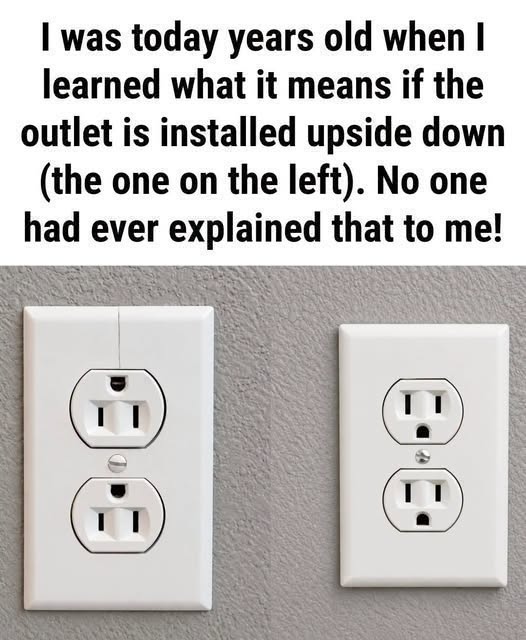
Instead of the familiar arrangement with the ground opening below the two vertical slots, the receptacle appears to be installed the other way around.
At first glance, it can look like an installation mistake.
But in some homes, there may be a practical reason for the unusual orientation.
Why Some Outlets Look "Upside Down"
There isn't one universal rule that requires every wall receptacle to face the same direction.
The orientation can vary depending on the electrician, local practices, the type of installation, and the design of the electrical system.
That's why seeing an outlet with the ground opening on top does not automatically mean it was installed incorrectly.
In certain situations, the orientation may also have been used as a visual clue for how the receptacle is wired or controlled.
Older Homes Often Used Switched Outlets
The history of home lighting helps explain why some older properties have unusual-looking receptacles.
Before ceiling lighting became standard in many rooms, floor and table lamps were often an important source of everyday lighting.
A wall outlet could be connected to a nearby wall switch, allowing a homeowner to turn a lamp on or off without reaching for the lamp itself.
This arrangement is commonly known as a switched receptacle.
How the Setup Works
The idea is fairly simple.
A lamp is plugged into the appropriate outlet, and the wall switch controls power to that outlet or to one portion of it.
Flip the switch, and the lamp turns on.
Turn it off, and the lamp goes dark.
Depending on the wiring design, only one part of a duplex receptacle may be switched while the other remains powered continuously.
That's one reason an apparently ordinary outlet can have a less obvious purpose.
Can the Orientation Tell You It's a Switched Outlet?
Sometimes people use outlet orientation as a visual clue, but it should not be treated as a guaranteed indication.
An upside-down receptacle does not, by itself, prove that the outlet is controlled by a wall switch.
Electricians may install receptacles in different orientations for a variety of reasons, and practices can differ between homes and regions.
 Up Next: Page 2 of 2
The only reliable way to determine how a particular outlet is wired...
In some installations, having a different orientation may have been a way to distinguish a switched receptacle from other outlets in the...
Continue Reading