
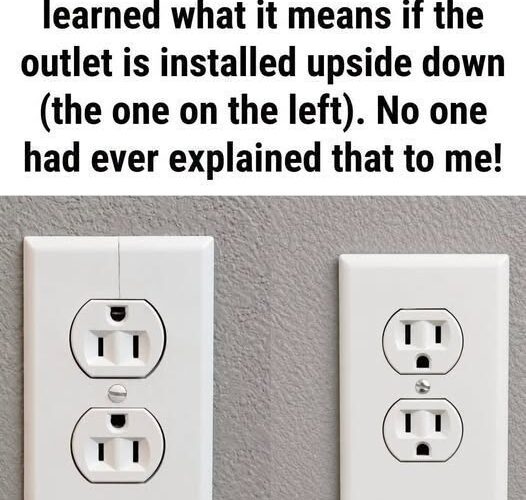

Why Some Outlets Look “Upside Down”
There isn’t one universal rule that requires every wall receptacle to face the same direction.
The orientation can vary depending on the electrician, local practices, the type of installation, and the design of the electrical system.
That’s why seeing an outlet with the ground opening on top does not automatically mean it was installed incorrectly.
In certain situations, the orientation may also have been used as a visual clue for how the receptacle is wired or controlled.
Older Homes Often Used Switched Outlets
The history of home lighting helps explain why some older properties have unusual-looking receptacles.
Before ceiling lighting became standard in many rooms, floor and table lamps were often an important source of everyday lighting.
A wall outlet could be connected to a nearby wall switch, allowing a homeowner to turn a lamp on or off without reaching for the lamp itself.
This arrangement is commonly known as a switched receptacle.
How the Setup Works
The idea is fairly simple.
A lamp is plugged into the appropriate outlet, and the wall switch controls power to that outlet or to one portion of it.
Flip the switch, and the lamp turns on.
Turn it off, and the lamp goes dark.
Depending on the wiring design, only one part of a duplex receptacle may be switched while the other remains powered continuously.
That’s one reason an apparently ordinary outlet can have a less obvious purpose.
Can the Orientation Tell You It’s a Switched Outlet?
Sometimes people use outlet orientation as a visual clue, but it should not be treated as a guaranteed indication.
An upside-down receptacle does not, by itself, prove that the outlet is controlled by a wall switch.
Electricians may install receptacles in different orientations for a variety of reasons, and practices can differ between homes and regions.
The only reliable way to determine how a particular outlet is wired is to inspect the electrical installation safely.
Why Would Someone Want a Visual Clue?
In some installations, having a different orientation may have been a way to distinguish a switched receptacle from other outlets in the room.
This could be useful in a home where several outlets serve different purposes.
For example, one outlet might remain powered all the time for electronics, while another is intended for a lamp controlled by a wall switch.
However, not every electrician uses orientation this way.
What About Modern Homes?
Switched outlets are still possible in modern homes, although lighting designs have changed considerably.
Many rooms now use recessed fixtures, ceiling lights, wall-mounted fixtures, or other built-in options.
As a result, homeowners may encounter fewer switched receptacles than they would have in older houses.
Still, they remain a useful feature in some rooms and certain electrical layouts.
Don’t Assume the Wiring From Appearance Alone
Electrical systems should never be judged solely by how an outlet looks.
If you discover an unfamiliar receptacle, especially one that doesn’t seem to behave like the others, avoid removing the cover or changing the wiring yourself unless you are properly qualified to do so.
Electrical work can present serious safety risks when handled incorrectly.
A licensed electrician can determine whether the outlet is switched, partially switched, properly grounded, or configured in another way.
The Small Detail That Can Tell a Bigger Story
That unusual outlet on your wall may be nothing more than a different installation choice.
But in some homes, it can also be a clue about how the room’s electrical system was designed—particularly in houses that once relied heavily on lamps for everyday lighting.
So the next time you see an outlet that appears to be “upside down,” don’t immediately assume someone made a mistake.
It may simply be a small detail left behind by an older electrical design—or an installation choice that has a practical explanation you never noticed.