
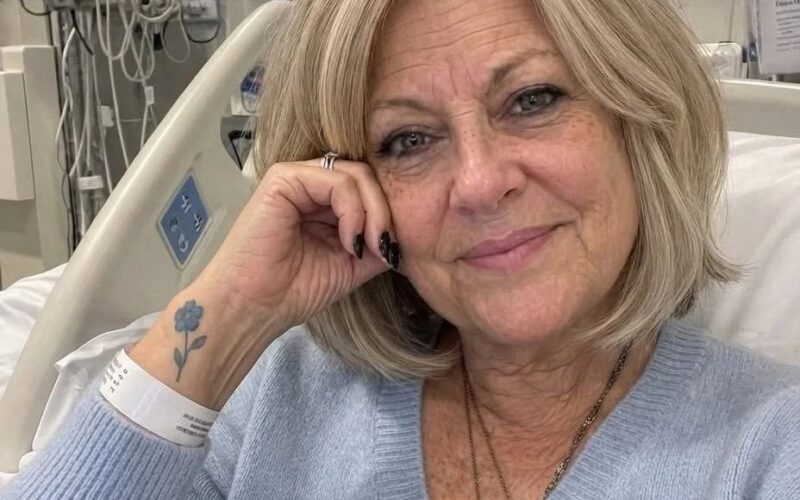

“More than thirty years.”
Mom lowered her eyes.
I stared at her.
“What is he talking about?”
She didn’t answer.
I felt a strange mixture of fear and frustration rising inside me.
For my entire life, I had believed that little blue flower was nothing more than an old tattoo.
Now three strangers were looking at it as if it were a piece of evidence.
“Mom,” I said, “please tell me what’s going on.”
She swallowed.
Then she looked at me.
“I was hoping you would never have to know.”
That sentence frightened me more than anything else.
The doctor pulled a chair closer.
“My name is Dr. Harris,” he said. “Before we go any further, I want you to understand that nobody here is accusing your mother of anything.”
He paused.
“But we need to understand why she has that symbol.”
I looked at the tattoo again.
It suddenly seemed completely different.
The tiny flower was faded almost to the point of disappearing. One of the petals had blurred with age.
“How could a tattoo possibly cause all this?” I asked.
Dr. Harris didn’t answer immediately.
Instead, he reached into a folder and removed an old photograph.
He placed it face down on the small table beside my mother’s bed.
Mom immediately recognized it.
“Where did you get that?”
Her voice was barely audible.
Dr. Harris looked toward her.
“From our hospital archives.”
Mom’s face changed.
“You shouldn’t have that.”
The room went silent again.
I reached toward the photograph.
Mom grabbed my wrist.
“No.”
It was the first time in my entire life she’d ever stopped me from seeing something so urgently.
“What is it?” I asked.
She released my hand.
For several seconds, she stared at the floor.
Then she finally said:
“That flower wasn’t a tattoo I got for fun.”
I waited.
“It was a symbol.”
“What kind of symbol?”
Mom closed her eyes.
“It’s complicated.”
I almost laughed.
After eighteen years of being told nothing more than I got it when I was young, suddenly it’s complicated wasn’t going to be enough.
“You’ve been hiding this from me my entire life.”
“I was trying to protect you.”
“From what?”
She looked at me.
“From the past.”
The doctor gently interrupted.
“Your mother was part of a volunteer medical program when she was very young. Some of the people involved used the flower as an identification symbol.”
I frowned.
“Identification for what?”
Nobody answered.
Dr. Harris opened the folder.
Inside were several photocopied documents, most of them yellowed and faded.
He pointed to one photograph.
It showed a group of young people standing outside a building.
In the corner of the photograph was a small blue flower painted on a sign.
I looked at Mom.
She nodded slowly.
“That was where I worked.”
“You worked there?”
“For a short time.”
“What happened?”
Her expression hardened.
“People disappeared.”
The words landed heavily.
I stared at her.
“What do you mean, disappeared?”
Mom shook her head.
“Not like in the movies. There were people who came through that program, and afterward their records were incomplete. Some left. Some changed their names. Some simply couldn’t be found.”
Dr. Harris spoke carefully.
“Your mother believes she was involved with a group that was later investigated.”
“Investigated for what?”
He looked at Mom.
Mom answered this time.
“Keeping records that should never have been kept.”
I felt a chill.
“What kind of records?”
Mom looked directly at me.
“Names. Birth dates. Medical information. Family connections.”
My heart began beating faster.
“Why would they keep those?”
“That,” Mom whispered, “is what I spent years trying to understand.”
The security officers exchanged a glance.
Then one of them stepped forward.
“There is another reason we’re here.”
He handed Dr. Harris a small envelope.
The envelope had been found in the hospital’s records department that morning.
There was no return address.
No name.
Only a drawing.
A tiny blue flower.
I stared at it.
“Who sent that?”
“We don’t know.”
Mom’s hands began trembling again.
But this time, she wasn’t looking at the envelope.
She was looking at me.
“Mom?”
She whispered my name.
Then she said something that made my entire understanding of my childhood shift.
“I didn’t choose that tattoo because of the organization.”
“Then why?”
“Because someone told me it was the only way they would recognize me.”
“Who?”
Mom hesitated.
“A woman I was trying to help.”
Dr. Harris opened the envelope.
Inside was a single handwritten note.
He read it silently.
His expression changed.
“What does it say?” I asked.
He handed it to me.
There were only seven words.
She was never supposed to find you.
I looked at my mother.
She covered her mouth.
For the first time, I understood that whatever secret she’d been carrying wasn’t simply about something that had happened decades ago.
Someone knew about it.
And someone had apparently been waiting for us to discover it.
The nurse who had first seen the tattoo returned a few minutes later.
She looked nervous.
“I’m sorry,” she said. “I didn’t mean to frighten you.”
I asked her why she’d recognized the flower.
She took a breath.
“My grandmother had the same symbol.”
I stared at her.
“What?”
“She had it on her wrist too.”
Mom looked up sharply.
“What was your grandmother’s name?”
The nurse told her.
Mom’s face went completely white.
She whispered the name as though she’d heard it a thousand times before.
Then she turned toward me.
“That was the woman.”
“The woman you were trying to help?”
Mom nodded.
The nurse looked confused.
“You knew my grandmother?”
Mom slowly shook her head.
“No.”
Then she looked at me.
“I knew her daughter.”
The nurse’s expression changed.
“My mother?”
Mom nodded.
And suddenly the room was filled with a silence that felt almost impossible to explain.
Three generations.
One small blue flower.
And a secret that had apparently survived longer than any of us realized.
The doctor closed the folder.
“Your mother’s surgery can be postponed,” he said. “For now, we need to make sure everyone understands what we’re dealing with.”
Mom looked at me.
“I wanted to tell you someday.”
“When?”
“I don’t know.”
“You had eighteen years.”
“I know.”
Her voice broke.
“I was afraid that if I told you, the past would come looking for you.”
I looked down at the faded flower on her wrist.
For most of my life, I had seen it as nothing more than a tiny piece of her youth.
Now I understood why she’d never talked about it.
It wasn’t a memory.
It was a reminder.
And as I sat beside her, holding her hand, her phone suddenly vibrated on the hospital table.
She looked at the screen.
The color drained from her face.
“What is it?” I asked.
She didn’t answer.
I picked up the phone.
There was a message from an unknown number.
No greeting.
No explanation.
Just a photograph.
It showed my mother decades earlier, standing beside the same blue-flower symbol.
And beneath the photograph was one sentence:
You should have told her the truth years ago.
I looked at Mom.
She stared at the screen.
Then, very quietly, she said:
“They found us.”
And for the first time, I realized the question wasn’t simply what did my mother’s tattoo mean?
The real question was much more frightening:
Why had someone waited all these years to remind her of it?