
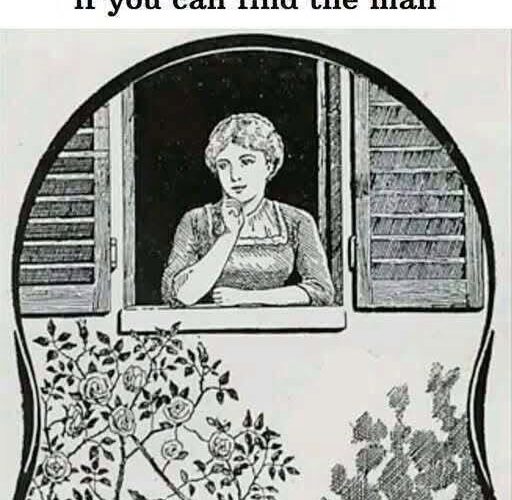

The Hidden Face Is Part of the Illustration
The man is not drawn as a separate character.
Instead, his features are created by combining elements that already appear in the picture.
Parts of the window, flowers, leaves, shadows, and surrounding outlines work together to create the appearance of another face.
At first, your brain may see only the obvious objects.
Once you recognize the larger pattern, however, the hidden image can suddenly become much easier to notice.
Why the Woman Captures Your Attention
The young woman is the clearest figure in the illustration.
Her face, clothing, and posture naturally attract attention, giving viewers an immediate focal point.
As a result, people may spend most of their time looking at her rather than stepping back and considering how the entire image fits together.
That’s one of the tricks behind this type of optical illusion.
The most noticeable object can prevent us from seeing the less obvious pattern surrounding it.
Try Looking at the Image Differently
If you are struggling to find the hidden man, don’t focus on one small section for too long.
Instead, try scanning the entire illustration.
Look at the window.
Then examine the garden.
Pay attention to the spaces between the flowers and leaves, as well as the darker areas and outlines.
It can also help to move the image farther away from your face or briefly look at it from a different angle.
The goal is to stop searching for a conventional portrait and start looking for a collection of shapes that could form one.
Your Brain Is Looking for Patterns
Optical illusions like this work because our brains are constantly organizing visual information.
Rather than treating every line and shape as a separate object, we naturally group related elements together and try to make sense of the scene as a whole.
That can be extremely useful in everyday life.
But in an optical illusion, the same tendency can make the hidden image difficult to spot.
You may see flowers as flowers and leaves as leaves until someone points out that those same shapes can also form something completely different.
Why the Hidden Man Suddenly “Appears”
One of the most satisfying parts of a visual puzzle is the moment when the hidden object finally becomes recognizable.
Before that moment, the image can seem ordinary.
Then, suddenly, the lines appear to connect.
A shadow becomes part of a feature.
A flower seems to form an edge.
The surrounding shapes begin to look like a face.
After that, it’s often surprisingly difficult to stop seeing the hidden image.
It’s Not a Test of Age or Intelligence
Some versions of this puzzle claim that spotting the hidden man quickly reveals something about your brain, age, or intelligence.
Those claims should be treated as entertainment rather than scientific assessments.
How quickly someone notices a hidden image can depend on many ordinary factors, including the size of the picture, image quality, viewing distance, previous experience with optical illusions, and where the person happens to look first.
There is no simple visual puzzle that can reliably determine someone’s intelligence or the “age” of their brain.
The Bigger Lesson
The interesting part of the puzzle isn’t just finding the hidden face.
It’s seeing how dramatically perception can change when you stop looking at individual objects and begin looking at the relationships between them.
The woman remains in the picture.
The garden remains in the picture.
The window remains in the picture.
But your interpretation of those same shapes changes completely.
That’s what makes hidden-image puzzles so compelling.
Sometimes the answer isn’t missing at all.
It’s been sitting in the picture the entire time—you just had to look at it differently.