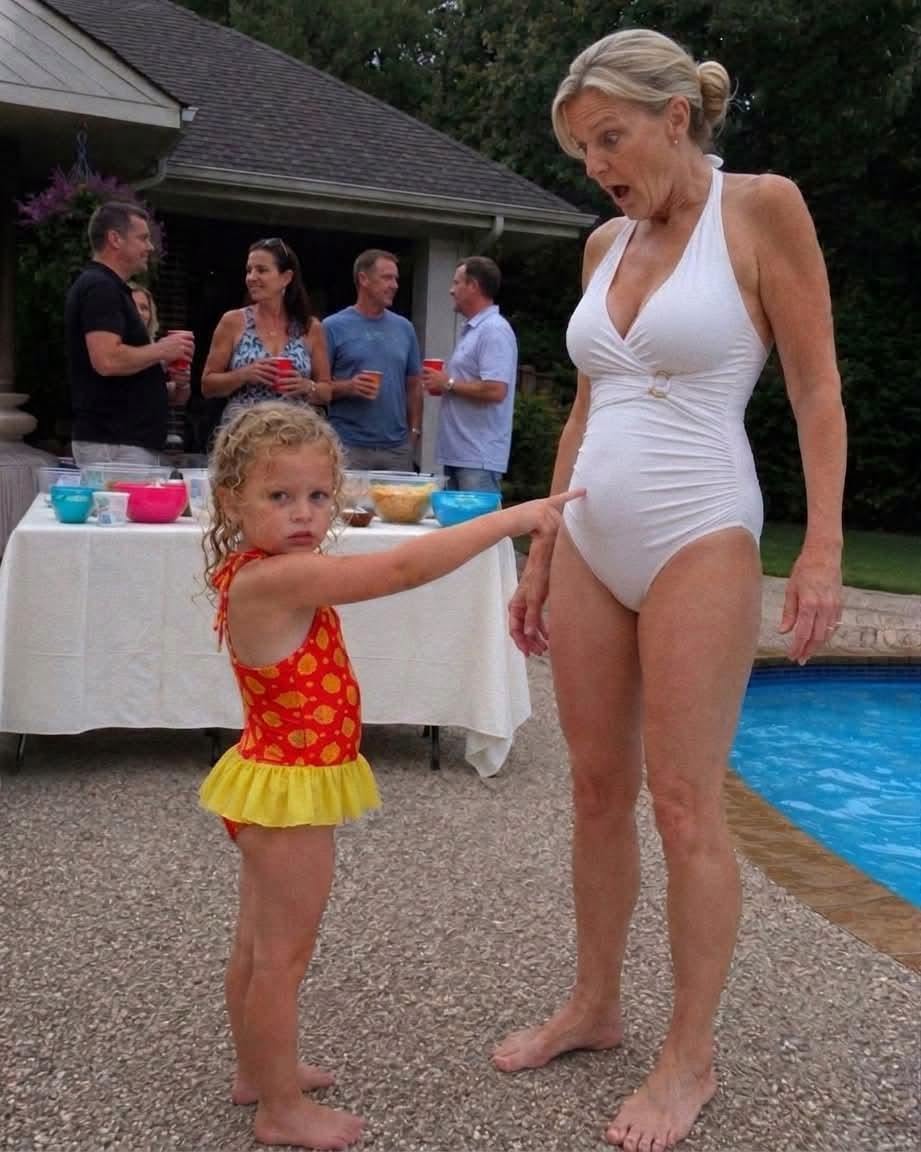
“Daddy!” she shouted.
Everyone turned to look.
Ariel pointed again.
“Daddy made that!”
At first, I laughed.
Three-year-olds have a remarkable way of making ordinary moments sound mysterious.
But then I noticed what she was pointing at.
Clara had taken off her cardigan because of the heat. As she adjusted her shirt, an old tattoo near her side became visible.
It was a small lighthouse with a simple sun beside it.
I stared at it.
Something about the design looked familiar.
Then I realized why.
My husband, Glen, had a habit of drawing a very similar sun.
He drew it on birthday cards, grocery lists, notes for our daughter, and almost anything else that happened to be nearby.
The little sun was almost like his personal signature.
I looked at Glen.
He was standing near the grill.
His expression changed immediately.
“What?” he asked.
I pointed toward Clara.
“Why does that tattoo look like something you would draw?”
The conversation around us suddenly became quiet.
Clara looked confused.
Glen stared at the tattoo for several seconds.
“I’ve seen that design before,” he finally said.
My heart began beating faster.
Clara pulled her shirt down slightly.
“What are you talking about?”
Glen put down the grilling utensils.
“I’m not sure.”
For a moment, nobody said anything.
Then Clara looked at the tattoo more carefully.
“Wait,” she said. “I remember where this came from.”
She explained that many years earlier, she had undergone surgery to remove a tumor. The procedure had left her with a scar that made her uncomfortable for a long time.
Afterward, she had attended a free community art program where local artists helped people create artwork that incorporated or covered old scars.
One of the volunteers had designed the small lighthouse and sun for her.
The lighthouse represented strength.
The sun represented hope.
Beneath the design were two faded words:
“Still Standing.”
Clara had kept the tattoo for years.
She had never thought much about the artist who created it.
Until now.
Glen suddenly remembered something from his own past.
When he was a young man, he had volunteered at a community art center. One of the programs involved helping people create small pieces of artwork that could help them feel more comfortable with scars or other physical reminders of difficult experiences.
He couldn’t remember every person he had worked with.
But the location Clara mentioned sounded familiar.
“Was it the art center on Willow Street?” he asked.
Clara’s eyes widened.
“Yes.”
Glen looked at the tattoo again.
“I think I might have drawn that.”
Everyone stared at him.
It was an extraordinary coincidence.
Years before Glen and I had ever met, he may have been the person who created a small piece of artwork that Clara had carried with her for decades.
And neither of them had recognized the other.
But there was something else about the moment that affected me even more.
For years, I had struggled with my relationship with Clara.
She had married my father after my mother passed away.
I was seventeen at the time.
Losing my mother had been one of the hardest experiences of my life, and I never really knew how to accept someone new in my father’s life.
Clara seemed to understand that.
She never tried to take my mother’s place.
But because she kept her distance, I interpreted her behavior differently.
I thought she didn’t care about me.
I thought she was uncomfortable around our family.
I thought perhaps she had never really wanted to be part of our lives.
The tattoo conversation made me see her differently.
I looked at her.
“Can I ask you something?”
Clara nodded.
“Why have you always stayed so far away from me?”
Her expression changed.
For a moment, she looked like she might cry.
Then she finally answered.
“Because I was afraid.”
I didn’t expect that.
“Afraid of what?”
She took a breath.
“Of you.”
I stared at her.
Clara quickly explained.
“Your mother had only been gone for a couple of years when your father and I married. You were still grieving. I was terrified that if I tried to become close to you, you’d think I was trying to replace her.”
She looked down at her hands.
“So I stayed back. I thought I was giving you space.”
I felt something shift inside me.
All those years, I had interpreted her distance as rejection.
But she had seen it as respect.
We had both been making assumptions about each other without ever having an honest conversation.
Suddenly, memories I had forgotten began returning.
I remembered how Clara always made my mother’s lemon bars during family gatherings.
I had once assumed she was trying to imitate my mother.
Now I wondered if she had simply been trying to keep a family tradition alive.
I remembered the gifts she gave me on birthdays.
They were always carefully chosen, even though she rarely said much.
Maybe she had been trying to show affection without crossing a boundary she believed I had created.
I looked at her and realized how much time we had both lost.
Not because of hatred.
Not because of some hidden family secret.
But because two people had been afraid of hurting each other.
Ariel suddenly interrupted the silence.
She pointed toward Clara’s tattoo.
“Daddy made it pretty!”
Everyone laughed.
The tension that had filled the yard disappeared.
Clara smiled through her tears.
Glen shook his head in disbelief at the strange coincidence.
And I realized that my daughter’s innocent observation had uncovered something far more important than the story behind an old tattoo.
It had opened a door that had been closed for years.
Later that evening, after everyone else had gone home, I sat beside Clara near the pool.
We talked for hours.
For the first time, we spoke honestly about my mother, my father’s marriage, grief, and all the misunderstandings that had quietly grown between us.
Clara told me she had always wanted to be part of my life but had never known how.
I told her that I had spent years believing she didn’t want to be.
We both laughed at how differently we had understood the same situation.
The old tattoo turned out to have a surprisingly simple story.
A young artist had created it for a woman who wanted to turn a difficult memory into something meaningful.
Years later, that same artist unknowingly became part of the family connected to the tattoo.
But the real discovery wasn’t about the artwork.
It was about us.
Sometimes, people can spend years standing on opposite sides of the same misunderstanding.
We assume we know what someone is thinking.
We interpret silence as rejection.
We mistake distance for indifference.
And sometimes, all it takes is one unexpected conversation to reveal that the truth was completely different.
That day, a three-year-old’s innocent observation helped me see my stepmother in a new way.
I couldn’t change the years we had lost.
But I could choose what happened next.
And for the first time, Clara and I weren’t standing on opposite sides of a family gathering.
We were finally sitting together.