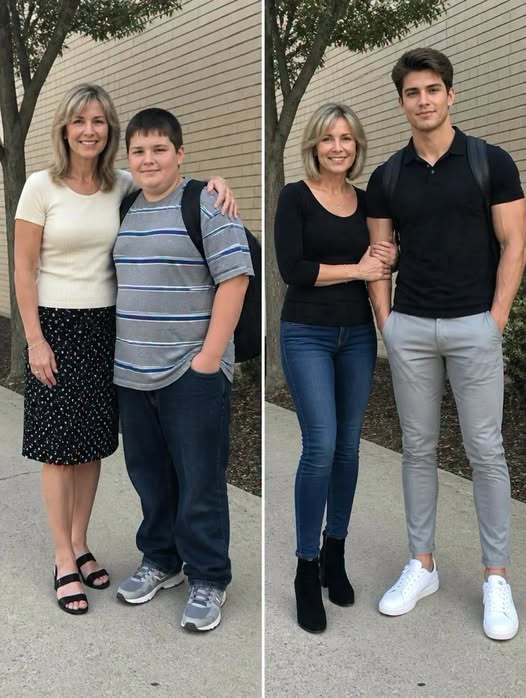
I watched him straighten his tie in the hallway mirror.
“You don’t have to go,” I told him gently.
“I know.”
“You don’t owe those people anything.”
“I know that too.”
He picked up his keys.
“Then why are you going?”
He looked at me for a moment.
“Because I want to see who we all became.”
I didn’t know what that meant.
I only knew that the boy who had once come home from school pretending not to care had grown into a man who no longer needed anyone’s approval.
He drove to the hotel where the reunion was being held.
I stayed home.
For the first hour, I couldn’t stop checking my phone.
Then a message arrived.
Mom, I’m inside.
A minute later:
You’ll never believe who’s here.
I called him.
He answered immediately.
“Are you okay?”
“I’m fine.”
“What happened?”
“Give me a minute.”
Then I heard music and voices in the background.
He hung up.
I sat on the edge of my bed, wondering whether I’d made a mistake by encouraging him to go.
Twenty minutes later, another message appeared.
I think you should come here.
I stared at the screen.
My heart began pounding.
I grabbed my coat and drove to the hotel.
When I reached the ballroom, I could hear laughter from behind the closed doors.
Then I saw my son standing just outside.
He wasn’t angry.
He wasn’t nervous.
He looked completely calm.
“What happened?” I asked.
He smiled.
“Come inside.”
The moment we entered, the room became quiet.
Dozens of people turned toward us.
I recognized some of them immediately.
The boy who had once mocked my son’s clothes.
The girl who had deliberately left him out of group projects.
The former class president.
Teachers.
Parents.
People I hadn’t seen in ten years.
For a few seconds, nobody knew what to say.
Then someone near the refreshments table whispered:
“Is that him?”
My son heard it.
He simply nodded.
“Yeah. It’s me.”
The class president approached.
His expression was awkward.
“We didn’t know you were coming.”
“I know.”
There was an uncomfortable silence.
Then he said, “I’m glad you came.”
My son smiled politely.
“Thank you.”
I expected him to say something about the invitation.
He didn’t.
Instead, he walked toward the small stage at the front of the room.
Everyone watched him.
He picked up the microphone.
“I wasn’t invited tonight,” he said.
A few people looked down.
“I found out about the reunion by accident.”
Nobody spoke.
“I almost didn’t come.”
He paused.
“Then I realized something.”
He looked around the room.
“I spent too many years wondering why none of you wanted me around.”
His voice remained calm.
“I wondered what was wrong with me. I changed the way I dressed. I changed the way I talked. I tried different hobbies. I tried being funnier. I tried being quieter.”
He took a breath.
“And eventually I realized something.”
The room was completely silent.
“You weren’t rejecting the person I was.”
He looked at several former classmates.
“You were rejecting someone you had decided didn’t belong.”
Nobody interrupted.
My eyes filled with tears.
But my son wasn’t finished.
He reached into his jacket and pulled out a small folder.
“I didn’t bring this to embarrass anyone.”
He placed it on the podium.
“I brought it because ten years ago, I promised myself that if I ever got the chance, I’d show you what happened after graduation.”
He opened the folder.
Inside were photographs.
Not embarrassing photographs.
Not revenge.
They were pictures of his life.
His first apartment.
His college graduation.
The small business he had started with a friend.
A community project he had helped organize.
A photograph of him standing beside a group of young students.
Someone in the crowd asked, “What is that?”
My son looked at the picture.
“I started a program for kids who feel left out at school.”
The room went quiet again.
“We help students who struggle socially find activities, clubs, and people who will give them a chance.”
He smiled.
“Because I know what it feels like to eat lunch alone.”
I looked around the room.
Some people were crying.
Others looked uncomfortable.
Then my son said something that surprised me.
“I didn’t come here to prove that I’m better than you.”
He closed the folder.
“I came here because I wanted to see whether I still needed your approval.”
He looked around.
“I don’t.”
Nobody moved.
Then something unexpected happened.
The former class president stepped forward.
“I owe you an apology.”
My son looked at him.
The man swallowed.
“I remember what happened back then. I told myself it was just kids being kids.”
He shook his head.
“That wasn’t true.”
Another former classmate spoke.
“I should have invited you.”
Then another.
“I should have said something.”
One by one, people began acknowledging what had happened.
Not excuses.
Not explanations.
Just apologies.
My son listened.
He didn’t interrupt.
He didn’t demand anything.
When they finished, he simply said:
“Thank you.”
The class president looked confused.
“That’s it?”
My son nodded.
“What else should there be?”
“You’re not angry?”
My son smiled.
“I was angry for a long time.”
He looked toward me.
“But eventually I realized that carrying all of that anger was keeping me connected to people I didn’t even want in my life.”
The room fell silent.
Then he stepped away from the microphone.
“I hope everyone here has had a good ten years.”
He paused.
“And I hope the next ten are even better.”
He turned to leave.
That’s when one of his former classmates stopped him.
“Wait.”
My son looked back.
She was crying.
“I remember you,” she said.
He smiled.
“I remember you too.”
“I should have been kinder.”
He nodded.
“You can be kinder now.”
She wiped her eyes.
“I will.”
My son walked back toward us.
I hugged him tightly.
“Are you okay?” I whispered.
He nodded.
“I really am.”
As we walked toward the exit, he looked back at the room one last time.
Then he smiled.
Not the nervous smile he’d worn as a teenager.
Not the smile of someone trying desperately to be accepted.
It was the quiet smile of someone who had finally made peace with his past.
Outside, the night air was cool.
I looked at him.
“You know what I’m most proud of?”
“What?”
“You didn’t become cruel just because people were cruel to you.”
He thought about that.
Then he said:
“Maybe that’s the thing I wanted them to see.”
“What?”
“That being hurt doesn’t mean you have to hurt someone else.”
We walked toward the car together.
For the first time in years, I realized that the boy who had once come home from school asking why nobody liked him was gone.
In his place was a man who knew exactly who he was.
And perhaps the biggest surprise of the evening wasn’t that my son had walked into a room where he wasn’t wanted.
It was that he walked back out without needing anyone inside it to tell him that he belonged.
Sometimes the strongest response to being excluded isn’t revenge.
It’s building a life so meaningful that you no longer need the door that was once closed to you.