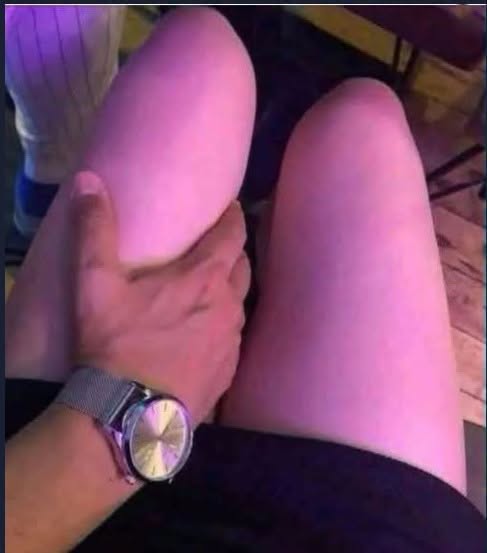
Touch Can Communicate Different Things
Physical contact is one form of nonverbal communication. A reassuring touch from a family member may communicate support, while a similar gesture from a stranger could feel uncomfortable.
Even among friends, people have different preferences about physical contact.
Some individuals naturally use gestures such as a brief touch on the arm or shoulder while talking. Others prefer more personal space and may feel uncomfortable with unexpected contact.
That difference doesn’t necessarily mean either person has done something wrong.
It simply shows that boundaries and communication styles vary.
Context Makes a Big Difference
Imagine someone placing a hand on your leg during a difficult conversation with a close friend.
They might be trying to offer reassurance.
Now imagine the same gesture happening unexpectedly during a casual conversation with someone you barely know.
You might interpret it very differently.
The circumstances surrounding the touch can change how it feels and how it should be understood.
This is why it is risky to assume that a single physical gesture automatically reveals someone’s personality, emotions, or intentions.
What About Romantic Situations?
In a romantic relationship, physical touch can sometimes be a way of expressing affection.
However, being in a relationship does not mean that every type of physical contact is automatically welcome.
Comfort can change from one moment to another.
A person may be comfortable with certain forms of affection but not others. They may also simply not want physical contact at a particular moment.
Healthy relationships make room for those differences.
If you are unsure whether a particular gesture is welcome, asking is often much clearer than trying to interpret body language.
A simple question such as, “Is this okay?” can prevent unnecessary confusion.
Your Personal Boundaries Matter
You never need to justify feeling uncomfortable with someone’s touch.
If you don’t want someone touching your leg, you can move away or calmly say:
- “Please don’t do that.”
- “I’m not comfortable with that.”
- “I’d rather you didn’t touch me.”
A respectful person should take your response seriously.
You do not need to accept physical contact simply because someone says they were joking, being friendly, or trying to show affection.
Your comfort matters.
What If the Person Doesn’t Stop?
If someone continues touching you after you have clearly asked them to stop, the situation becomes more concerning.
In that circumstance, prioritize your safety and create distance if you can.
If the person is someone you know and the behavior continues, consider speaking with a trusted adult, friend, family member, teacher, counselor, or another appropriate person who can help.
In a workplace or other professional setting, unwanted physical contact may also violate workplace policies. Depending on the circumstances, reporting the behavior to a supervisor or another responsible person may be appropriate.
Body Language Isn’t a Perfect Decoder
People sometimes claim that specific gestures reveal exactly what someone is thinking.
Human behavior is much more complicated.
Crossed legs don’t automatically mean someone is defensive.
Avoiding eye contact doesn’t necessarily mean someone is lying.
And placing a hand on someone’s leg doesn’t automatically prove romantic interest, confidence, attraction, or manipulation.
Body language can provide context, but individual gestures rarely have one fixed interpretation.
The safest approach is to consider the situation as a whole and communicate directly when something is unclear.
Pay Attention to How You Feel
You don’t have to become an expert in body language to understand whether an interaction is comfortable for you.
If a particular touch feels welcome, you can allow it.
If it feels uncomfortable, you can create distance.
If you’re unsure, you can ask what the person intended.
And if you don’t want physical contact, you are allowed to say so.
There is no requirement to accept unwanted touch simply to avoid appearing impolite.
Respect Works Both Ways
Healthy communication isn’t only about protecting your own boundaries. It also means respecting other people’s boundaries.
Before initiating physical contact, consider whether the situation is appropriate and whether the other person is likely to welcome it.
When there is uncertainty, asking is often the simplest solution.
A respectful interaction doesn’t require people to guess what one another wants.
The Bottom Line
A hand on the leg doesn’t have one universal meaning.
It can represent affection, reassurance, familiarity, or simply a person’s habitual way of communicating. In other circumstances, it may be unwanted or inappropriate.
The important question isn’t only, “What does this gesture mean?”
It’s also, “Am I comfortable with it?”
Your personal space belongs to you, and other people deserve the same respect.
When communication, consent, and boundaries come first, physical interactions become much easier to understand—and much less mysterious.