They were photographs of me.
Me at seventeen.
Me standing outside the bus station.
Me leaving for college.
Me receiving my nursing diploma.
Me standing beside a hospital entrance decades later.
My hands began trembling.
“Thomas kept these?”
The lawyer, Mr. Bennett, nodded.
“He did.”
I picked up another photograph.
It showed me at twenty-three.
I had never seen it before.
“Where did he get these?”
Mr. Bennett sat down across from me.
“That’s the question you should be asking.”
I looked at him.
“What do you mean?”
He reached into the box and pulled out a second envelope.
“This was meant to be opened only after his funeral.”
My stomach tightened.
I recognized Thomas’s handwriting immediately.
Nancy.
Just my name.
Nothing else.
I opened it.
The first line made my eyes fill with tears.
If you’re reading this, then I finally ran out of time.
I stopped.
Mr. Bennett looked away, giving me privacy.
I continued.
Thomas wrote that he had thought about me almost every day since we separated.
But then he admitted something I hadn’t expected.
He hadn’t simply accepted my decision to leave.
He had spent years wondering whether I had left because I didn’t love him—or because I believed he wasn’t ambitious enough for the future I wanted.
He had been hurt.
So had I.
But there was something else.
Something I had never known.
Thomas had received a letter from me shortly after I left for college.
A letter I had written myself.
I remembered it immediately.
I had been seventeen and terrified.
I’d written that I loved him.
I’d written that I wanted to return someday.
I’d written that leaving didn’t mean I was choosing a life without him.
I had mailed the letter.
Thomas never received it.
I looked at Mr. Bennett.
“What happened to it?”
He sighed.
“Your letter was intercepted.”
“By whom?”
He hesitated.
“Thomas’s father.”
I couldn’t speak.
According to Thomas’s letter, his father had believed I was distracting his son from the family business.
He had convinced Thomas that I had left without looking back.
Then, when Thomas’s father discovered the letter I had sent, he hid it.
Thomas never knew.
And I never knew he was waiting.
For fifty-six years, we had both lived with the same misunderstanding.
The Letter That Changed Everything
Mr. Bennett reached into the box again.
This time, he pulled out a yellowed envelope.
My name was written across it.
I recognized the handwriting immediately.
Thomas.
“That’s the letter,” Mr. Bennett said.
I stared at it.
“The letter I wrote him?”
“No.”
He shook his head.
“It’s the letter he wrote you.”
I opened it.
Thomas had written it when he was twenty.
He explained that after months of silence, he had finally accepted that I didn’t want him.
He wrote that he had almost followed me to college.
Then he had decided against it.
Not because he didn’t love me.
Because he believed I had chosen a different life.
I pressed the letter against my chest.
All those years.
All those assumptions.
All that wasted time.
Then I reached the final page.
Thomas had written one sentence that made me cry.
“If life ever gives us another chance, I promise I won’t let pride make the decision for us.”
I closed my eyes.
And suddenly, I understood what Mr. Bennett had meant.
Thomas hadn’t married me because he was trying to manipulate me.
He had married me because he wanted to correct the biggest misunderstanding of our lives.
But there was still something I couldn’t explain.
I looked at the lawyer.
“Why did you call it a trap?”
Mr. Bennett smiled sadly.
“Because Thomas wanted to trap you into discovering something you would never have accepted voluntarily.”
“What?”
He stood.
“Come with me.”
The House I Had Never Seen
I followed him to Thomas’s old home.
I had passed it many times during my childhood.
But I’d never entered.
Mr. Bennett unlocked the front door.
Inside, everything was quiet.
There were shelves filled with books, framed photographs, old furniture, and memories collected over decades.
But the lawyer didn’t stop in the living room.
He walked down a hallway and opened a door.
I stepped inside.
And froze.
The room was filled with boxes.
Hundreds of them.
Every box had a date written on the side.
I stared at him.
“What is all this?”
Mr. Bennett smiled.
“Thomas’s life.”
Then he pointed toward the boxes.
“Or rather, the parts of his life that had something to do with you.”
I felt dizzy.
“Why would he keep all this?”
“Because he never stopped wondering what your life became.”
I opened one box.
Inside were newspaper clippings.
A nursing award I had received.
A photograph from my graduation.
A local article about a charity event I had volunteered at.
Even a photograph of my children.
I stared at it.
“How did he get these?”
“Some were public. Some were sent by people who knew him. Some came from mutual friends.”
I shook my head.
“This is impossible.”
Mr. Bennett nodded.
“Thomas never wanted to interfere with your life.”
That distinction mattered.
“He didn’t contact you because he believed you were happy.”
I looked at him.
“How could he know?”
“He didn’t.”
The room suddenly felt painfully quiet.
“He simply hoped you were.”
The Real Surprise
Mr. Bennett walked toward another cabinet.
He opened a drawer.
Inside was a stack of documents.
He handed me the first one.
I read it.
Then read it again.
It was a charitable trust.
Thomas had created it years earlier.
Its purpose was to provide scholarships for students who wanted to enter nursing but couldn’t afford their education.
I looked at him.
“What does this have to do with me?”
“Everything.”
Mr. Bennett explained that Thomas had remembered how difficult it had been for me to leave home at seventeen.
He remembered how hard I had worked to become a nurse.
And he knew how much the profession had meant to me.
Over the years, he had quietly donated money to education programs.
But shortly before his death, he changed the trust.
He named it after the small hospital where we had met again.
I stared at the document.
“You’re telling me he did all this because of me?”
“No.”
Mr. Bennett smiled.
“He did it because of what you represented to him.”
I didn’t understand.
“You were the first person he knew who believed that life could become something different.”
That sentence broke something open inside me.
Thomas hadn’t spent fifty-six years simply waiting for me.
He had built a life.
He had helped people.
He had worked.
He had made mistakes.
He had grown old.
But apparently, one part of our teenage dream had never disappeared.
The belief that people should be allowed to pursue the future they wanted.
The Final Trap
Mr. Bennett handed me one final envelope.
“There’s something else.”
I almost laughed.
“Of course there is.”
He smiled.
“Thomas specifically instructed me to give you this after you had seen the trust.”
I opened it.
Inside was a single sheet of paper.
Thomas’s handwriting covered the page.
Nancy,
You probably think I brought you back into my life because I wanted one last month with the girl I loved at seventeen.
I stopped reading.
My eyes filled.
That’s partly true.
I smiled through the tears.
But there’s another reason.
You spent your whole life taking care of everyone else. Your patients. Your family. Your colleagues. Everyone who needed someone strong.
And I knew that if I simply asked you to accept something from me, you’d refuse.
I laughed softly.
That was exactly what I would have done.
So I had to make you my wife first.
I stared at the page.
Mr. Bennett chuckled.
“There it is.”
“The trap.”
“Exactly.”
I continued reading.
I knew you wouldn’t accept a gift from an old boyfriend.
But I suspected you might accept something from your husband.
I covered my mouth.
The final paragraph was short.
Please use the trust to help young people become what they dream of becoming. Don’t build a monument to me. Build a doorway for someone else.
Below that, he had written:
And Nancy?
I’m sorry we lost fifty-six years.
But I’m grateful we found each other again.
I couldn’t read the next line because my tears had blurred the ink.
Mr. Bennett quietly handed me a tissue.
“What did he write?” he asked.
I smiled.
“He said he loved me.”
The lawyer nodded.
“That’s what I thought.”
Six Months Later
I didn’t keep the money for myself.
I kept enough to live comfortably.
The rest went into Thomas’s scholarship trust.
Six months after his funeral, the first group of students received scholarships.
I attended the ceremony.
One young woman approached me afterward.
She was nervous.
“I wanted to thank you.”
“You don’t have to thank me.”
“But I do.”
She smiled.
“I thought I would have to give up on nursing because I couldn’t afford the tuition.”
I looked at her.
For a moment, I saw myself at seventeen.
A girl with a suitcase.
A dream.
A bus waiting to take her somewhere unknown.
And a boy standing behind her, believing their story was ending.
I smiled.
“Don’t give up.”
The young woman nodded.
Then she hugged me.
When she walked away, I looked toward the window.
For just a moment, I imagined Thomas standing beside me.
Not the frail man from the hospital.
Not the teenager at the bus station.
Just Thomas.
My Thomas.
The boy who had once asked me not to leave.
The man who had waited too long.
And the husband who had somehow found one last way to change my life.
The Photograph
That evening, I returned home and opened the little wooden box one final time.
At the bottom was a photograph I hadn’t noticed before.
It showed Thomas and me at seventeen.
We were standing beside the bus station.
I was holding my suitcase.
He was looking at me.
And I was looking at him.
On the back, Thomas had written:
“The moment I thought I lost her.”
Underneath, in smaller handwriting, he had added:
“The moment I promised myself I’d never waste another chance.”
I sat there for a long time.
Then I laughed.
Because I finally understood.
The lawyer hadn’t been exaggerating.
Thomas really had trapped me.
But not into giving him money.
Not into inheriting his house.
Not into becoming someone I wasn’t.
He had trapped me into accepting something I had spent my entire life refusing:
The chance to turn a painful past into something meaningful.
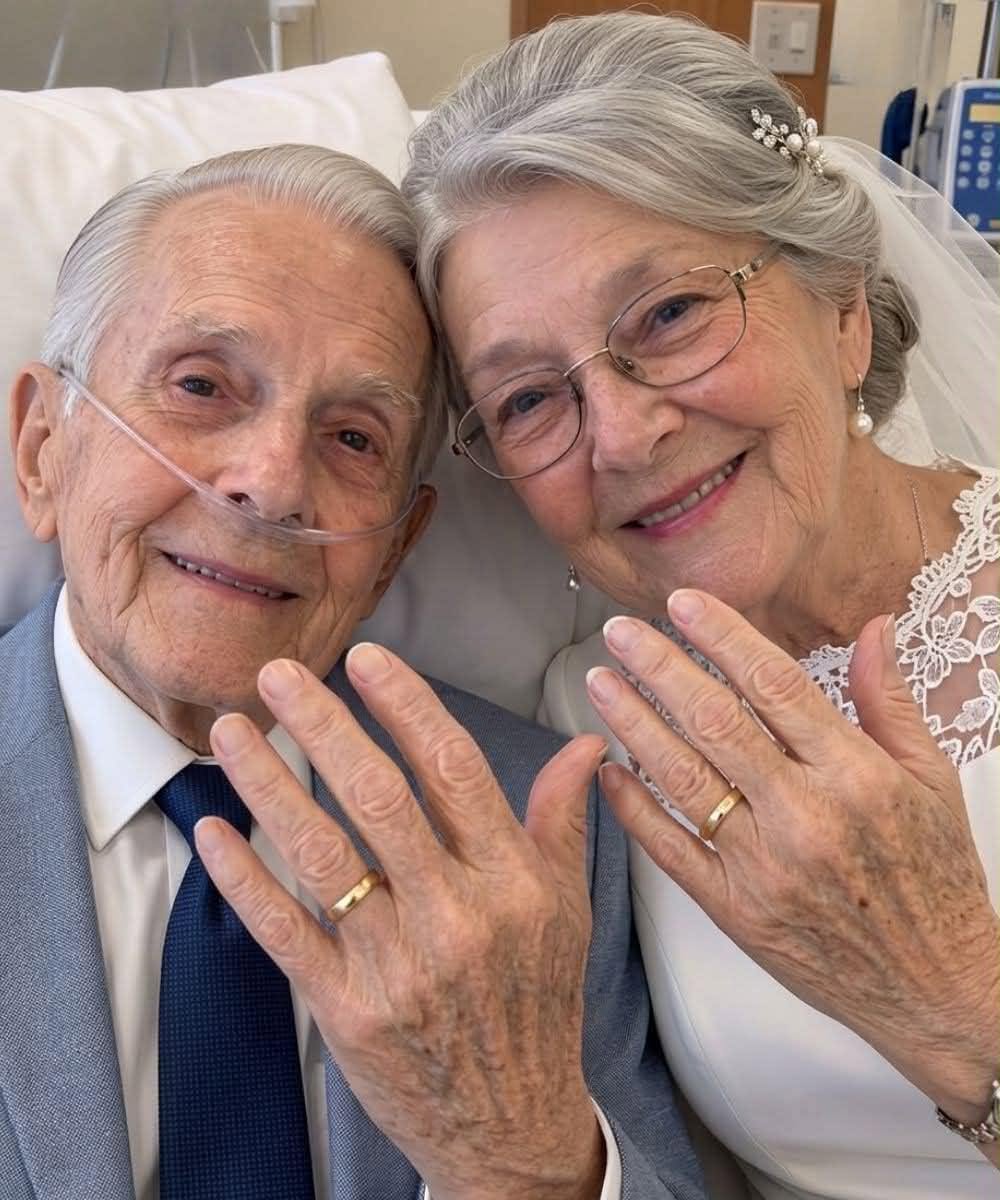
At seventy-three, I had married my first love.
I had lost him again.
But this time, there was no unfinished question between us.
No misunderstanding.
No unanswered letter.
No wondering what might have happened.
We had finally found each other.
And perhaps that was Thomas’s real final wish.
Not to make me his widow.
Not to leave me his possessions.
But to make sure that when I looked back at the life we had lost, I no longer saw only regret.
I saw what we had managed to build from the time we had left.
And whenever someone asks me whether I believe it’s possible to get a second chance, I think about that little box.
Then I smile.
Because sometimes the greatest surprise isn’t discovering what someone left behind.
It’s discovering why they left it for you.