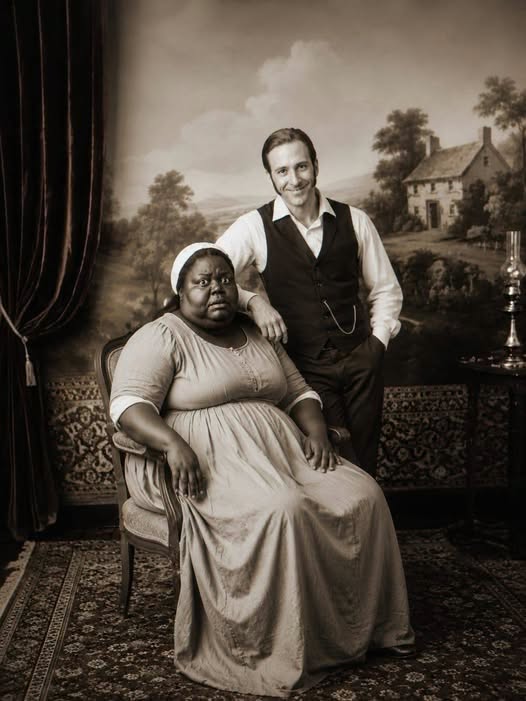
For the briefest moment, their eyes met.
And Joaquim noticed something that none of the other buyers seemed to see.
She wasn’t confused.
She was calculating.
Her eyes moved across the square, taking in the people, the exits, the horses, the buildings, and the road leading away from the market.
Joaquim’s expression changed.
He raised his hand.
“Seven cents.”
The auctioneer stared at him.
“Sold.”
The laughter became louder.
One farmer slapped another on the shoulder.
“Joaquim, you’ve finally lost your mind.”
Joaquim ignored them.
He climbed onto the platform and stopped several feet from Benedita.
“Come with me.”
She didn’t move.
The auctioneer immediately stepped forward.
“Woman, you heard him.”
Benedita’s jaw tightened.
Joaquim raised one hand.
“Don’t.”
The auctioneer looked at him.
“She belongs to you now.”
Joaquim’s face hardened.
“No.”
The word was quiet.
But it silenced the men nearby.
He looked at Benedita.
“Come with me if you choose.”
For the first time that morning, Benedita’s expression changed.
It wasn’t trust.
Not yet.
It was surprise.
She climbed down from the platform.
And together they walked away.
The Stable
Everyone expected Joaquim to put her to work immediately.
Instead, when they reached Santo António, he brought her to the stable.
Benedita stopped at the entrance.
Joaquim noticed.
“You’re not sleeping outside,” he said.
She stared at him suspiciously.
He pointed toward a small room adjoining the stable.
“It isn’t much. But it’s private.”
She didn’t answer.
Joaquim placed a bowl of food and a cup of water on the table.
Then he walked away.
Benedita watched him disappear.
She didn’t touch the food for nearly an hour.
That evening, Joaquim returned.
The bowl was empty.
He said nothing.
Neither did she.
The following morning, Joaquim discovered something unusual.
One of the stable doors had been repaired.
He had left several broken wooden boards beside it the previous night.
Benedita had repaired them.
Not perfectly.
But efficiently.
Joaquim studied the work.
“You’ve done carpentry before?”
Benedita shrugged.
“Many things.”
Those were her first words to him.
Joaquim looked at her.
“What things?”
She stared toward the coffee fields.
“Whatever they needed.”
He understood the answer.
She had learned to survive by becoming useful at everything.
But there was something else in her voice.
Something that told him she had learned much more than manual labor.
The Secret
For several weeks, Joaquim allowed Benedita to work around the stable rather than in the fields.
He soon discovered that she understood animals remarkably well.
A frightened horse settled when she approached.
A stubborn mule obeyed her more readily than it obeyed experienced handlers.
She could identify a sick animal before anyone else noticed anything was wrong.
But her greatest talent became obvious one afternoon.
Joaquim had been reviewing his coffee records when Benedita entered the office.
She looked at the ledger.
“You’ve made a mistake.”
Joaquim frowned.
“What?”
She pointed at a column.
“This number.”
He stared at it.
It was a small discrepancy.
Barely noticeable.
“How do you know?”
“Because the numbers before it don’t match.”
Joaquim looked again.
She was right.
He pulled another ledger from the shelf.
Then another.
Within minutes, Benedita had identified several inconsistencies.
Joaquim’s face became increasingly serious.
Someone had been taking advantage of him.
Not once.
Repeatedly.
“You can read?”
Benedita nodded.
“Who taught you?”
“My mother.”
“Where did she learn?”
“She taught herself.”
Joaquim sat back.
The woman everyone had called useless could read.
She could calculate.
She could repair buildings.
She understood animals.
And she had an extraordinary memory.
Suddenly, Joaquim understood something.
The auctioneer had never described Benedita’s abilities.
He had described only the things that made her inconvenient to the people who wanted obedience.
A Different Kind of Training
Joaquim began teaching Benedita something in return.
Not how to work harder.
How to manage.
He taught her about crop yields, supplies, contracts, weather records, and expenses.
She learned quickly.
Too quickly.
Within months, she could calculate figures faster than Joaquim’s bookkeeper.
But Joaquim kept her abilities private.
When visitors arrived, Benedita stayed away.
When neighboring farmers asked about the unusually tall woman, Joaquim gave them vague answers.
“She helps around the property.”
That was all.
The rumors continued.
Some said Joaquim had purchased a strong laborer.
Others claimed he was preparing her for some unusual task.
Nobody guessed the truth.
Joaquim wasn’t training Benedita to become a better captive.
He was preparing her for a future in which she would no longer be one.
The Hidden Plan
One evening, Joaquim locked the office door.
Benedita stood across from him.
On the desk was a document.
She stared at it.
“What is that?”
Joaquim took a breath.
“An agreement.”
“About me?”
“Yes.”
She didn’t touch it.
“Why?”
“Because I want you to understand something.”
Joaquim pushed the document toward her.
“This paper recognizes the money you’ve earned through your work.”
Benedita looked at him.
“Earned?”
“Yes.”
She stared at the figures.
They were more money than she had ever possessed.
“What am I supposed to do with it?”
“Save it.”
“For what?”
Joaquim looked toward the locked door.
“For freedom.”
Benedita didn’t move.
The word seemed almost too dangerous to say aloud.
“Freedom isn’t something you buy.”
“No,” Joaquim said. “But sometimes the world makes people pay for what should already belong to them.”
She looked down at the document.
For the first time, Joaquim saw tears in her eyes.
She quickly wiped them away.
“I don’t believe you.”
“I know.”
“Why would you help me?”
Joaquim remained silent for several seconds.
Finally, he answered.
“Because my father owned people.”
Benedita looked up.
Joaquim’s voice was quiet.
“I grew up watching him treat human beings as property. I told myself I was different because I wasn’t cruel in the same ways he was.”
He looked at the document.
“But eventually I understood that being less cruel isn’t the same as being good.”
Benedita said nothing.
“I can’t undo what happened to you,” he continued. “But I can refuse to continue it.”
The Day Everything Changed
Two years passed.
Benedita became indispensable to the farm.
Not because she was unusually strong.
Because she was unusually capable.
She organized supplies.
She kept records.
She negotiated purchases.
She identified problems before they became expensive.
And eventually, she began teaching others how to read.
Joaquim quietly provided books.
At first, only a few people attended.
Then more.
The stable became a classroom in the evenings.
Benedita stood beside a wooden board, writing letters carefully while several students watched.
She always began with the same lesson.
“Your name belongs to you.”
Then she taught them how to write it.
Joaquim sometimes stood outside the doorway listening.
He never interrupted.
One evening, Benedita walked into his office carrying a small bundle of papers.
“I’ve saved enough.”
Joaquim looked up.
“For what?”
She placed the papers on his desk.
“For my freedom.”
Joaquim’s throat tightened.
He had known the day would come.
But knowing didn’t make it easier.
He reached into a drawer and removed another document.
Benedita opened it.
Her eyes widened.
“What is this?”
“Your freedom papers.”
She stared at him.
“You already signed them?”
“Months ago.”
“Why?”
“Because freedom shouldn’t depend on whether you have enough money.”
Benedita stood completely still.
Then she folded the document carefully.
For years, she had imagined freedom as something enormous.
A dramatic escape.
A road disappearing into the distance.
A moment when she would finally outrun everyone who had ever claimed ownership over her life.
Instead, it arrived as a piece of paper on an ordinary wooden desk.
She began to cry.
Joaquim looked away.
He understood that some moments belonged entirely to the person experiencing them.
The Return to Vassouras
A year later, Benedita returned to the town where everything had begun.
She walked through the same central square.
The auction platform was still there.
But the people who had laughed at Joaquim were different now.
Some had heard about the woman who could manage accounts better than experienced clerks.
Some had heard about the school she had helped establish.
Others had heard that she was purchasing land.
A few recognized her immediately.
The same woman they had once dismissed as useless was now walking through the square carrying documents that represented years of work, determination, and independence.
One of the old farmers approached her.
“Benedita.”
She stopped.
He looked uncomfortable.
“I remember that day.”
“So do I.”
He glanced at her.
“Everyone thought Joaquim had wasted his money.”
Benedita smiled faintly.
“He paid seven cents.”
The farmer shook his head.
“And somehow everyone else was the one who failed to understand what they were looking at.”
Benedita looked toward the old platform.
“No,” she said. “They understood what they wanted to understand.”
Then she walked away.
What Joaquim Had Really Seen
Joaquim died several years later.
Benedita was beside him.
By then, the farm had changed.
The old records were gone.
The stable had become a small school.
And the woman who had once been described as incapable of doing anything useful had become known throughout the region for her knowledge, organization, and determination.
After Joaquim’s death, Benedita discovered one final letter.
It was addressed to her.
She opened it alone.
The letter was short.
Joaquim wrote that he had never considered the seven cents important.
He had simply offered what he could at a moment when everyone else had decided Benedita wasn’t worth anything.
Then came the sentence she remembered for the rest of her life:
“The greatest mistake they made was thinking your value could be measured by what someone was willing to pay for you.”
Benedita folded the letter.
Then she placed it inside the first book she had ever used to teach another person to read.
Years later, people would tell the story differently.
Some said Joaquim had recognized her strength.
Others said he had discovered her intelligence.
Some insisted he had simply been lucky.
Benedita always corrected them.
“He wasn’t lucky,” she would say.
“He was willing to look at a person instead of a price.”
And that was the part of the story she wanted remembered.
Not the auction.
Not the seven cents.
Not even the laughter.
She wanted people to remember what happened afterward.
A woman whom others had treated as property became a teacher, a manager, and an independent landowner.
The person everyone had dismissed as useless became the person others came to for advice.
And the farmer who had shocked an entire town with a tiny offer eventually understood something much bigger:
A person’s worth was never determined by the price someone placed on them.
It was there all along.
They simply had to be willing to see it.