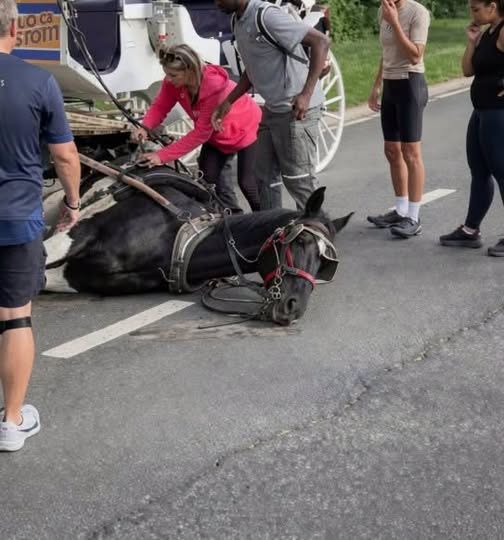
Then they noticed movement beneath the horse.
Something was there.
A Surprising Discovery
As the rescuers carefully assessed the scene, they realized that the horse was positioned over a much smaller, vulnerable animal.
The discovery changed their understanding of what they were seeing.
The horse’s unusual posture was not necessarily a sign that it was unable to move. It appeared that the animal was remaining close to the younger animal, creating a form of protection while it was vulnerable.
What had initially looked like an emergency involving an injured horse had become a situation requiring patience and careful observation.
The rescuers now had to consider two animals rather than one.
Why Observation Mattered
Approaching an animal too quickly can increase stress and make a difficult situation more complicated.
The rescuers therefore worked cautiously, watching for signs of distress and assessing the safest way to provide assistance.
Their goal was simple: help the animals without unnecessarily frightening them or separating them before it was safe to do so.
The experience demonstrated why people working around animals often need to pay attention to behavior rather than relying solely on appearances.
An animal lying on the ground may be injured, resting, frightened, or responding to another situation entirely. Context matters.
Animal Behavior Can Be Complicated
Protective behavior is common throughout the animal world, particularly when vulnerable young animals are involved.
However, it is important not to automatically assign human emotions or intentions to every animal behavior. Scientists generally examine factors such as instinct, social relationships, environmental conditions, and previous experience when interpreting what animals do.
In this case, the horse’s behavior provided an important clue that there was more happening than rescuers initially realized.
The smaller animal beneath or near the horse changed the entire context of the scene.
A Careful Rescue
Once the situation became clearer, the rescuers could focus on how best to assist both animals.
They moved deliberately rather than rushing toward them. Keeping the animals as calm as possible was important, particularly because an unfamiliar group of people could cause additional stress.
The encounter also showed why animal rescues can require more than simply removing an animal from a potentially dangerous location.
Understanding the circumstances first can make it easier to determine what kind of help is actually needed.
Looking Beyond First Impressions
The most memorable part of the encounter may have been how different the situation looked once the rescuers understood what they were seeing.
At first, the horse appeared to be the animal in need of help.
Then the rescuers realized that another vulnerable animal was involved.
That discovery turned an apparently straightforward situation into something much more complicated—and much more interesting.
It is a useful reminder that appearances can sometimes be misleading.
Whether dealing with wildlife, domestic animals, or livestock, careful observation can provide important information that might otherwise be missed.
A Lesson From an Unexpected Encounter
The horse’s behavior left the rescuers with a memorable example of how animals can respond when another member of their group is vulnerable.
It also reinforced a practical lesson: when an animal behaves unusually, the safest response is often to observe first and act carefully rather than immediately assuming what is wrong.
Nature does not always provide an obvious explanation at first glance.
Sometimes, the detail that seems least important is the one that changes the entire story.
In this case, what looked like an injured horse turned out to be a situation involving protection and vulnerability—an unexpected reminder that there can be much more happening in the natural world than we initially realize.