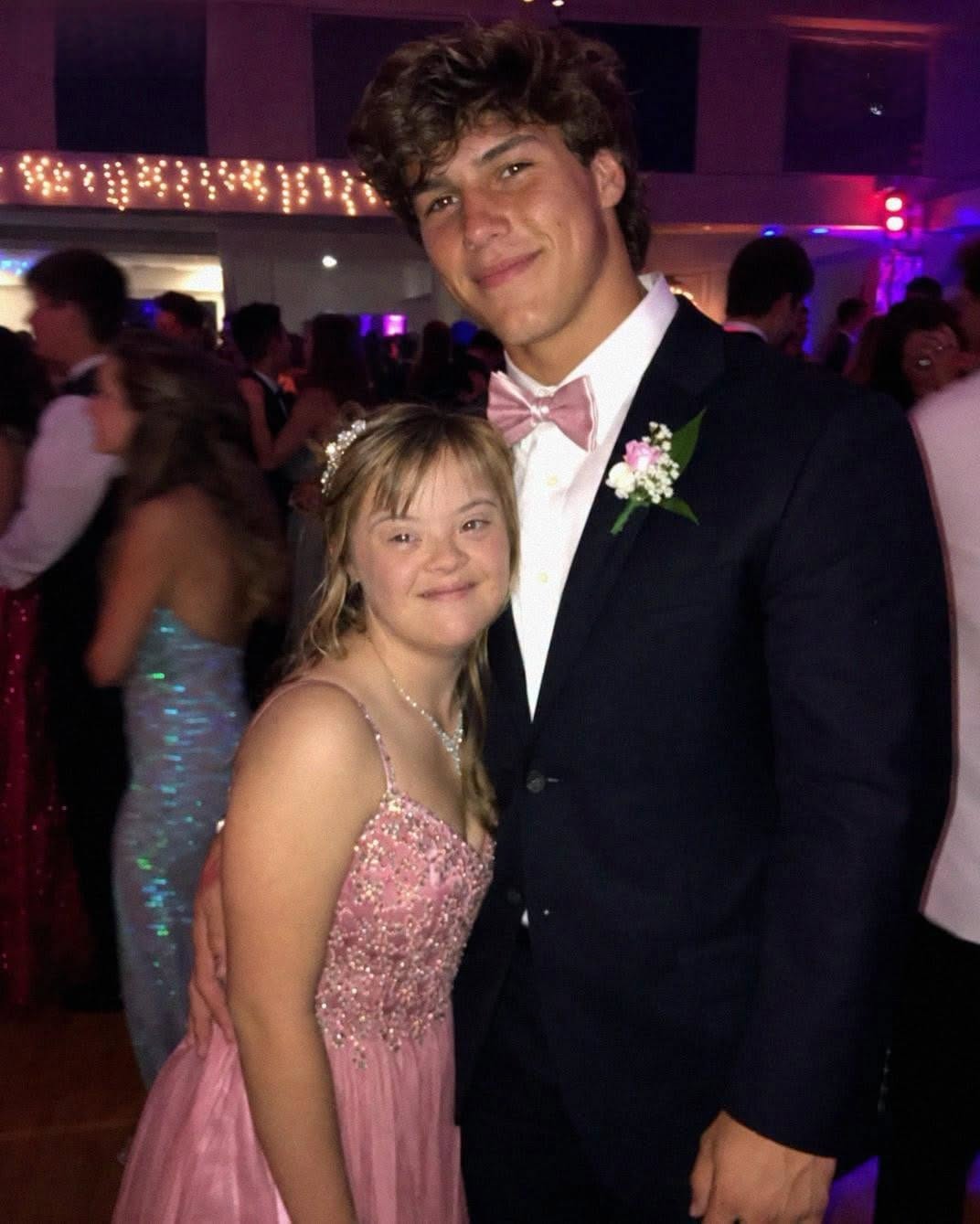
So when Steven—the football captain, the student everyone seemed to know, the boy who could walk into a room and immediately become the center of attention—asked Rosie to prom, I didn’t know what to think.
Rosie did.
She was thrilled.
For three weeks, our kitchen became her dance studio.
She practiced in silver shoes, carefully counting under her breath.
“One-two-three. Turn.”
Then she’d laugh when she lost her balance and start again.
“One-two-three. Turn.”
I had never seen her so excited about something.
And on prom night, when Steven approached her and politely asked, “May I have this dance?” Rosie’s entire expression changed.
For once, she didn’t look like the girl wondering whether she belonged.
She looked like she knew she belonged.
People applauded as Steven led her onto the dance floor.
He was careful with her, matching her pace instead of rushing ahead.
I watched from my table, trying not to cry.
Then Steven’s jacket slipped from the back of a chair beside me.
I leaned over to pick it up.
That’s when I felt something hard inside the pocket.
A flash drive.
Several photographs.
And a red envelope with three words written across the front:
AFTER THEY LAUGH.
My heart began racing.
Before I could understand what I was looking at, Steven appeared beside me.
His expression had changed completely.
“Don’t,” he whispered.
I stared at him.
“What’s this?”
He reached toward the envelope.
“Please.”
I pulled my hand away.
Then he said something that made my anger flare.
“Stay quiet, for your daughter’s sake, or you’ll regret it.”
I stared at him.
Across the room, Rosie was laughing.
She had no idea what was happening.
I leaned toward him.
“If you have done anything to my daughter—”
“I haven’t.”
His answer came so quickly that it stopped me.
“Then explain this.”
“I will.”
“Now.”
He looked toward the dance floor.
“Not yet.”
I didn’t trust him.
But before I could say anything else, Steven walked toward the stage.
He spoke to the DJ.
The music stopped.
Dozens of students turned around.
Steven picked up the microphone.
“Everyone,” he said, “there’s something important about Rosie.”
My stomach dropped.
“Steven, stop!”
I started toward him.
Two of his friends stepped in front of me.
“Ma’am, please.”
“Move.”
“Just wait.”
The projector screen came alive.
The first photograph appeared.
Rosie.
Sitting alone in a bathroom stall.
My heart broke.
The next picture showed her holding a torn jacket.
Then another showed her sitting in math class, hugging the stuffed bear she had carried with her since childhood.
A murmur moved through the room.
I felt sick.
I turned toward Steven.
“What are you doing?”
He looked at Rosie.
She was staring at the screen.
Her smile had disappeared.
Steven lowered the microphone.
“Rosie, I’m sorry.”
She looked confused.
“Why are you showing those?”
Steven turned back toward the audience.
“Because these aren’t funny.”
Nobody said anything.
He clicked to the next photograph.
This time, it wasn’t Rosie.
It was a group of students standing behind her at school.
Someone had taken the picture secretly.
Several of the students in it were laughing.
Rosie was in the foreground, unaware.
Then another photograph appeared.
And another.
The room became completely silent.
Steven looked at the students in the photographs.
“Some of you were there.”
Nobody moved.
“You laughed at her.”
One boy near the back shook his head.
“I didn’t do anything.”
Steven looked directly at him.
“You were standing right beside her.”
The boy looked down.
Steven continued.
“Some of you filmed it. Some of you shared it. Some of you pretended you didn’t see it.”
He paused.
“But one person did see it.”
He looked toward Rosie.
“She did.”
Rosie’s eyes widened.
Steven turned to her.
“You kept coming to school anyway.”
Rosie swallowed.
“Why are you doing this?”
Steven’s voice softened.
“Because I wanted everyone to know something.”
He reached into his jacket and pulled out the red envelope.
My hands tightened.
He opened it.
Inside were several printed pages.
“I found these in the school office,” he said.
A teacher standing near the wall suddenly stepped forward.
“Steven.”
He looked at her.
“Tell them.”
She hesitated.
Then she nodded.
Steven held up the pages.
“These are copies of complaints Rosie and her family made about bullying.”
I stared at him.
I hadn’t known about all of them.
Rosie hadn’t told me.
Steven looked around the ballroom.
“Some of you probably thought she never noticed.”
He shook his head.
“She noticed everything.”
Rosie looked down.
I walked toward her.
She immediately reached for my hand.
I took it.
Steven continued.
“I asked Rosie to prom because I wanted to make sure she knew something.”
He looked directly at her.
“You were never the problem.”
Rosie blinked rapidly.
Then Steven clicked the next slide.
The screen changed.
This time, it showed a completely different photograph.
Rosie was standing in front of a classroom.
She was holding a certificate.
I recognized it immediately.
It was from the school leadership program she had joined that year.
Steven smiled.
“Rosie volunteered to help younger students who were struggling to fit in.”
Rosie looked at him.
“You weren’t supposed to have that.”
“I know.”
She frowned.
“Then how did you get it?”
“Your teacher gave it to me.”
The teacher stepped forward.
“I asked Steven to help organize tonight’s presentation.”
Rosie looked from her teacher to Steven.
“Presentation?”
Steven nodded.
“The prom committee wanted to do something different this year.”
I stared at the red envelope.
“Then what was ‘AFTER THEY LAUGH’ supposed to mean?”
Steven looked embarrassed.
“That’s the part I handled badly.”
He glanced at me.
“I wrote it because I knew some people would laugh when the photographs started.”
My expression hardened.
“And you thought threatening me was a good idea?”
“No.”
He looked down.
“I panicked.”
“That’s not an excuse.”
“I know.”
For the first time all evening, he looked less like the confident football captain everyone admired and more like an eighteen-year-old who had realized he had made a terrible decision.
“I was afraid you would stop the presentation before Rosie heard what I wanted to tell her.”
I stared at him.
“You could have simply explained that.”
“I should have.”
Rosie suddenly spoke.
“Mom?”
I turned toward her.
“Yes?”
“Can I say something?”
I squeezed her hand.
“Of course.”
Rosie walked toward the microphone.
The room became quiet.
She looked at the screen.
Then she looked at the students who had once laughed at her.
“I knew.”
A few people lowered their heads.
“I knew when you laughed.”
Nobody spoke.
“I knew when you stopped talking when I walked over.”
Her voice shook, but she continued.
“I knew when you made jokes.”
She paused.
“But I didn’t always know why.”
Her eyes filled with tears.
“Sometimes I thought maybe I really was annoying.”
My heart broke.
Rosie looked at me.
I wanted to interrupt.
She shook her head gently.
She wanted to finish.
“Then I met people who didn’t treat me like I was a problem.”
She looked at Steven.
“And I realized something.”
Steven stood completely still.
Rosie smiled faintly.
“People can be different without one person being better than the other.”
The room remained silent.
Then she looked toward her classmates.
“If you don’t like me, that’s okay.”
Several people looked surprised.
“But don’t make somebody else feel small just because you don’t understand them.”
No one laughed.
No one whispered.
Rosie stepped away from the microphone.
For several seconds, nothing happened.
Then one person began clapping.
It was the school counselor.
Another person joined.
Then another.
Within moments, the entire room was applauding.
Rosie looked overwhelmed.
She turned toward me.
I hugged her.
“Mom,” she whispered.
“What?”
“I think I want to go home.”
I smiled.
“Okay.”
But before we left, Steven approached us.
He stopped several feet away.
He didn’t touch Rosie.
He didn’t even try to make the moment about himself.
“I owe you both an apology,” he said.
I looked at him.
“You do.”
He nodded.
“I’m sorry for the way I spoke to you.”
Then he looked at Rosie.
“And I’m sorry if tonight embarrassed you.”
Rosie thought for a moment.
“It did.”
Steven nodded.
“I’m sorry.”
She studied him.
Then she said:
“But I liked the dancing.”
Steven smiled.
“So did I.”
Rosie glanced at me.
I raised an eyebrow.
She laughed.
“Mom!”
“What?”
“Don’t make that face.”
“What face?”
“The mom face.”
Steven laughed.
For the first time that night, the tension broke.
But there was still one thing I couldn’t let go.
I looked at Steven.
“Why did you really ask her?”
He became quiet.
Then he answered honestly.
“Because I noticed her.”
I frowned.
“That’s all?”
“No.”
He looked toward Rosie.
“Everyone else was trying to decide whether she belonged.”
He shrugged.
“I didn’t understand why they were deciding that.”
That answer stayed with me.
Not because Steven had somehow become a hero.
He hadn’t.
He had made mistakes.
He had handled the situation badly.
But he had also chosen to stand beside someone whom other people had pushed aside.
And Rosie had done something even more important.
She had refused to let their behavior define her.
As we walked toward the exit, Rosie stopped.
She looked back at the dance floor.
“Mom?”
“Yes?”
“Can we stay for one more song?”
I smiled.
“Of course.”
We returned to the ballroom.
The DJ started a slower song.
Steven approached Rosie.
He held out his hand.
“One more?”
Rosie looked at him.
Then she looked at me.
I nodded.
She took his hand.
And once again, she stepped onto the dance floor.
This time, nobody was watching her because they felt sorry for her.
Nobody was laughing.
Nobody was whispering.
She was simply a young woman at her prom, wearing silver shoes and dancing with someone she trusted.
I watched her count quietly.
“One-two-three.”
She turned.
“One-two-three.”
And smiled.
I realized then that the flash drive hadn’t contained a secret that could destroy my daughter’s life.
It contained something much more powerful.
Evidence that people had underestimated her.
Evidence that she had noticed more than they thought.
And evidence that, despite everything, she had continued showing up.
The red envelope had frightened me.
The photographs had broken my heart.
But Rosie’s words were what I would remember.
Because the most important thing that happened that night wasn’t that a popular boy asked my daughter to dance.
It wasn’t even that he exposed the bullying.
It was that Rosie finally stood in front of the people who had made her question herself and reminded them of something they should have understood all along:
Being different isn’t an invitation to be unkind.
And as we drove home that night, Rosie kicked off her silver shoes in the back seat.
“Mom?”
“Yeah?”
“That was a pretty good prom.”
I looked at her in the mirror.
“Pretty good?”
She grinned.
“Okay. Really good.”
I laughed.
And for the first time, I understood that maybe the night hadn’t been about proving that Rosie belonged.
She had never needed to prove that.
She belonged the moment she walked through those doors.
She belonged when she laughed.
She belonged when she danced.
She belonged when she spoke.
And most importantly, she belonged exactly as she was.