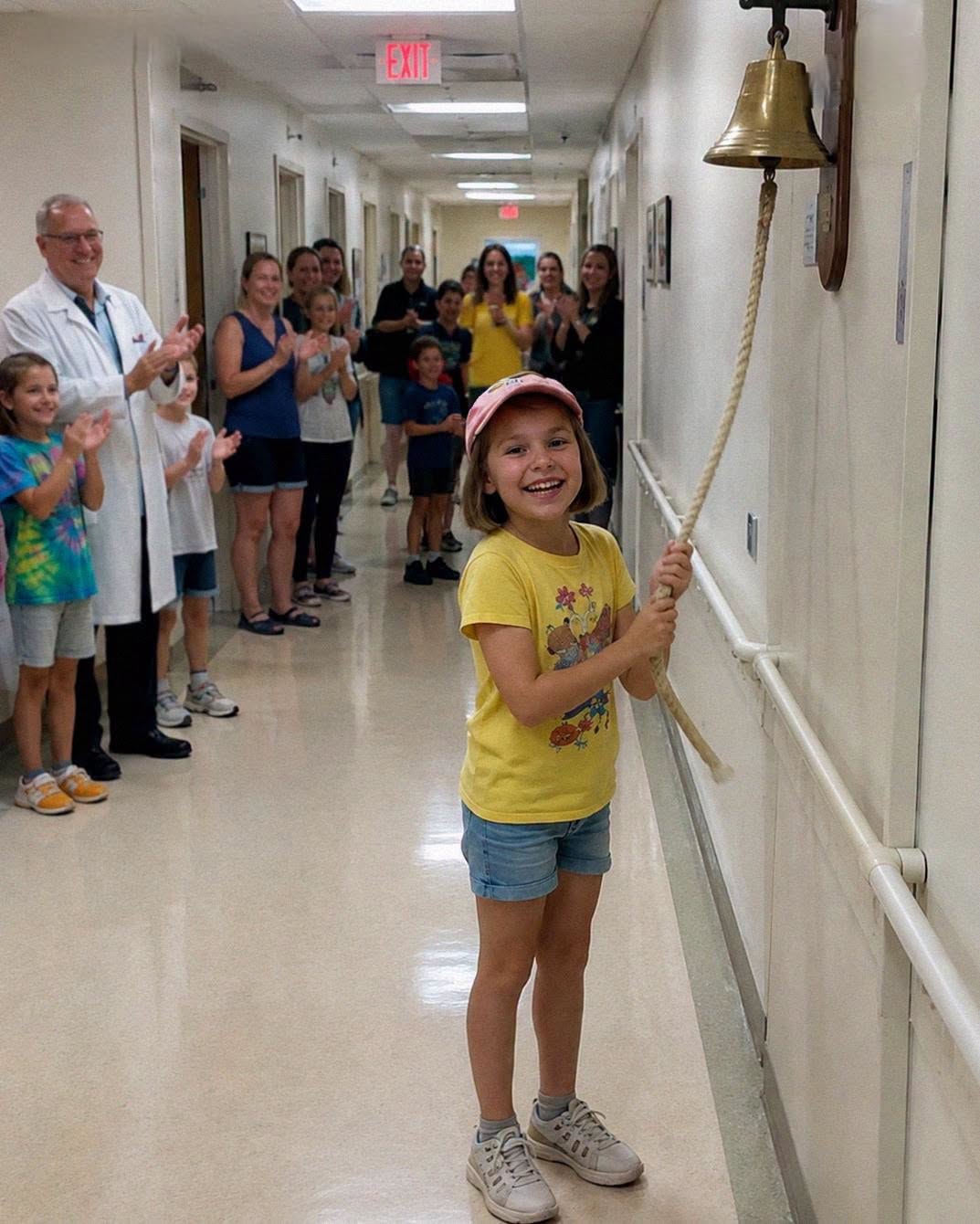
Her new pink hat sat crooked on her head.
And for the first time in two years, she wasn’t wearing a hospital bracelet.
I turned back to the doctor.
“What are you talking about?”
He glanced toward Martha.
Then toward the hallway behind him.
His expression changed.
It wasn’t the expression of a doctor delivering bad news.
At least, that’s what I desperately wanted to believe.
“Can we talk somewhere private?” he asked.
My heart immediately began racing.
“No.”
The word came out sharper than I intended.
“If this is about her treatment, you can tell me right here.”
The doctor looked at Martha again.
She was watching both of us.
“Mom?”
I immediately knelt beside her.
“It’s okay, sweetheart.”
But she didn’t look convinced.
“Did I do something wrong?”
My heart broke.
“No. Absolutely not.”
The doctor crouched down.
“Martha, you’ve done nothing wrong. In fact, you’re one of the bravest people I’ve ever met.”
She gave him a suspicious look.
“Then why are you chasing us?”
Despite everything, I almost laughed.
The doctor smiled faintly.
“That’s a very good question.”
Then he stood.
“Your mother and I need to talk for a minute.”
Martha crossed her arms.
“About me?”
“Yes.”
“Then I want to hear it.”
The doctor looked at me.
I looked at Martha.
There was no way I was going to convince that child to leave.
Finally, the doctor nodded.
“All right.”
He took a breath.
“The reason I came after you is because there is something about Martha’s treatment history that you need to understand before you leave.”
My stomach tightened.
“What?”
He reached into the folder tucked beneath his arm.
Then he pulled out a single sheet of paper.
I recognized it immediately.
It was one of Martha’s earliest medical records.
The date was from two years earlier.
The day everything had changed.
“What am I looking at?”
The doctor didn’t answer immediately.
Instead, he pointed toward a section near the bottom.
I read it once.
Then again.
I didn’t understand.
“What does this mean?”
“It means,” he said carefully, “that the diagnosis recorded on that first day wasn’t the complete story.”
I stared at him.
“What are you saying?”
He glanced at Martha.
“I’m saying there was an unusual finding in her original records that we didn’t fully understand at the time.”
My mouth went dry.
“Is she sick?”
“No.”
The answer came immediately.
“No, Martha is not being told that her cancer has returned. That’s not what this is.”
I felt my knees weaken.
I grabbed the nearest chair.
“Then please stop talking in riddles.”
The doctor nodded.
“You’re right.”
He sat across from me.
“Martha’s treatment has gone extremely well. Her current tests are encouraging, and her oncology team is comfortable with the plan we’ve made for her follow-up care.”
I looked at my daughter.
She was listening carefully.
“Then what secret could possibly be important enough for you to chase us down?”
The doctor lowered his voice.
“Because we recently discovered something in the hospital archives.”
I frowned.
“Archives?”
“Old laboratory records. Stored samples. Documentation from the period when Martha was first diagnosed.”
I looked at him blankly.
“What does that have to do with my daughter?”
He placed another document on the table.
“This.”
I picked it up.
There was a name at the top.
It wasn’t Martha’s.
I stared at it.
Then I looked at the doctor.
“Who is this?”
He didn’t answer.
Instead, he asked:
“Do you recognize the name?”
I looked again.
I didn’t.
“No.”
He seemed relieved.
Then he said something that made my entire body go cold.
“You should.”
I looked at Martha.
She was staring at the paper.
“Mom?”
I folded it immediately.
“It’s nothing, sweetheart.”
The doctor shook his head.
“Actually, it isn’t nothing.”
I glared at him.
“Then tell me.”
He took a slow breath.
“The name belongs to a patient who was treated here more than thirty years ago.”
I didn’t understand.
“What does an old patient have to do with Martha?”
“That’s what we’ve been trying to determine.”
He opened his folder again.
Inside was a copy of a laboratory report.
“This patient had an unusual genetic finding. It’s rare, but not impossible.”
I felt confused.
“Why are you telling me this?”
“Because when Martha’s records were reviewed recently, we found a remarkably similar pattern.”
I stared at him.
“What does that mean?”
“It means we need to look more carefully at the family history.”
I almost laughed.
“Doctor, we’ve already given you our family history.”
“Yes.”
“You’ve asked me those questions a dozen times.”
“I know.”
“Then what’s missing?”
He looked at me.
“Your mother’s maiden name.”
I froze.
My mother.
For years, I’d barely thought about that part of my family history.
She had died when I was young.
My relationship with her had been complicated.
And there was something else.
Something I’d spent most of my life trying not to think about.
“My mother was adopted,” I said.
The doctor’s expression changed.
“Are you certain?”
“Yes.”
“Do you know anything about her biological family?”
“No.”
He looked down at the report.
“That’s important.”
My daughter suddenly spoke.
“Mom?”
I turned toward her.
“Yeah?”
“Does this mean I’m related to the doctor?”
The doctor nearly smiled.
“No, Martha.”
“Then why is everyone acting weird?”
I looked at her.
There was no easy answer.
So I told her the truth.
“Because sometimes adults find something they don’t understand, and they need time to figure it out.”
She considered that.
“Okay.”
Then she looked at the doctor.
“Are you going to figure it out?”
He smiled.
“We’re going to try.”
Martha nodded.
“Good.”
Then she picked up her stuffed rabbit.
“Because I’m hungry.”
The doctor laughed.
It was the first normal sound anyone had made in ten minutes.
I almost cried from relief.
We left the hospital that evening with a stack of follow-up instructions, several appointments, and a mystery I hadn’t asked for.
But there was one thing the doctor had told me that I couldn’t stop thinking about.
Before we left, he had pulled me aside again.
“Please don’t assume the worst.”
I looked at him.
“Then what should I assume?”
“That we found something interesting.”
“That sounds like something doctors say when they don’t want to scare someone.”
He smiled sadly.
“Sometimes that’s exactly what we’re doing.”
For the first time in two years, I drove home without thinking about chemotherapy.
Instead, I thought about my mother.
And the name on that document.
Three days later, the doctor called.
I almost didn’t answer.
When I finally picked up, he said:
“We found the connection.”
I sat down.
“What connection?”
“Between your family and the old patient.”
My heart began pounding.
“Who was she?”
There was a pause.
Then he said:
“Her name was Eleanor.”
I closed my eyes.
My grandmother had been named Eleanor.
“That’s impossible.”
“We thought so too.”
“My grandmother died years before Martha was born.”
“I know.”
“Then how could she have been treated here?”
Another pause.
“Because the patient wasn’t your grandmother.”
I stared at the wall.
“Then who was she?”
The doctor said:
“Your grandmother’s sister.”
I couldn’t breathe for a second.
My family had never spoken about her.
Not once.
I had grown up believing my grandmother had been an only child.
Apparently, that wasn’t true.
The doctor continued.
“We’re still investigating the old records. But there is something else you should know.”
“What?”
“The original record contains a handwritten note.”
I waited.
“Written by the physician who treated Eleanor.”
“What does it say?”
The doctor hesitated.
“It’s difficult to read.”
“Just tell me what you can.”
He took a breath.
“It says, ‘If another member of this family ever presents with a similar condition, make sure the family knows about the history.’”
I stared at the phone.
“That’s it?”
“No.”
He paused.
“There’s another sentence underneath.”
My heart began pounding again.
“What does it say?”
“‘Especially if the patient is a child.’”
I didn’t sleep that night.
The next morning, I called my father.
He was the only person alive who might know something.
“Dad, did Grandma have a sister?”
There was silence.
Not confusion.
Not surprise.
Silence.
That told me everything.
“Dad?”
“Where did you hear that?”
My hands went cold.
“Who was she?”
He sighed.
“Your grandmother didn’t like talking about her.”
“Why?”
“Because there was a family disagreement.”
“What kind of disagreement?”
Another pause.
Then he said:
“Eleanor was sick.”
I sat down.
“What kind of sick?”
“I don’t remember.”
“Dad.”
“I was a child.”
“Please.”
He finally told me what he knew.
Eleanor had become seriously ill when she was young.
The family had been frightened.
There had been arguments about doctors, treatments, and what information should be shared with relatives.
Eventually, Eleanor moved away.
The family stopped talking about her.
And over time, her existence practically disappeared from our family stories.
I couldn’t believe it.
“How could you never tell me?”
“I didn’t think it mattered.”
I looked toward Martha’s bedroom.
She was sitting on the floor surrounded by coloring books.
“It matters now.”
My father went quiet.
Then he said:
“Does this have something to do with Martha?”
I couldn’t answer.
He immediately understood.
“Oh.”
That single word broke my heart.
“Dad, what aren’t you telling me?”
“Nothing.”
“You just did the same thing the doctor did.”
“What?”
“Acted like there was something you were afraid to say.”
My father sighed.
“Your grandmother used to keep a box.”
“What box?”
“An old wooden box.”
“Where is it?”
“I don’t know.”
I stood.
“Dad.”
“I haven’t seen it in decades.”
“What was inside?”
“I don’t remember.”
I stared at the wall.
“Do you remember anything?”
He thought.
“Letters.”
“From Eleanor?”
“Yes.”
“Pictures?”
“I think so.”
“Anything else?”
My father was silent.
Then he said:
“There was a photograph.”
“What photograph?”
“I remember your grandmother looking at it once.”
“What was in it?”
He took a breath.
“Two little girls.”
My heart stopped.
“Your grandmother and Eleanor.”
That afternoon, I drove to my father’s house.
We searched the attic for almost two hours.
Martha sat downstairs with her grandfather, drawing pictures and eating crackers while we opened old boxes.
Then I saw it.
A small wooden container pushed behind a stack of Christmas decorations.
I pulled it out.
Dust covered the lid.
My father stared at it.
“That’s it.”
My hands trembled.
We opened it together.
Inside were letters.
Photographs.
An old hospital bracelet.
And one envelope.
Unlike the others, it had never been opened.
My name was written on the front.
Not my mother’s.
Not my grandmother’s.
Mine.
I stared at it.
“Dad?”
He looked confused.
“I’ve never seen that.”
I opened it carefully.
Inside was a single handwritten page.
The handwriting was old.
The ink had faded.
But I could read the first sentence.
“If you are reading this, then someone in our family has become sick again.”
I stopped breathing.
My father reached for the paper.
I pulled it away.
“Let me read it.”
I continued.
The letter explained that Eleanor had spent years trying to understand the condition that had affected her family.
She had learned that the illness wasn’t necessarily passed directly from parent to child in the way the family had assumed.
There were complex factors involved.
But she had also learned that certain family patterns could matter when doctors were evaluating a patient.
Then I reached the final paragraph.
I read it twice.
Then I looked at my father.
“What?”
He looked frightened.
“What does it say?”
I handed him the paper.
His eyes moved across the page.
Then he sat down.
“What?”
He didn’t answer.
“Dad?”
He looked at me.
“Your grandmother knew.”
“Knew what?”
“That there might be a hereditary connection.”
My heart sank.
“Why didn’t she tell me?”
“I don’t know.”
I looked down at the letter.
Then I noticed something.
A second sheet of paper was folded behind it.
I pulled it out.
There was a date.
The date was only six months before Martha was born.
I stared at it.
Then I read the final line.
“If Martha ever becomes sick, don’t let them tell you the family history is irrelevant.”
I couldn’t move.
My father’s face had gone pale.
“How did Eleanor know my daughter’s name?”
We looked at each other.
Neither of us had an answer.
Then my phone rang.
It was Martha’s doctor.
I answered immediately.
“Hello?”
His voice was quiet.
“We need to talk.”
My heart began racing.
“About Martha?”
“Yes.”
“Is she okay?”
“Yes. Her current results remain reassuring.”
I closed my eyes.
“Then what happened?”
“We found something else in the records.”
I looked at the letter in my hand.
“What?”
“A note attached to the original laboratory sample.”
My throat tightened.
“What does it say?”
The doctor paused.
“It’s not from the hospital.”
“Then who is it from?”
He answered:
“Your mother.”
I couldn’t speak.
The doctor continued.
“She apparently contacted the hospital years ago.”
My knees nearly gave out.
“My mother?”
“Yes.”
“Why?”
“We don’t know yet.”
“Then what did she say?”
Another pause.
“She asked that if you ever had a child who developed a serious blood disorder, you should be contacted immediately.”
I stared at my father.
He was watching me.
The doctor continued.
“And there’s one more thing.”
I whispered:
“What?”
“We found evidence that your mother knew about Eleanor’s records.”
My father’s eyes widened.
I looked at him.
“Dad?”
He didn’t answer.
“Dad, what did Mom know?”
He slowly lowered his head.
And then he said something that changed everything.
“Your mother wasn’t the one who hid Eleanor’s story from you.”
I stared at him.
“Then who did?”
He looked toward the old wooden box.
“Your grandmother.”
“Why?”
My father shook his head.
“I don’t know.”
I looked down at Martha’s name on the medical papers.
Then I remembered something.
The folded photograph she had carried in her wallet on the day she rang the bell.
The one she had said was supposed to be a memory of her grandmother.
I had assumed it was simply a family photograph.
But now I remembered something about it.
There had been two little girls standing beside my grandmother.
I had never noticed the second child.
I called Martha into the room.
“Sweetheart?”
She came running.
“What?”
“Can I see the photograph you keep in your wallet?”
She frowned.
“Why?”
“Because I want to look at it.”
She handed it to me.
I turned it over.
There was writing on the back.
I’d never seen it before.
A sentence.
Written in my mother’s handwriting.
My hands began shaking.
I read it aloud.
“One day, Martha will ask why I kept this picture. When that day comes, tell her the girl beside Grandma was Eleanor—and tell her that the family secret was never about the illness.”
I looked at my father.
Then at Martha.
“Then what was it about?”
My father didn’t answer.
My phone rang again.
It was the doctor.
I answered.
“Hello?”
His voice sounded different this time.
“There’s something we’ve just confirmed.”
“What?”
“We found Eleanor’s complete medical file.”
I waited.
“And we discovered why your grandmother spent her entire life refusing to talk about her.”
My heart pounded.
“Why?”
The doctor took a breath.
“Because Eleanor wasn’t the only person in that file.”
I gripped the phone.
“Who else was there?”
He said a name.
My mother’s name.
I stared at the photograph.
The room seemed to tilt around me.
“What does my mother have to do with Eleanor?”
The doctor was silent.
Then he said:
“That’s the part we need to show you in person.”
I looked at Martha.
She was standing beside me, holding her stuffed rabbit.
After everything we’d been through, I wanted to protect her from every frightening question the world could possibly ask.
But I also knew something now.
The bell hadn’t marked the end of our story.
It had marked the beginning of a different one.
A story about a family secret that had been buried for decades.
A story about a woman whose name had disappeared from our family history.
And a story about why my mother had left instructions that could somehow have been connected to the day her granddaughter finished treatment.
The next morning, Martha and I returned to the hospital.
Her doctor was waiting for us in a private consultation room.
On the table was a thick brown file.
Beside it was an old photograph.
I sat down.
Martha climbed into the chair beside me.
The doctor closed the door.
Then he placed the photograph in front of me.
I looked at it.
And immediately recognized the two little girls.
My grandmother.
And Eleanor.
But there was someone else standing behind them.
Someone I’d never seen before.
Someone who looked remarkably familiar.
I leaned closer.
My breath caught.
Because the woman standing behind my grandmother and Eleanor wasn’t a stranger.
It was my mother.
And she was holding something in her hands.
A hospital bracelet.
The same kind Martha had worn throughout her treatment.
I looked at the doctor.
“What does this mean?”
He didn’t answer.
Instead, he opened the old file.
And the first page contained a date.
A date from before I was born.
I looked at the name beneath it.
Then everything I thought I knew about my family changed.