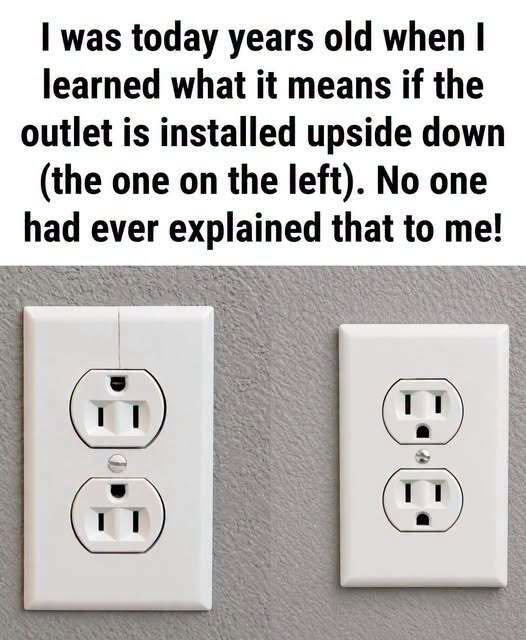
It May Indicate a Switched Outlet
One possible explanation involves outlets that are controlled by a wall switch.
In older homes especially, it was common for a wall switch to control a lamp plugged into an outlet rather than a ceiling light. Some receptacles were designed so that one half could be switched while the other remained powered.
This arrangement provided flexibility. A lamp could be connected to the switched portion, while another device could remain plugged into the continuously powered portion.
In some installations, an unusual outlet orientation may have been used as a visual reminder that the receptacle had a special function.
However, orientation alone doesn’t prove that an outlet is switched.
There Isn’t One Universal Orientation
Many people assume that every electrical outlet must be installed in exactly the same direction.
In reality, outlet orientation can vary.
Depending on local practices, the type of installation, the electrician’s preference, and the design of the building, you may see receptacles installed with the grounding opening facing upward, downward, or even sideways.
Electrical requirements can also vary by location and installation type, so it’s important not to assume that one orientation has a universal meaning.
An upside-down outlet isn’t automatically evidence of faulty workmanship.
Why Would an Electrician Choose a Different Orientation?
There are several possible reasons.
A particular orientation may make the wiring arrangement more convenient. It may help distinguish a specialized receptacle from others nearby. In some cases, it may simply reflect the installer’s preferred method.
Some people also believe that a particular orientation can provide practical advantages when a plug or cord is pulled or placed under tension. However, the safety implications depend on the specific receptacle, plug, installation, and applicable electrical requirements.
For that reason, it’s better not to treat outlet orientation as a guaranteed safety feature.
What About Older Homes?
Older houses can contain electrical installations that reflect the practices common when they were built or renovated.
You might find a mixture of outlet orientations throughout the same property, particularly if different rooms were updated at different times.
A home may have had its electrical system modified several times over the decades. As a result, an unusual-looking outlet may simply be a remnant of an earlier installation.
This is one reason why the orientation of a receptacle doesn’t necessarily tell you when it was installed or exactly how it functions.
How Can You Tell Whether an Outlet Is Switched?
The orientation of the receptacle isn’t enough to determine how it’s wired.
If you want to understand what a particular outlet does, look for nearby wall switches and see whether one controls the receptacle. A simple plug-in lamp can help identify whether power is controlled by a switch.
However, don’t remove the outlet cover or attempt to alter electrical wiring yourself.
If an outlet is loose, damaged, warm to the touch, making unusual sounds, showing signs of scorching, or behaving unexpectedly, stop using it and have it inspected by a qualified electrician.
Electrical work can involve serious hazards, so questions about wiring should be handled by someone properly trained and familiar with the applicable local requirements.
A Small Detail With a Practical Explanation
The next time you see an outlet installed “upside down,” there’s no need to assume that someone made a mistake.
It could be connected to a switched circuit, reflect a particular installation practice, or simply be the electrician’s preferred orientation.
The important point is that the direction of an outlet by itself doesn’t tell the whole story.
Something that looks unusual at first may actually be a small clue about how the electrical system was designed or installed.
And that’s what makes ordinary details around a home so interesting: sometimes the things we barely notice have a practical story behind them.