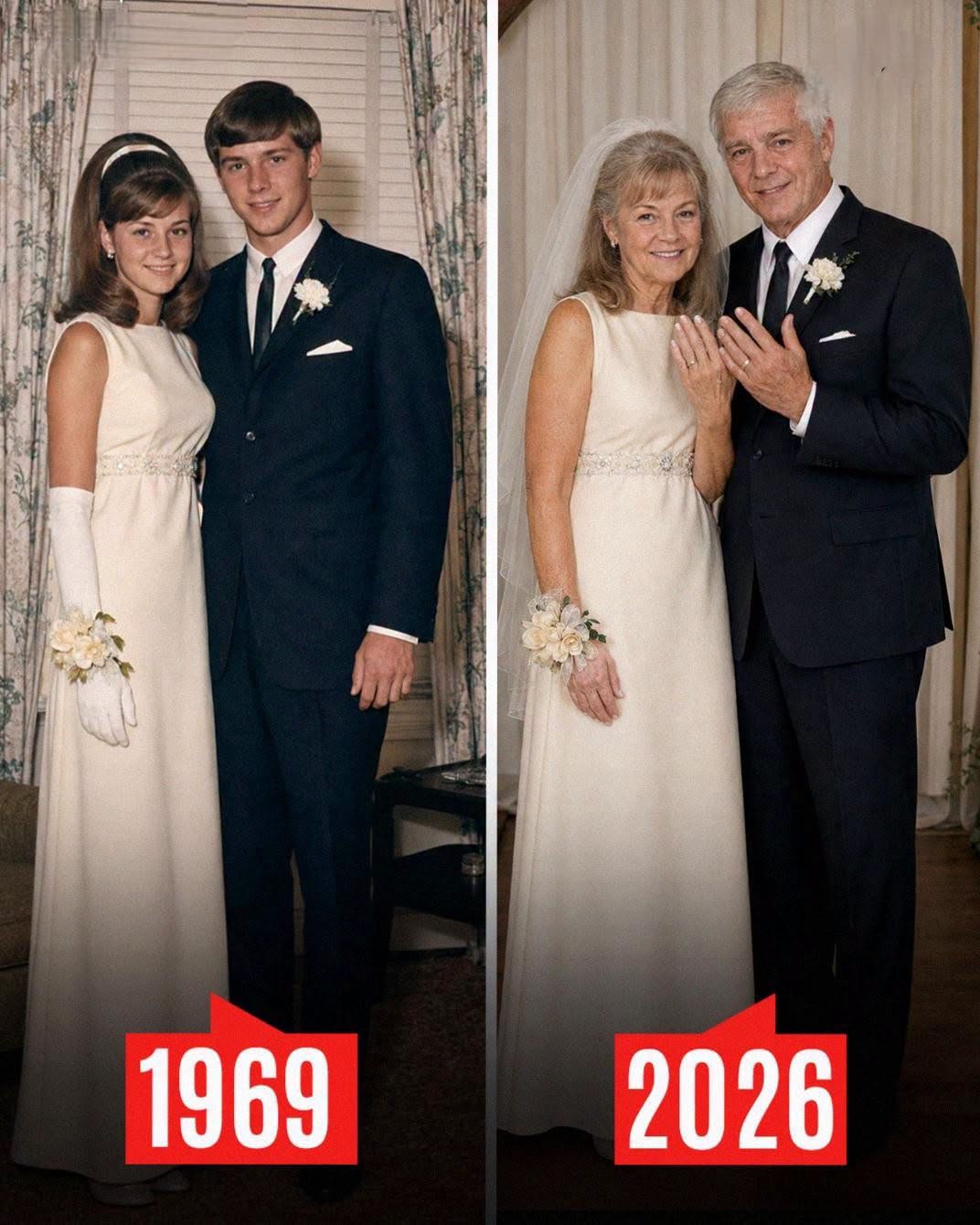
“I know how it sounds.”
“No,” I said. “You don’t understand. My father died twenty-eight years ago.”
“I know.”
“Then how could he have kept you from me?”
Daniel looked down at his hands.
“Because he started doing it before he died.”
I stood and walked toward the window.
Outside, the porch light illuminated the flowers our neighbors had brought after the wedding. There were still ribbons tied to the railing. Someone had left a small basket of bread beside the door.
Everything looked peaceful.
Everything felt completely wrong.
“My father told me you were dead.”
Daniel closed his eyes.
“I was told you believed I was dead.”
I turned around.
“Who told you that?”
He hesitated.
“Your father.”
My heart began pounding.
“Tell me everything.”
Daniel took a slow breath.
“I came home in 1971.”
The words seemed impossible.
I stared at him.
“You came home?”
“Yes.”
I gripped the back of a chair.
“But the military said you were missing.”
“I was missing for a long time. But eventually I was located and brought home.”
I remembered the day my mother had sat me down.
The phone call.
The silence afterward.
My father’s hand on my shoulder.
The words he’d chosen so carefully.
Daniel isn’t coming back.
I had been eighteen years old.
I had believed him.
Daniel continued.
“When I came home, I wasn’t the same person who had left.”
He didn’t elaborate, and I didn’t ask him to.
There were parts of his past I knew he carried quietly.
“I tried to contact you,” he said. “Several times.”
“Why didn’t I hear from you?”
“Because every time I did, something happened.”
He reached into the pocket of his jacket and pulled out a small envelope.
It was yellowed with age.
My name was written across the front.
I stared at the handwriting.
I knew it immediately.
My own name.
Written by Daniel.
“What’s that?”
“The first letter I sent you after I came home.”
My hands began to shake.
I took it from him.
“Why have you kept it all these years?”
“Because it came back to me.”
I looked at him.
“What do you mean?”
“It was returned.”
“Why?”
“Address unknown.”
I stared at the envelope.
“That was my house.”
“I know.”
He pulled out another.
Then another.
Then another.
There were seven.
Seven letters.
All addressed to me.
All unopened.
I sat down.
“Daniel…”
“I thought you’d moved.”
“I didn’t.”
“I thought you were angry.”
“I wasn’t.”
“I thought you had married someone else.”
“I didn’t.”
He looked at me.
“And eventually, I thought maybe you simply didn’t want me anymore.”
My eyes filled with tears.
“Daniel, I waited.”
He looked away.
“I waited too.”
For a moment, neither of us spoke.
Then I remembered something.
“My father always handled the mail.”
Daniel’s eyes lifted.
“What?”
I swallowed.
“When I was young, he insisted on checking the mailbox first. He said he was protecting me from bills and bad news.”
Daniel stared at me.
“Did he ever mention my letters?”
“No.”
I thought about it.
Then another memory surfaced.
A week after Daniel had supposedly died, my father had taken the prom dress from my bedroom.
He had folded it carefully.
I had asked him where he was taking it.
He told me I needed to stop living in the past.
I had thought he was trying to help me.
Now I wasn’t sure.
Daniel reached into another pocket.
“This is why I came here.”
He placed a folded piece of paper on the table.
It looked even older than the letters.
I unfolded it.
My father’s handwriting covered the page.
I recognized it immediately.
My eyes moved across the first few lines.
Then I stopped.
I couldn’t continue.
“What does it say?” Daniel asked.
I looked at him.
“You already know.”
“Yes.”
I forced myself to read.
My father had written that Daniel had returned home.
He had written that Daniel wanted to see me.
He had written that he had spoken to Daniel himself.
And then came the part that made my hands go cold.
My father had told Daniel that I had moved on.
That I had no interest in seeing him.
That I had asked my father to make sure Daniel never contacted me again.
I looked up.
“I never said this.”
“I know.”
“How?”
Daniel reached into the envelope and removed another piece of paper.
This one was addressed to him.
I recognized the handwriting again.
But this time, my father’s words were different.
He had written that I had been heartbroken after hearing Daniel was alive.
He had written that I was desperate to find him.
And then he had made an offer.
He told Daniel that if he truly loved me, he would leave me alone.
According to the letter, my father believed Daniel’s return would destroy my future.
He told Daniel that I was building a new life.
That I was engaged.
That I was happy.
That I had begged him not to let Daniel come back.
None of it was true.
I had never been engaged.
I had never asked my father to keep Daniel away.
I had never stopped loving him.
My entire life suddenly seemed to tilt beneath my feet.
“Why would he do this?”
Daniel looked at me.
“That’s the question I’ve spent fifty-five years trying to answer.”
I sat quietly.
Then I remembered something else.
My father had never liked Daniel.
Not because Daniel was cruel.
Not because he was irresponsible.
Quite the opposite.
My father thought Daniel was too ambitious.
He wanted me to attend college nearby, marry someone from our town, and stay close to home.
Daniel wanted to leave.
He wanted to travel.
He wanted a life bigger than the one we’d grown up imagining.
My father had called him reckless.
I had called it dreaming.
But there was something I had never understood.
My father had been afraid of losing me.
Not to another man.
To another life.
Daniel reached for my hand.
“I eventually stopped writing.”
I looked at him.
“Why?”
“Because I believed you didn’t want me.”
“And what did you do?”
“I tried to start over.”
He told me about the years that followed.
He moved from state to state.
He worked different jobs.
He built a quiet life.
He had married once, years after returning home.
The marriage had ended peacefully.
He never had children.
He told me that every few years he searched for my name.
But my surname had changed after I briefly married in my thirties.
The trail disappeared.
Then, decades later, a retired military clerk helped him locate an old record.
That record eventually led him back to our town.
And then to me.
“I found your address three months ago,” Daniel said.
“Three months?”
He nodded.
“Why didn’t you come immediately?”
He smiled sadly.
“Because I was terrified.”
That surprised me.
“Of me?”
“Of what I would find.”
I understood.
“What changed?”
Daniel looked toward the staircase leading to the attic.
“The dress.”
I froze.
“What about it?”
“The woman who helped me find you mentioned it.”
I stared at him.
“She knew about the dress?”
“She told me you’d kept it.”
Daniel’s voice softened.
“That was when I knew.”
“Knew what?”
“That you hadn’t forgotten.”
Tears slipped down my cheeks.
I looked toward the attic.
For fifty-five years, I had believed that dress represented a promise I had made to a boy who never came home.
Now I realized it had been a promise to a man who had been searching for me too.
Daniel stood.
“Come with me.”
“Where?”
“Upstairs.”
I followed him.
We climbed slowly.
When I opened the attic door, the familiar smell of old wood and cedar surrounded us.
The garment bag was still hanging from the same hook.
Daniel stopped.
For a moment, he simply stared at it.
Then he laughed softly.
“I can’t believe you kept it.”
“You told me to.”
He looked at me.
“I didn’t think you’d take me seriously.”
“I did.”
I unzipped the garment bag.
The ivory dress was still there.
A little more fragile.
A little more yellow than it had been in 1969.
But unmistakably the same.
Daniel reached toward it but stopped before touching the fabric.
“May I?”
I nodded.
His fingers brushed the sleeve.
His eyes filled with tears.
“I remember this.”
“So do I.”
He smiled.
Then his expression changed.
“What?”
He looked at the inside of the dress.
There was a tiny pocket sewn into the lining.
I had forgotten about it.
Daniel reached inside.
His fingers found something.
He pulled out a small folded piece of paper.
I stared at it.
“What is that?”
“I don’t know.”
He unfolded it.
My heart stopped.
It was a note.
The handwriting wasn’t my father’s.
It wasn’t Daniel’s.
It was my mother’s.
I hadn’t seen her handwriting in years.
Daniel read it silently.
Then he handed it to me.
There were only a few sentences.
My mother had written that she had discovered what my father was doing.
She had found Daniel’s returned letters.
She had found copies of the messages my father had sent him.
And she had confronted him.
According to her note, my father admitted that he had deliberately kept us apart.
But there was something else.
Something my mother had never told me.
She wrote that she had planned to tell me everything.
She had intended to give me the letters and explain what had happened.
But before she could, she became seriously ill.
She died less than a year later.
The note ended with one sentence:
“If you’re reading this, sweetheart, please know that Daniel never stopped trying to come home to you.”
I pressed the note against my chest.
Daniel put his arm around me.
For the first time that night, I cried without trying to stop myself.
Not because I was angry.
Not because I was heartbroken.
But because I was finally mourning something I had never understood I’d lost.
Years.
Decades.
A lifetime of moments that could have happened.
Christmas mornings.
Birthdays.
Ordinary Tuesday evenings.
Arguments about groceries.
Trips we might have taken.
Children we might have raised.
Grandchildren we might have spoiled.
All those tiny pieces of an ordinary life.
Gone.
And yet, somehow, Daniel was standing beside me.
After a while, I wiped my eyes.
“I’m angry with him.”
“I know.”
“I’m angry with myself too.”
“Don’t.”
“I believed him.”
“You were eighteen.”
I looked at Daniel.
“You were young too.”
“So were you.”
He took my hand.
“We were both given a story and told it was the truth.”
That sentence stayed with me.
We carried the letters downstairs.
Daniel spread them across the dining table.
Seven letters.
Fifty-five years old.
Seven attempts to find me.
I read them one by one.
The first was awkward.
The second was hopeful.
The third was desperate.
The fourth was short.
By the seventh, Daniel had stopped asking me to wait.
He simply wrote that he hoped I was safe.
That was the one that broke me.
Not because it demanded anything.
Because it didn’t.
He had loved me enough to let me go when he believed I wanted him gone.
I looked across the table.
“I’m sorry.”
“For what?”
“For all those years.”
Daniel shook his head.
“You didn’t do this.”
“No.”
I looked at the letters.
“But someone did.”
He nodded.
We sat there until almost sunrise.
Eventually, Daniel looked at his wedding ring.
The one he’d taken off earlier.
“Do you regret marrying me?”
I stared at him.
“After tonight?”
He looked nervous.
I smiled.
“No.”
His shoulders relaxed.
“I don’t either.”
Then I noticed something.
His wedding ring was slightly loose.
“Why are you wearing it like that?”
He laughed.
“Because I bought it before I knew your ring size.”
I laughed too.
For the first time that night, the heaviness lifted.
We had spent fifty-five years imagining a grand reunion.
There wasn’t one.
There were no fireworks.
No perfect explanation.
No way to recover the years we’d lost.
There was just an old house, a pile of letters, a fragile dress, and two people who had finally stopped living according to someone else’s version of their past.
A few months later, I had the attic cleaned.
I almost threw away the garment bag.
Then I changed my mind.
The dress stayed.
But I didn’t keep it hidden anymore.
I brought it downstairs and placed it inside a glass-front cabinet in our bedroom.
Daniel asked why.
“Because I’m done hiding it.”
He smiled.
“Good.”
Sometimes, I still think about the girl I was in 1969.
She had no idea what was coming.
She thought love meant keeping a promise.
She didn’t know that love could also mean surviving disappointment, misunderstanding, time, and circumstances neither person could control.
She certainly didn’t know that the boy she loved would one day return as an old man and knock on her door.
And she could never have imagined that the greatest mystery of her life wouldn’t be why Daniel disappeared.
It would be discovering that he hadn’t disappeared at all.
Someone had simply made sure neither of us knew where to look.
On our first anniversary, Daniel and I went back to the hill where we had said goodbye all those years ago.
We brought the old prom dress with us.
We didn’t wear it.
We simply unfolded it on the hood of the car and watched the evening light settle over the town.
Daniel took my hand.
“Do you ever wonder what would have happened if your father hadn’t interfered?”
“All the time.”
“Me too.”
I looked at him.
“Would you change everything?”
He thought for a moment.
Then he shook his head.
“I’d change what happened to us.”
He squeezed my hand.
“But I wouldn’t erase the life you lived.”
I smiled.
“Why not?”
“Because that woman became the person I found again.”
I looked at him.
“And you?”
He smiled.
“I became the man who finally came back.”
We sat there quietly.
Then Daniel leaned closer.
“I still owe you something.”
“What?”
He pointed toward the dress.
“You never got the wedding you were promised.”
I laughed.
“We just got married.”
“I know.”
He smiled.
“But you wore a different dress.”
I shook my head.
“You’re impossible.”
“Probably.”
He stood and offered me his hand.
“Come on.”
“Where?”
“Home.”
I looked at the dress.
Then at him.
And suddenly I understood something.
For fifty-five years, I had thought the dress was a reminder of the life I had lost.
It wasn’t.
It was proof that some promises survive even when people don’t know where to find each other.
I folded it carefully.
Daniel opened the car door for me.
And as we drove home together, I realized that sometimes the biggest mystery isn’t why someone left.
It’s how two people can spend an entire lifetime believing they lost each other—
only to discover that, somewhere beneath all the lies, letters, and lost years,
neither one of them had ever truly let go.