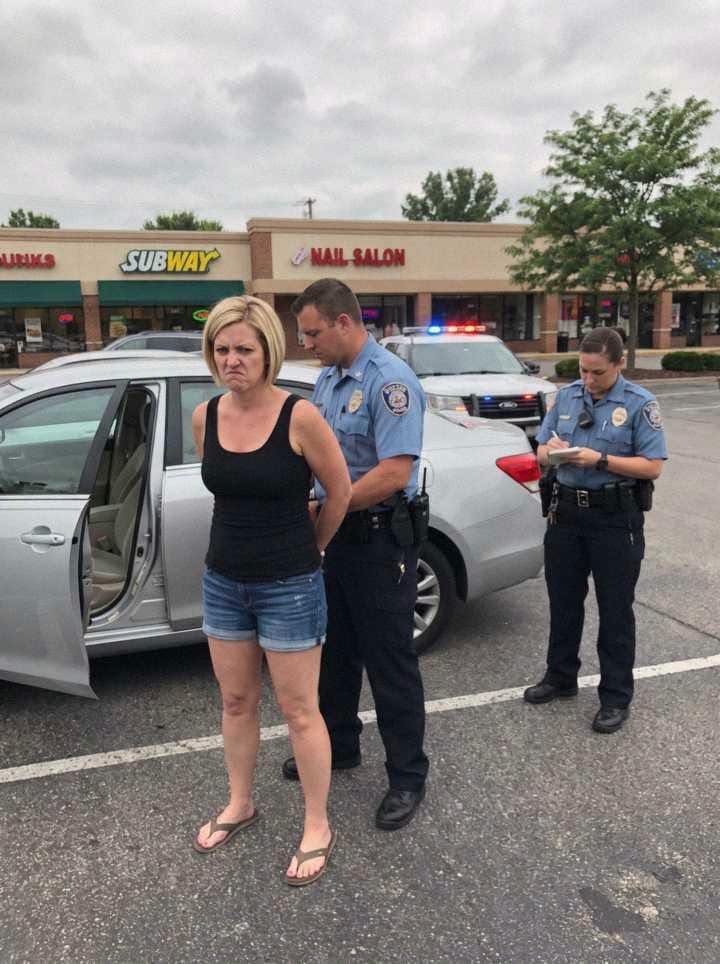
For several seconds, neither man said anything.
Victoria remained perfectly still.
“Now,” she said calmly, “look at the name.”
The first officer lowered his eyes.
His expression changed.
The second officer stepped closer.
“What is it?”
The first officer handed him the card.
The second officer read it.
His confidence disappeared almost immediately.
Victoria watched them carefully.
“You wanted to know why I wasn’t afraid,” she said.
The second officer swallowed.
“Who are you?”
Victoria gave him a tired look.
“You stopped me without explaining the reason. You demanded my documents. You tried to prevent me from recording what was happening. Then you detained me.”
She paused.
“And now you’re asking who I am?”
The first officer looked at the identification card again.
His partner leaned toward him.
“Maybe we should—”
“No,” Victoria interrupted. “Don’t suddenly change the subject.”
The first officer’s jaw tightened.
“What exactly do you think this card proves?”
Victoria smiled faintly.
“Nothing by itself.”
That answer clearly surprised them.
She continued.
“It proves who I work for. It doesn’t give me special privileges. It doesn’t put me above the law.”
The second officer stared at her.
“Then why did you ask us to take it out?”
“Because I wanted you to see it.”
“Why?”
“Because you refused to listen to anything I said.”
The first officer looked toward the patrol car.
Then back at Victoria.
“Take the cuffs off.”
His partner immediately turned toward him.
“What?”
“You heard me.”
Victoria didn’t move.
“Why?”
The officer looked uncomfortable.
“Because this situation has gone too far.”
Victoria’s expression hardened.
“No. It went too far several minutes ago.”
The officer reached for the handcuffs.
Victoria stepped away as soon as they were removed and rubbed her wrists.
She didn’t say anything.
She didn’t need to.
The silence itself seemed to make the officers uncomfortable.
Then the second officer finally asked the question that had clearly been bothering him.
“Are you an investigator?”
Victoria looked at him.
“Something like that.”
“What does that mean?”
“It means you should have asked questions before putting your hands on me.”
The first officer’s face became tense.
“You’re recording this?”
Victoria looked down at her phone.
“Yes.”
The second officer immediately glanced toward the vehicle.
“Your phone was—”
“Recording from the moment you approached my car.”
The two men looked at each other.
The first officer suddenly seemed much less certain of himself.
Victoria reached toward the phone, then stopped.
“My hands are still shaking,” she said. “So I’ll let you do the talking.”
The first officer frowned.
“What are you talking about?”
“You told me I was going to the station.”
He said nothing.
“So take me there.”
The second officer stared at her.
“Why would you want that?”
“Because if you believe you acted properly, you shouldn’t have anything to worry about.”
That sentence changed the atmosphere completely.
The officers had expected fear.
Instead, Victoria was asking them to explain their actions.
The first officer finally looked at the identification card again.
His voice was quieter when he spoke.
“You work with the state oversight office?”
Victoria nodded.
The second officer’s eyes widened.
“Internal affairs?”
“No.”
“Then what?”
“Civilian oversight and training.”
The officers became silent.
Victoria continued.
“I wasn’t conducting an investigation today. I was driving home.”
The first officer stared at her.
“Then why carry that?”
“Because it’s my job.”
She pointed toward the card.
“And because tomorrow morning I was scheduled to attend a meeting about complaints involving traffic stops.”
The second officer looked away.
Victoria noticed.
“Interesting timing, isn’t it?”
“Don’t make assumptions,” he said.
“I’m not.”
She picked up her phone.
“I’m looking at what happened.”
The first officer stepped closer.
Victoria immediately raised her hand.
“Stay there.”
He stopped.
For the first time since the traffic stop began, he seemed to understand that the situation had changed.
Not because Victoria had some secret power.
Not because her job made her more important than anyone else.
But because there were now questions that needed answers.
Why had they stopped her?
Why had they refused to explain?
Why had they escalated the encounter?
Why had they tried to stop her from recording?
And why had they detained her after she asked for the legal basis?
Victoria looked from one officer to the other.
“I want your names and badge numbers.”
The first officer hesitated.
Then he provided them.
The second officer did the same.
Victoria entered the information into her phone.
“Thank you.”
The first officer looked irritated.
“Are you filing a complaint?”
Victoria looked at him.
“I haven’t decided.”
He seemed relieved for half a second.
Then she added:
“But I will be preserving the recording.”
His expression fell again.
The second officer suddenly pointed toward her vehicle.
“Your documents are still on the roof.”
Victoria walked over and collected them.
Her hands were still trembling slightly.
She checked her license.
Then the vehicle documents.
Everything was there.
She looked at the officers.
“Am I free to leave?”
The first officer took a breath.
“Yes.”
Victoria opened the driver’s door.
Then she stopped.
She turned around.
“One more thing.”
Neither officer answered.
“You should remember that people don’t need to be experts in the law to deserve basic respect.”
The second officer looked down.
Victoria continued.
“Someone who is nervous during a traffic stop isn’t necessarily guilty. Someone who asks questions isn’t necessarily being difficult. And someone who records an interaction isn’t automatically your enemy.”
The first officer looked at her.
“We were doing our job.”
Victoria nodded.
“Then do it properly.”
She got into her car.
The officers remained beside their patrol vehicle as she started the engine.
Victoria didn’t drive away immediately.
Instead, she lowered the window.
“I hope you both take this seriously.”
Then she drove off.
The Following Morning
Victoria arrived at work earlier than usual.
She placed her phone on the desk and transferred the recording to a secure system.
Then she sat quietly for several minutes.
She had spent the entire drive home thinking about what had happened.
She knew that many officers performed difficult work under stressful conditions.
She also knew that authority came with responsibility.
A routine traffic stop should not become a contest of pride.
And a citizen asking why they had been stopped should not automatically be treated as a threat.
Victoria eventually walked into the conference room.
Several colleagues were already there.
One of them looked at her.
“You look exhausted.”
“I had an interesting drive home.”
“What happened?”
Victoria placed the phone on the table.
“I was stopped.”
Her colleague smiled.
“That’s not exactly unusual.”
Victoria looked at her.
“Two officers detained me without clearly explaining why.”
The room became quiet.
“Are you serious?”
Victoria nodded.
She played the recording.
Nobody interrupted.
They listened to the entire exchange.
When it ended, one of the senior officials leaned back in his chair.
“Do you know who they were?”
Victoria gave him their names.
The room became even quieter.
One colleague immediately opened a database.
A few moments later, she looked up.
“They’re assigned to the same district that has received several complaints recently.”
Victoria’s expression changed.
“Complaints about what?”
“Traffic-stop conduct.”
Victoria looked at the phone.
She suddenly understood why the incident had bothered her so much.
It wasn’t simply about what happened to her.
It was about how easily someone without her professional knowledge might have responded.
Someone might have been too frightened to ask questions.
Someone might not have known they could document the interaction.
Someone might have accepted the officers’ explanation simply because they were wearing uniforms.
Victoria leaned forward.
“Then this needs to be reviewed.”
Her colleague nodded.
“It will be.”
What Happened to the Officers?
The review did not happen overnight.
The recording had to be examined alongside patrol records, dispatch information, body-camera footage, and the officers’ written reports.
That process mattered.
Victoria didn’t want anyone punished simply because she had made a complaint.
She wanted the facts established.
Several days later, she received an update.
The officers had been removed from traffic-stop duties while the investigation continued.
Their supervisors had also discovered discrepancies between the officers’ written account and the available recordings.
Victoria wasn’t surprised.
But she wasn’t celebrating either.
The situation was more serious than she had initially realized.
The investigation eventually concluded that the stop had not been properly justified and that the officers’ conduct during the encounter had violated department procedures.
The department announced disciplinary action and required additional training.
The case also prompted a broader review of traffic-stop procedures in the district.
Victoria read the report carefully.
Then she closed it.
Her colleague looked at her.
“How do you feel?”
Victoria thought about the question.
“Relieved.”
“Not angry?”
“I was angry.”
She looked toward the window.
“But anger isn’t the point.”
“What is?”
“Making sure the next person doesn’t have to go through the same thing.”
A Month Later
Victoria was driving home again when she noticed a patrol car behind her.
For a brief moment, her stomach tightened.
The flashing lights came on.
She pulled over.
The officer approached her window.
“Good evening. The reason I stopped you is that one of your rear lights appears to be out.”
Victoria nodded.
“Okay.”
The officer explained what he had observed and asked for her documents.
She handed them over.
The interaction was calm.
Professional.
Ordinary.
Before leaving, the officer returned the documents.
“Thank you for your cooperation.”
Victoria smiled.
“Thank you for explaining the reason for the stop.”
The officer nodded.
Victoria watched him return to his vehicle.
Then she drove away.
She knew one unpleasant encounter couldn’t define every police officer.
And she knew that accountability wasn’t about treating every officer as an enemy.
It was about making sure authority was exercised responsibly.
As she drove down the country road, Victoria thought about the little identification card still sitting in her wallet.
It hadn’t magically saved her.
It hadn’t given her special rights.
What changed the situation was something much simpler.
There was a record.
There were questions.
And there were procedures designed to determine what had actually happened.
The small card had simply reminded the officers that the person they were dealing with knew how important those things could be.
Victoria eventually reached home.
She parked in the driveway, turned off the engine, and sat quietly for a moment.
Then she looked at herself in the rearview mirror.
The entire incident had started with two flashing lights behind her.
It ended with a lesson she would remember for years.
A uniform can represent authority.
But authority doesn’t remove the need for fairness.
And sometimes, the most important thing a person can do when a situation becomes confusing isn’t to shout or fight.
It’s to stay calm, document what happens, ask reasonable questions, and let the facts speak for themselves.