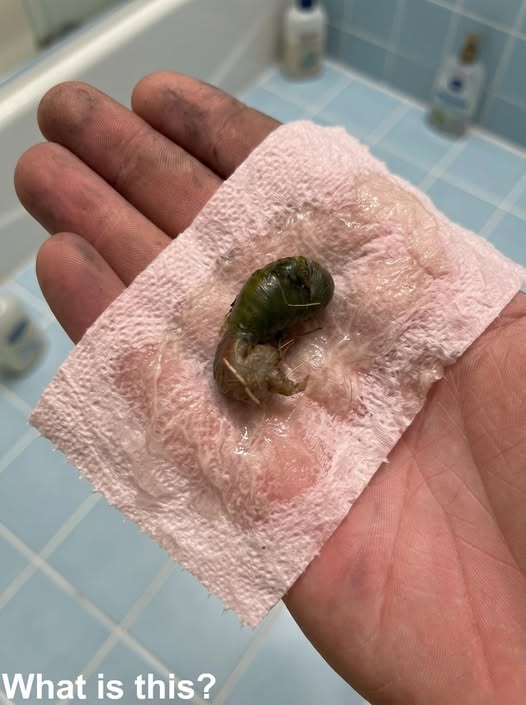
“No idea.”
We were used to finding ordinary things around the house—dust, bits of leaves, the occasional insect that had somehow made its way indoors.
But this looked different.
Its unusual shape immediately caught our attention.
We didn’t want to pick it up before knowing what it was, so we kept our distance and tried to work out where it might have come from.
My husband suggested that it could be part of a plant or something that had accidentally been carried indoors.
I wondered whether it might be an insect.
Neither explanation seemed completely convincing.
So instead of guessing, we decided to take a closer look without disturbing it.
The more we examined it, the more questions we had.
Had it come through a window?
Could it have been brought inside on clothing?
Was it something that had been hiding unnoticed for several days?
We eventually took a clear photograph and searched for similar images online.
Within minutes, we had an answer.
And it was far less alarming than we had imagined.
The object was a beetle pupa, a stage in the insect’s life cycle between the larval and adult stages.
In other words, we hadn’t discovered anything mysterious or dangerous.
We had simply encountered a small part of an insect’s natural development.
The discovery made us laugh at how quickly our imaginations had gotten ahead of the evidence.
Something unfamiliar can seem much more concerning when we don’t know what we’re seeing. Once we understood what the object actually was, the mystery disappeared.
Why Did It Appear Indoors?
Finding an insect or its developmental stage inside a home isn’t necessarily unusual.
Small insects can occasionally enter through open doors, windows, gaps, or other openings. They can also be carried indoors accidentally on clothing, plants, firewood, or other objects.
Depending on the species, a beetle may spend part of its life cycle hidden in soil, vegetation, wood, or another sheltered environment.
That means an unexpected discovery doesn’t automatically indicate a serious household problem.
What Should You Do If You Find Something Similar?
The simplest approach is to avoid handling an unfamiliar object immediately.
If it’s safe to do so, take a photograph and try to identify it using a reliable identification resource. You can also ask a local pest-control professional, naturalist, or other qualified expert if you’re unable to determine what you’ve found.
If you believe the object could be hazardous, avoid direct contact and seek appropriate professional advice.
Most importantly, don’t rely on a frightening guess simply because something looks unfamiliar.
A Small Lesson From a Strange Discovery
Our unexpected visitor turned out to be nothing more than a small part of nature’s life cycle.
The experience was a useful reminder that appearances can be misleading. Something that initially seems strange or alarming may have a perfectly ordinary explanation.
The next time we find something unusual around the house, we’ll probably still be curious.
But we’ll also remember one simple lesson:
Before assuming the worst, find out what you’re actually looking at.
Sometimes the most surprising discoveries aren’t dangerous at all.
They’re simply small pieces of the natural world appearing where we least expect them.