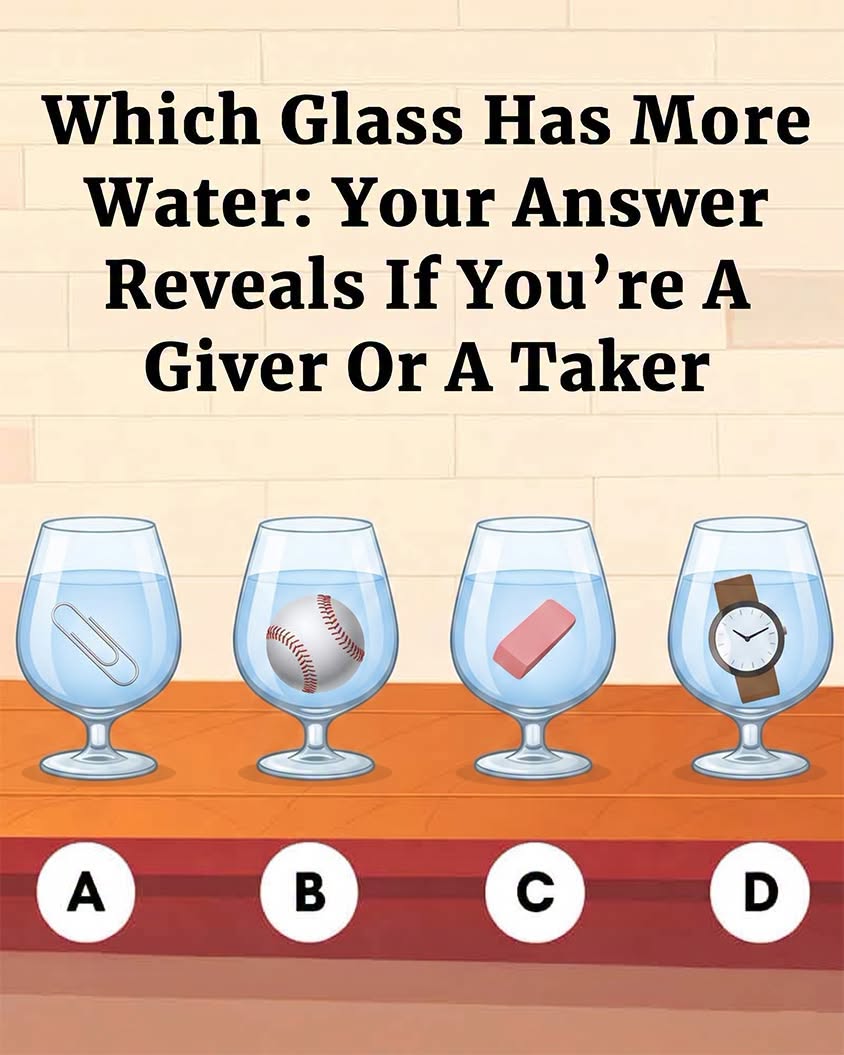
Your first instinct might be to choose the glass with the smallest object. And from a scientific perspective, that is a reasonable answer.
But the puzzle becomes more interesting when we consider what your choice might say about the way you approach problems.
The Science Behind the Puzzle
The answer begins with a basic principle of physics called displacement.
When an object is placed into water, it takes up space. As a result, the amount of water that can fit into the container decreases according to the volume of the submerged object.
That means two glasses can appear to have the same water level while actually containing different amounts of water.
If the glasses are otherwise identical and the objects are submerged to the same extent, the glass containing the smallest object would generally contain the greatest amount of water.
The larger the object, the more space it occupies and the less room remains for the water.
So, assuming the objects are fully submerged and the glasses have the same dimensions:
- Paperclip: occupies very little space.
- Eraser: takes up more space than the paperclip.
- Watch: occupies somewhat more space, depending on its design.
- Baseball: takes up considerably more volume.
This makes the puzzle a fun example of how appearances can be misleading.
But What About Personality?
This is where the puzzle moves from science into entertainment.
There is no scientific rule saying that choosing a particular glass proves someone is a “giver,” “taker,” “realist,” or any other personality type.
However, puzzles like this can be useful as reflection exercises.
The answer you choose may simply reveal what you noticed first or how you approached the question.
If You Chose the Paperclip
Perhaps you focused on the smallest object and immediately thought about displacement.
That could suggest that you tend to pay attention to details that other people might overlook.
You may enjoy solving problems by breaking them into smaller pieces rather than focusing only on what appears most important.
If You Chose the Baseball
Maybe the largest object caught your attention first.
That doesn’t mean you’re selfish or a “taker.”
It may simply mean that you naturally notice the most obvious feature in a visual puzzle.
You might prefer to identify the biggest factor in a situation before worrying about the smaller details.
If You Chose the Eraser
The eraser can make the puzzle a little harder because it sits somewhere between the smallest and largest objects.
Choosing it might simply mean that you were comparing several possibilities before making your decision.
That kind of approach can be useful when a problem doesn’t have an obvious answer.
If You Chose the Watch
Perhaps the watch made you think about something other than size.
Maybe you considered its shape, how much of it was submerged, or even the fact that a watch represents time.
There is no wrong personality interpretation here.
You may simply have approached the puzzle from a different perspective.
The Important Part: Your Answer Isn’t a Personality Test
It’s tempting for online puzzles to claim that one answer reveals your “true personality.”
Real personality is much more complicated.
A single choice in a visual puzzle cannot determine whether someone is generous, selfish, ambitious, cautious, optimistic, or anything else.
Our decisions are influenced by experience, mood, attention, expectations, and the information available at the moment.
That’s what makes these puzzles fun: they encourage us to notice how we think without pretending that one answer defines who we are.
Why These Puzzles Are So Interesting
The real lesson may have less to do with personality and more to do with perspective.
At first, you might look only at the water levels.
Then you notice the objects.
Then you realize that the objects change the amount of space available inside each glass.
A simple picture suddenly becomes a small physics problem.
That shift in perspective is valuable beyond puzzles.
Sometimes a situation looks confusing because we’re focusing on the wrong detail. Changing the question we ask can completely change the way we understand the problem.
So, Which Glass Has More Water?
If all four glasses have identical dimensions, the objects are fully submerged, and the water reaches the same level, the glass containing the smallest-volume object will generally contain the most water.
In the example above, that would likely be the glass containing the paperclip.
But there is another question worth asking:
Why did you choose the glass you chose?
Did you immediately think about physics?
Did you focus on the largest object?
Did you compare all four possibilities?
Or did you simply make a quick guess?
There isn’t necessarily a deeper psychological meaning behind your answer.
Sometimes a puzzle is simply a puzzle.
And sometimes, the most interesting part isn’t discovering what your answer supposedly says about you.
It’s discovering that something that looked obvious at first wasn’t quite as simple as it seemed.