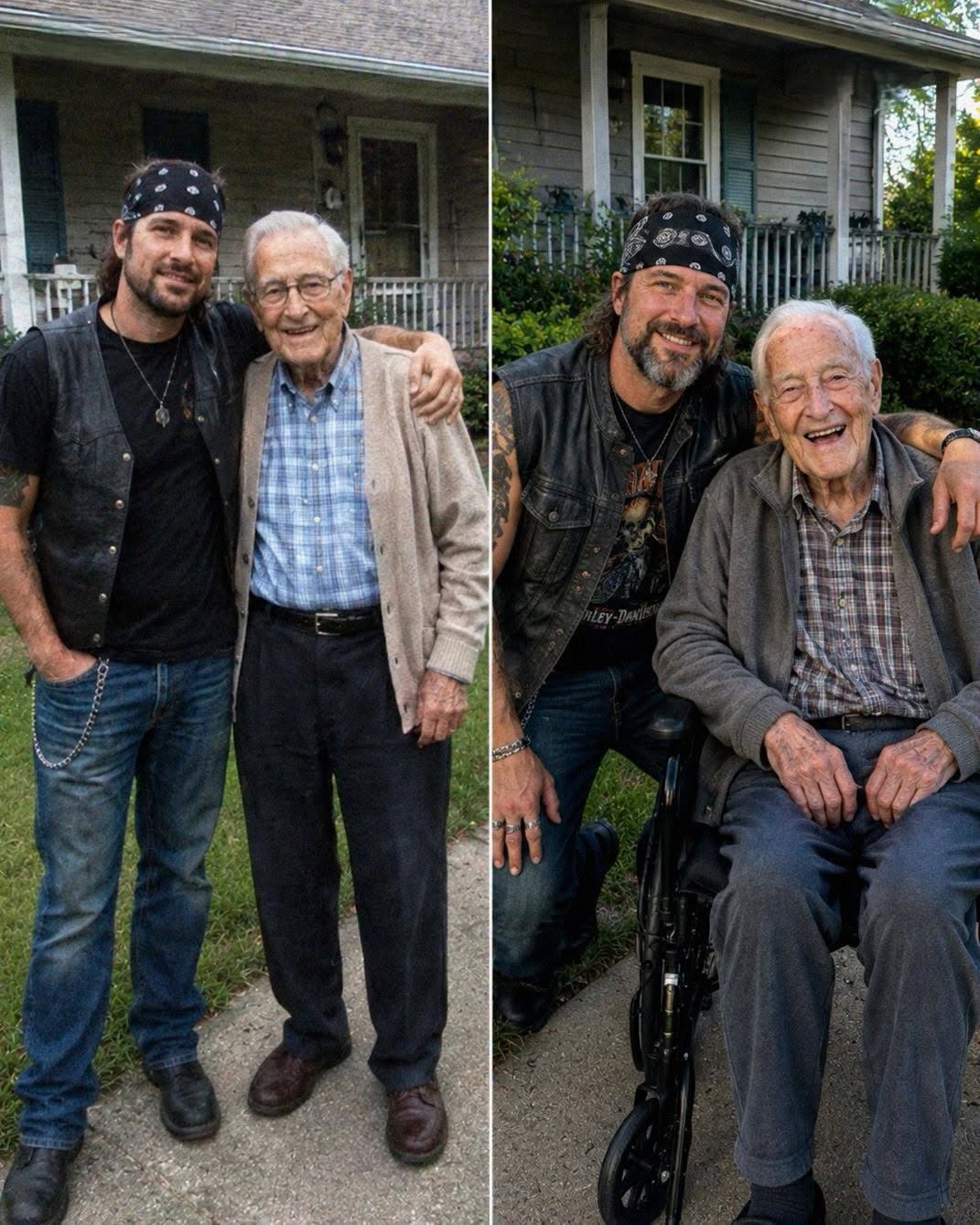
Why would he leave this to me?
And more importantly, why had he specifically instructed his lawyer to hand it to me after his funeral?
My hands were still trembling when I opened the first clasp.
Inside was a neatly folded sweater.
Beneath it were several envelopes.
The first one had my name written across it.
Anthony.
I recognized Ezra’s handwriting immediately.
I sat down.
For a moment, I couldn’t bring myself to open it.
Then I carefully unfolded the letter.
The first sentence made me stop breathing.
“If you’re reading this, then I didn’t get the chance to tell you what your Sunday visits truly meant to me.”
I read it again.
Then I continued.
Ezra wrote that when I first helped him with those grocery bags twelve years earlier, he had been going through one of the loneliest periods of his life.
His wife had died years before.
His closest friend had moved away.
His health was beginning to decline.
And although he lived in a neighborhood surrounded by people, he had started feeling invisible.
Then I had knocked on his door.
Not because I knew anything about his life.
Not because I expected anything in return.
I had simply seen an older man struggling with grocery bags and stopped to help.
According to Ezra, that small moment had changed his entire week.
Then his entire routine.
And eventually, his life.
I wiped my eyes.
But the letter continued.
There was something else he wanted me to know.
Something he had kept secret.
I reached into the suitcase and found another envelope.
This one was much older.
The handwriting wasn’t Ezra’s.
It was written in blue ink, with a date from nearly thirty years earlier.
I opened it carefully.
Inside was a photograph.
Ezra stood beside a much younger man.
I stared at the picture.
The other man looked strangely familiar.
I turned the photograph over.
There was a handwritten note on the back.
“My brother Daniel and the man who gave me a second chance.”
I frowned.
I had never heard Ezra mention a brother named Daniel.
I searched through the suitcase.
There were more photographs.
Ezra as a young man.
Ezra standing outside a small factory.
Ezra beside a woman who I assumed was his wife.
And then I found something that made my heart race.
A newspaper clipping.
The headline described a young employee who had prevented a serious workplace accident and helped several coworkers escape safely.
The employee’s name was Daniel Harrison.
Ezra’s brother.
I kept reading.
Daniel had apparently suffered a serious injury during the incident.
The story explained that he had later struggled financially and had been unable to return to his previous work.
But there was another name mentioned in the article.
A local business owner who had helped Daniel find employment and supported his family during his recovery.
I recognized the surname immediately.
It was my surname.
I stared at the clipping.
That couldn’t be a coincidence.
My father had the same surname.
I searched the suitcase again, this time more urgently.
At the bottom was a small wooden box.
Inside was a collection of documents.
One was an old photograph of my father.
I froze.
My father was standing beside Ezra.
I had never seen that photograph before.
There was another letter beneath it.
This time, Ezra had written directly about my family.
He explained that decades earlier, my father had helped his brother Daniel during a difficult period.
He had given Daniel work when other employers wouldn’t.
He had helped him rebuild his life.
And Ezra had never forgotten it.
But that still didn’t explain why he had kept this secret from me.
I found the answer in the final pages of his letter.
Ezra had discovered years earlier that my father had passed away without ever telling me about the connection.
He had considered reaching out.
But he decided against it.
He didn’t want our friendship to become an obligation.
He didn’t want me to feel as though my Sunday visits were repayment for something my father had done.
So he said nothing.
Instead, he waited.
And over the years, something unexpected happened.
The relationship that had begun because of an old connection became completely independent of it.
I wasn’t helping Ezra because my father had once helped his brother.
I was helping him because he had become my friend.
I put the letter down.
For several minutes, I couldn’t move.
Then I noticed another envelope.
This one was labeled:
“Open only after you’ve read everything else.”
My heart began pounding.
I opened it.
Inside was a simple note.
“Anthony, there is one final thing I want you to understand.”
Ezra explained that the suitcase contained documents, photographs, and several personal belongings.
But none of them were the real gift.
He had arranged for his lawyer to place the suitcase in my hands because he wanted me to understand something he had learned late in life.
People often think the most important things they leave behind are money, houses, or possessions.
Ezra didn’t believe that anymore.
He believed the most valuable thing a person could leave behind was evidence that they had mattered to someone.
Then I reached the final paragraph.
I read it twice.
Ezra had left instructions for his lawyer to make a modest donation in my name to a local community program that provided groceries and companionship to older adults who lived alone.
He had funded it with part of his savings.
But there was a condition.
He wanted me to decide whether I would continue helping with it.
I stared at the page.
I understood immediately.
The grocery trips weren’t supposed to end with his funeral.
Ezra wanted the kindness to continue.
Not because he expected me to spend every Sunday shopping for strangers.
Not because he wanted me to become responsible for other people’s lives.
He simply wanted the small act that had once changed his own life to have the opportunity to reach someone else.
I closed my eyes.
I remembered our first Sunday.
The grocery bag falling onto the driveway.
Ezra looking embarrassed.
Me laughing and telling him he should call me next time.
Neither of us could have known where that moment would lead.
The following Sunday, I went back to the grocery store.
I bought the usual things.
Bread.
Milk.
Fruit.
Coffee.
Then I added a few items I remembered Ezra always keeping in his kitchen.
For a second, I stood in the aisle smiling at myself.
There was nowhere to deliver them.
Then I remembered the letter.
I drove to the community center named in Ezra’s instructions.
A volunteer was organizing food packages for older residents.
I handed over the bags.
“These are from the Harrison fund,” I said.
The woman smiled.
“Thank you.”
I almost walked away.
Then I noticed an elderly man sitting alone near the window.
He was holding a grocery list.
I hesitated.
“Do you need any help with that?”
He looked up.
“Actually, yes.”
I smiled.
And for the first time since Ezra’s funeral, I felt the ache in my chest ease.
Weeks later, I returned to Ezra’s old house.
The new owners hadn’t moved in yet.
I stood outside for a while, looking at the porch where I had spent countless Sunday afternoons.
I remembered Ezra sitting in his chair with his coffee.
I remembered his stories.
His terrible jokes.
The way he always pretended he didn’t need help carrying anything.
And I remembered the suitcase.
The thing that had frightened and confused me when I first opened it hadn’t been money or some shocking family secret.
It had been something much more valuable.
A history.
A friendship.
A reminder that kindness can travel through generations without anyone realizing it.
My father had helped Ezra’s brother.
Years later, I had helped Ezra.
And now Ezra had given me a reason to help someone else.
Three people.
Three generations.
One simple act of kindness connecting them all.
I never saw Ezra again.
But every Sunday, I still think of him.
Sometimes I buy groceries for someone who needs them.
Sometimes I sit and listen to an older person tell a story I’ve heard before.
And sometimes I simply stop when I see someone struggling.
Because Ezra taught me something I never expected to learn from a battered suitcase.
You may never know how much a small act means to someone else.
You may never see where it leads.
And you may never realize that something as ordinary as carrying a few grocery bags can become part of a story that lasts far beyond your own lifetime.
The suitcase is still in my closet.
I kept the photographs.
I kept the letters.
And I kept the old grocery list Ezra had tucked inside one of the envelopes.
At the top, in his familiar handwriting, were five words:
“Don’t forget the people nearby.”
I haven’t.
Not since that Sunday twelve years ago.
And I never will.