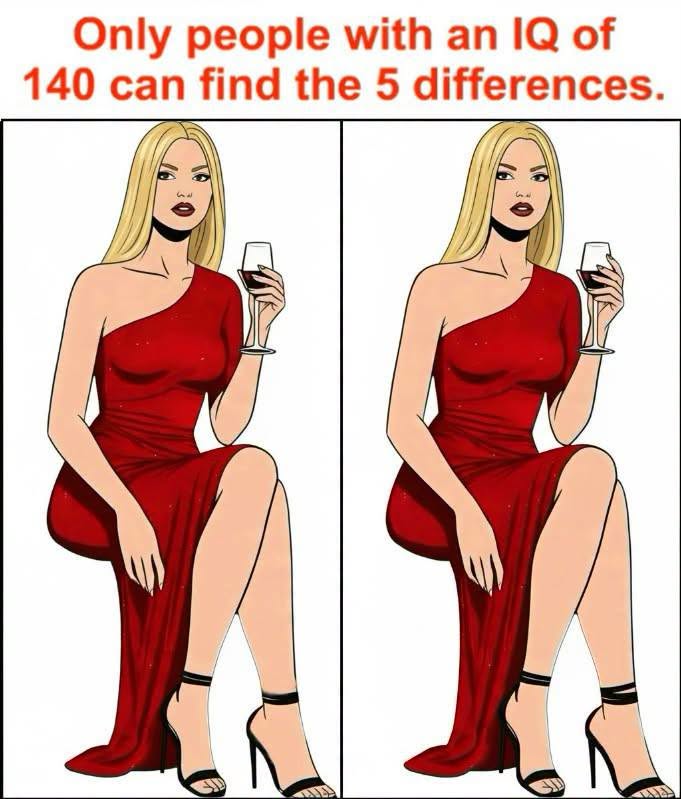
Can You Find All 5 Differences? This Puzzle Is Designed to Fool Your Eyes
At first glance, there is absolutely nothing wrong with these two pictures.
They look identical.
Same colors.
Same objects.
Same background.
Same tiny details.
But look again.
Hidden somewhere between them are five differences.
And here’s the frustrating part: once you finally notice one, you may wonder how you missed it in the first place.
So forget the distractions.
Forget the comments.
Forget the answer key.
Can you find all five before you give up?
Your Brain Is Already Trying to Trick You
Spot-the-difference puzzles seem easy because your brain is built to recognize patterns quickly.
When you see two nearly identical scenes, your mind doesn’t carefully inspect every pixel.
Instead, it takes shortcuts.
It recognizes the overall picture and essentially says:
“I’ve seen this before. They’re the same.”
That’s extremely useful in everyday life.
But in a visual puzzle, that shortcut can work against you.
The difference you’re searching for might be sitting in an area you’ve already examined—and your brain may still be automatically filling in what it expects to see.
Five Tiny Changes Are Hiding Somewhere
The challenge isn’t about finding something obvious.
A missing object would be too easy.
Instead, the differences may involve tiny details:
A shape.
A line.
A color.
A pattern.
A small object in the background.
Something that appears perfectly normal until you compare it with the other image.
That’s why rushing usually doesn’t help.
Your eyes can move quickly while your attention remains surprisingly shallow.
Try This Strategy
If you’re struggling, don’t randomly bounce between the two pictures.
Use a system.
Start at the top-left corner.
Move slowly across the image from left to right.
Then drop down one section and scan back across.
Continue until you’ve covered the entire picture.
Think of it as dividing the image into an invisible grid.
Check These Areas Carefully:
1. Background objects
Small details behind the main subject can be surprisingly easy to overlook.
2. Edges and corners
Your attention naturally gravitates toward the center, which makes the edges perfect hiding places.
3. Repeating patterns
Look at windows, stripes, decorations, leaves, shapes, or anything that repeats.
4. Colors
A tiny color change can be much harder to notice than a missing object.
5. Symmetry
If two objects are supposed to match, compare them carefully.
Don’t assume they’re identical just because they look similar.
Don’t Trust the “Genius IQ” Claims
You’ve probably seen puzzles claiming that only people with a certain IQ can solve them.
Those numbers make great headlines.
But spotting differences isn’t a reliable way to measure someone’s IQ.
Your performance can depend on plenty of ordinary factors, including concentration, eyesight, screen size, image quality, familiarity with visual puzzles, and how much time you spend searching.
So don’t worry about proving you’re a genius.
This is simply a test of observation.
And observation is a skill that gets better when you slow down and pay attention.
The First Few Are Usually the Easy Ones
Keep reading…