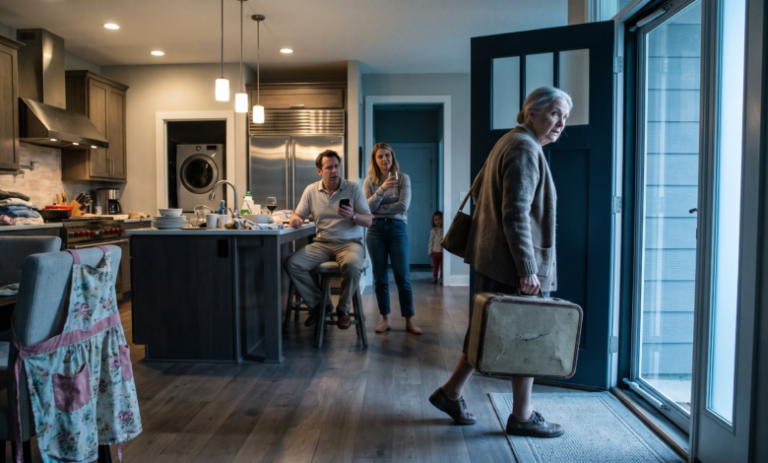
When I stepped onto the porch, I expected to feel uncertain.
Instead, I felt calm.
It reminded me of the mornings I used to spend on my own porch in Hudson, drinking coffee while the sunlight reached the wooden steps.
For three months, I had lived in a house that was supposed to feel like family.
But I had gradually begun to feel more like a helper than a member of the household.
Now I was leaving.
And strangely, leaving felt like the beginning of something rather than the end.
I placed my suitcase beside me and took out my phone.
There was one person I wanted to call.
Margaret.
My old neighbor.
She had known me for twenty years. She knew David, our home, our routines, and the life we had built there.
She answered quickly.
“Eleanor?”
Her voice immediately made me smile.
“I was just thinking about you.”
“That’s funny,” I said. “I was thinking about you too.”
She paused.
“What happened?”
I looked back at Michael’s house.
“I’m coming home.”
There was silence.
“Your house?”
“Yes.”
“But Eleanor…”
“I know.”
My house was supposed to be gone.
I had signed the sale documents months earlier.
But there was something Margaret didn’t know.
Something Michael didn’t know either.
When I had decided to sell my home, I had taken the time to review every part of the agreement carefully.
David had always taught me to plan ahead.
He used to say:
“Love people with your heart, Eleanor. But protect yourself with your mind.”
I used to laugh whenever he said it.
But after he passed away, I understood why he had always kept important documents organized.
Accounts.
Receipts.
Legal papers.
Property records.
Everything had a place.
And before selling my house, I had made sure the agreement included a period during which certain parts of the transaction could still be reconsidered.
I had never mentioned those details to Michael because he had never asked.
He was focused on when I could move in.
I had been focused on whether I was ready to leave the home I had shared with David.
Those were very different questions.
That night, I stayed at a small hotel near town.
It wasn’t fancy, but it was comfortable.
The quiet felt wonderful.
I placed David’s photograph on the nightstand.
“You would have had a lot to say about all of this,” I whispered.
I smiled.
“You probably would have noticed the problem long before I did.”
The next morning, I woke before sunrise.
I made coffee from the small machine in the room.
It wasn’t very good.
I laughed.
“David would have complained about this.”
Then I packed my suitcase and headed back to my neighborhood.
When I arrived, I saw familiar streets, maple trees, and the bakery on the corner.
Everything looked almost exactly as I remembered it.
Margaret was waiting outside.
She hugged me as soon as she saw me.
“Oh, Eleanor.”
I nearly cried.
Not because I regretted leaving Michael’s house.
Because someone was genuinely happy to see me.
Inside my old house, furniture sat beneath protective sheets.
Dust covered some of the surfaces.
But I smiled.
This was my home.
My memories.
My responsibility.
My choice.
I walked into the kitchen and ran my hand across the wooden counter.
The same counter where David used to make pancakes on Sunday mornings.
“I’m back,” I whispered.
Then I noticed a small envelope.
My name was written on it.
Eleanor.
I recognized the handwriting immediately.
David’s handwriting.
I picked it up carefully.
There was no way the letter could have been written recently.
David had been gone for five years.
I opened the envelope.
Inside was a letter and several documents.
The first sentence made me pause.
“My dear Eleanor, if you are reading this, something may have happened that made you question where you belong.”
I sat down.
David had written the letter years earlier.
Before Michael called me.
Before I sold the house.
Before I moved in with my son.
Before any of the recent disagreements.
I continued reading.
“I know our son loves you. But sometimes people we love become accustomed to receiving our help. That does not mean you have to give more than you can comfortably give.”
Tears filled my eyes.
David had not predicted the future.
He had simply understood that people sometimes needed reminders about boundaries.
The next paragraph explained that he had arranged several financial and legal safeguards for me.
I looked at the documents.
A trust.
A protected account.
Property-related paperwork.
One sentence stood out:
“The beneficiary, Eleanor Whitmore, shall maintain full control and ownership of the assets placed under this trust.”
I read it again.
The assets were mine.
The decisions were mine.
The responsibility was mine.
And that meant I still had choices.
For months, I had allowed myself to believe that moving in with Michael meant becoming dependent on him.
David’s letter reminded me that independence was not something I had lost simply because I had accepted help from family.
I continued reading.
“Eleanor, if our son ever needs help, help him because you choose to, not because you feel obligated. There is a difference between love and surrendering your independence.”
I closed my eyes.
Those words felt like advice from the past arriving exactly when I needed it.
I had spent years making sure everyone else had what they needed.
Now I needed to make sure I had a place in my own life too.
Margaret returned to the kitchen and found me looking through the documents.
“Are you all right?”
I smiled.
“I think I will be.”
She looked at the papers.
“What does all this mean?”
I folded the documents carefully.
“It means I have more options than I thought.”
Meanwhile, Michael was realizing that I might not return.
At first, he assumed I simply needed some time.
One hour passed.
Then two.
Then midnight.
Still nothing.
Jessica sat on the couch.
“She’ll calm down,” she said.
Michael looked toward the room where I had been staying.
For the first time, he noticed how little space I had.
He remembered how I had smiled when I arrived and said:
“Don’t worry. I don’t need much.”
He had accepted those words without thinking about what I actually deserved.
Michael picked up his phone and called me.
No answer.
He called again.
Still nothing.
For years, I had answered whenever he called.
Now he began to understand that things were different.
The next morning, Michael received a notification from his bank.
A scheduled financial transfer involving an account to which he had previously been given access had been canceled.
He stared at the screen.
Then another notification appeared.
The access permissions had been updated.
He called the bank.
After verification, the representative explained that the changes had been made by the account owner.
“My mother?”
“Yes.”
Michael went quiet.
Months earlier, he had convinced me to allow him to help organize some of my finances.
He had said it would make things easier.
Now those permissions had been removed.
Michael remembered the lawyer who had helped me with my paperwork.
The lawyer had warned me to keep control of my accounts and make decisions carefully.
At the time, I had believed my family would always respect my trust.
Now I understood why those safeguards mattered.
Michael ended the call.
Jessica looked at him.
“What happened?”
“My mom changed her financial arrangements.”
“What does that mean?”
Michael looked toward the window.
“It means she’s making her own decisions.”
For the first time, he began to understand that I might not return simply because he expected me to.
Three days later, I returned to my old house.
The windows were open.
Fresh air moved through the rooms.
My rocking chair was back on the porch.
My coffee cup sat beside it.
I felt like I was rebuilding something important.
Then my phone rang.
Michael.
I let it ring.
After several attempts, he sent a message.
“Mom, please. We need to talk.”
I stared at the screen.
A month earlier, those words might have made me immediately return.
Now I simply took a breath.
I wasn’t closing the door forever.
I was giving myself time to decide what kind of relationship we could have moving forward.
And that decision would be based on respect, not obligation.
PART 5
I stared at Michael’s message for several minutes.
“Mom, please. We need to talk.”
Once, I would have immediately called him back.
I had spent much of my life believing that being a good mother meant always being available.
But I had learned something during those difficult months.
Being available for someone did not mean ignoring your own needs.
So I placed the phone on the table and went outside to water my flowers.
For the first time in years, I was paying attention to my own life.
Over the following weeks, I restored my home.
Margaret helped me clean the rooms.
We opened the windows.
We washed the curtains.
We brought my books out of storage.
I placed David’s photograph above the fireplace.
My rocking chair returned to the porch.
Every morning, I made coffee and sat outside.
The silence felt different now.
It wasn’t loneliness.
It was peace.
Michael continued calling.
At first, I didn’t answer.
I needed time.
After a week, his calls became less frequent.
Then one afternoon, someone knocked on my door.
I already knew who it was.
Michael stood on the porch.
He looked tired.
“Hi, Mom.”
“Hi, Michael.”
For a moment, neither of us spoke.
Then he said:
“I’m sorry.”
I didn’t answer immediately.
“For what?” I asked.
“For making you feel unwelcome.”
He looked down.
“For treating your help like something we were entitled to.”
He paused.
“And for not realizing how much you had given up.”
His apology sounded sincere.
But I had learned that apologies mattered most when they were followed by changed behavior.
“Why are you sorry now?” I asked.
Michael looked uncomfortable.
“I realized how much I took for granted.”
I nodded.
“That realization matters. But rebuilding trust will take time.”
“I understand.”
We talked for a long time.
I told him how I had felt during those three months.
I told him that I had been hurt not because they needed help, but because I had begun to feel that my value in the household depended on what I could provide.
Michael listened.
He didn’t interrupt.
That was different.
A few days later, Jessica came to visit.
She looked around the house.
“I didn’t realize how important this place was to you,” she said.
“You never asked,” I replied gently.
She nodded.
“I should have.”
She sat down.
“I was overwhelmed. I made mistakes.”
“I know.”
She looked surprised.
“Are you still angry?”
“I was.”
I looked at David’s photograph.
“But I don’t want anger to control the rest of my life.”
Jessica wiped her eyes.
“Can you forgive us?”
I thought about it.
“Forgiveness doesn’t mean pretending nothing happened.”
She nodded.
“It means I can move forward without carrying resentment with me.”
She understood.
The biggest surprise came from Clare.
A month later, she visited me alone.
She brought a small box.
“What is this?” I asked.
“Something I made for you.”
Inside were photographs from the years we had spent together.
There were pictures of baking, family gatherings, school projects, and quiet afternoons.
On top was a handwritten note.
“Grandma, thank you for teaching me that being kind doesn’t mean forgetting yourself. You showed me that you can love people and still have boundaries.”
My eyes filled with tears.
I hugged her.
“Remember that lesson,” I told her.
“I will.”
Six months passed.
Michael and Jessica slowly changed the way they treated me.
They stopped assuming I would automatically handle things for them.
They began asking how I was doing.
Michael started visiting simply to spend time with me.
One afternoon, he repaired a loose step on my porch.
Another weekend, he helped me plant flowers.
One morning, we sat together drinking coffee.
“Mom?”
“Yes?”
“I don’t know if I can ever completely make up for what I did.”
I smiled.
“You can’t change the past.”
He looked disappointed.
“But you can make better choices from now on.”
He nodded.
“I will.”
This time, I believed he was trying.
A year after leaving Michael’s house, I sat on my porch with my coffee.
The same porch.
The same chair.
The same morning sunlight.
But I was different.
The experience had taught me something I wished I had understood earlier.
Love should not require you to disappear.
Helping family should be a choice, not an obligation.
And healthy family relationships need respect from everyone involved.
I looked at David’s photograph beside me.
“I finally listened to you,” I whispered.
I smiled.
Then I looked around my home.
For years, I had thought home was simply a building.
Now I understood that home was also the place where I could make decisions, feel respected, and live according to my own values.
I didn’t need to prove anything to Michael.
I didn’t need to punish anyone.
I simply needed to remember who I was.
A mother.
A grandmother.
A widow.
A friend.
A woman with her own hopes, choices, and boundaries.
And most importantly, Eleanor.
I belonged in my own life.
And that was something I would never forget again.