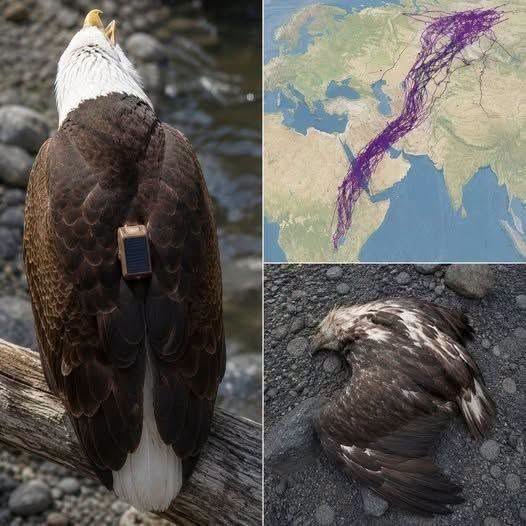
The GPS data offered researchers an unusual opportunity: they could study the bird’s movements over an extended period rather than relying on occasional observations in the field.
Why GPS Tracking Matters
Wildlife researchers have increasingly used GPS technology to understand animal behavior.
A tracking device can record an animal’s location at regular intervals, creating a detailed picture of where it travels. When researchers compare those movements with information about weather, food availability, terrain, and seasonal changes, they can begin to identify patterns.
For large birds such as eagles, this information can be especially useful because they may cover considerable distances during their lifetime.
The data can help researchers answer questions such as:
- Where do birds spend different parts of the year?
- Which areas are important for feeding and resting?
- How do weather conditions influence movement?
- Do individual birds use the same areas repeatedly?
- How might environmental changes affect their behavior?
A Journey That Initially Looked Unusual
When researchers first examined the eagle’s tracking data, some of its movements appeared difficult to explain.
The bird did not simply travel from one location to another in a straight line. It sometimes changed direction, returned to areas it had previously visited, and spent different amounts of time in particular locations.
To someone looking at the GPS map without additional information, the route could appear random.
But animal movements are rarely random in the strict sense.
Birds constantly respond to their surroundings. Food availability, weather, temperature, breeding behavior, competition, habitat conditions, and seasonal changes can all influence where an animal travels.
A route that looks confusing on a map may therefore make sense when viewed alongside environmental information.
The Importance of Food and Habitat
One of the most important factors influencing wildlife movement is access to suitable habitat and food.
An eagle may travel considerable distances when searching for favorable conditions. If prey becomes less available in one area, the bird may spend more time elsewhere.
Similarly, seasonal changes can alter the availability of food and suitable habitat.
This means that an animal’s movements can change from one year to another without indicating that anything is wrong.
Instead, flexibility can be an important part of survival.
Weather Can Influence Movement
Weather is another major factor that researchers consider when studying bird movements.
Wind conditions can affect how efficiently large birds travel. Temperature, storms, precipitation, and other environmental conditions can also influence when and where birds move.
For soaring birds, atmospheric conditions may be particularly important because they can use rising air currents to travel while conserving energy.
Consequently, a GPS route may sometimes reflect environmental conditions that are invisible when looking only at a map.
Why Individual Animals Can Behave Differently
Another important lesson from wildlife tracking is that animals of the same species do not necessarily behave in exactly the same way.
Two eagles may use different territories, respond differently to environmental conditions, or develop different movement patterns based on their experience.
Age, reproductive status, habitat familiarity, and access to food can all contribute to individual differences.
This is why long-term tracking can be so valuable. Studying one animal over an extended period can reveal behavior that might be missed during a short observation.
Turning GPS Data Into Scientific Knowledge
A GPS tracker does not automatically explain why an animal behaves a certain way.
Researchers must interpret the location data alongside other evidence.
They may compare movement records with weather observations, habitat maps, prey availability, seasonal changes, and information from other tracked animals.
Over time, these comparisons can reveal relationships that are difficult to see from individual observations.
What initially looks like an unexplained series of movements may eventually become part of a broader picture of how wildlife responds to its environment.
What This Teaches Us About Nature
Long-term wildlife tracking provides an important reminder that nature is often more complicated than it first appears.
An animal’s movements may seem unpredictable when viewed from a distance, yet those movements can be influenced by numerous factors operating at the same time.
The eagle’s GPS data therefore represents more than a collection of points on a map.
It provides researchers with an opportunity to study how an individual animal interacts with changing environmental conditions.
Modern tracking technology has made it possible to observe these patterns in ways that earlier generations of scientists could only imagine.
A Window Into the Wild
The real value of tracking an animal for years is not necessarily discovering one dramatic explanation.
It is learning how many small factors can shape the life of a wild animal.
Every change in direction, every return to a familiar area, and every long-distance journey can provide another piece of information.
When scientists combine those pieces with other observations, they gain a better understanding of wildlife behavior and the environments animals depend on.
The story of a GPS-tracked eagle is ultimately a reminder that nature does not always reveal its patterns immediately.
Sometimes, understanding comes from watching carefully, collecting information over time, and recognizing that what first appears mysterious may simply be part of a much larger and more complex natural system.