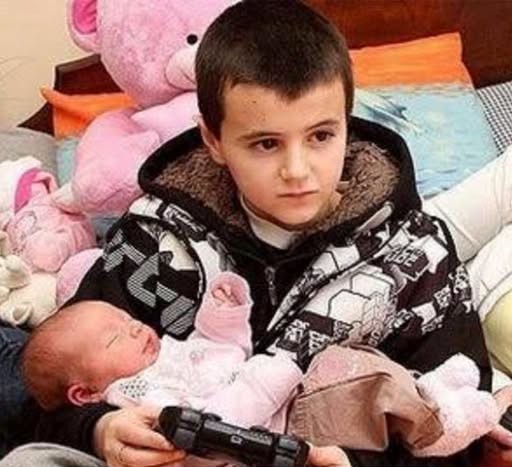
British newspapers devoted substantial coverage to the case, with The Sun among the publications that prominently reported it.
Alfie’s youthful appearance contributed to the public fascination surrounding the story. Images of the schoolboy with a newborn created a powerful visual contrast that was repeatedly used in news coverage.
The story soon became part of a wider discussion about teenage pregnancy and the challenges young people can face when dealing with major responsibilities.
For Alfie and his family, however, the attention meant that a deeply personal situation was suddenly being discussed by people throughout the country.
A Wider Debate About Young People
The story quickly moved beyond questions about the individual family.
Politicians and commentators discussed issues including sex education, relationships, teenage pregnancy, parenting, and the influence of popular culture on young people.
Nigel Waterson, who was then the Member of Parliament for Eastbourne, used the case to raise questions about how schools approached relationship and sex education.
The debate demonstrated how quickly an individual news story can become a symbol in a much larger discussion about society.
At the same time, the case involved children whose circumstances deserved careful and responsible treatment.
Alfie Believed He Was the Father
Before the DNA test, Alfie apparently believed that he was Maisie’s father.
He reportedly attended the hospital and spent time with the newborn after her birth.
In interviews at the time, his comments reflected the fact that he was still very young and had limited understanding of the long-term responsibilities associated with parenthood.
His family also described him as wanting to remain involved rather than simply walk away from the situation.
The circumstances highlighted an important point that was sometimes overshadowed by the headlines: Alfie himself was still a child.
Maisie Roxanne Was Born in February 2009
Maisie was born in February 2009, weighing 7 pounds 3 ounces.
Photographs of Alfie with the newborn became central to the media coverage.
For audiences, the images appeared to confirm the story being reported. For Alfie, however, the experience was based on his genuine belief that he had become a father.
That distinction became important when questions about paternity emerged.
Questions About Paternity
Doubts eventually arose within Alfie’s family about whether he was actually Maisie’s biological father.
Those concerns led to a DNA test approximately six weeks after the birth.
The result established that Alfie was not the biological father.
Reports subsequently identified another teenager, Tyler Barker, as Maisie’s biological father.
The finding fundamentally changed the story that had dominated headlines for weeks.
The Impact of the DNA Result
Although the test corrected the central factual issue, it could not undo the experience Alfie and his family had already gone through.
Alfie had believed he was the baby’s father, had spent time with her, and had experienced intense public attention as a result.
Reports at the time said that he was deeply upset after learning the result.
The family had also become recognizable to strangers, while the story had been discussed nationally and internationally.
A correction could establish the facts, but it could not simply return the family to the privacy they had before the story became public.
Questions About Media Coverage
The case also generated discussion about the way newspapers reported stories involving children.
The Press Complaints Commission, which was the UK’s newspaper and magazine industry complaints body at the time, examined aspects of the coverage.
Questions included how the story had been obtained and issues surrounding the involvement of the family in media coverage.
The newspaper involved defended its reporting and argued that the story was in the public interest.
The controversy highlighted the difficult balance between legitimate public-interest reporting and protecting the privacy of young people.
Why the Case Remains Significant
The Alfie Patten story is remembered not simply because of the unusual circumstances surrounding the original report.
It also illustrates the importance of verifying significant claims before they become widely accepted as fact.
The original narrative spread rapidly because it was unusual and emotionally compelling. Once the story became established in the public imagination, however, changing the central fact proved much more difficult.
The DNA result demonstrated how important independent verification can be, particularly when reporting concerns children and families.
The Difference Between a Headline and a Person
One of the most important lessons from the case is that a young person can quickly become a public symbol without having any control over the way others interpret their story.
Alfie was discussed in newspapers, television programs, political debates, and public conversations.
Yet behind the headlines was a teenager dealing with a complicated family situation.
The experience serves as a reminder that news coverage can have consequences long after a story disappears from the front pages.
Later Reports About Alfie’s Life
As Alfie grew older, he occasionally appeared in later news reports.
Some coverage concerned legal difficulties and challenges in his personal circumstances. These reports should be viewed separately from the events of 2009, rather than treated as a continuation of the original paternity story.
The teenage boy who had once been at the center of international headlines eventually became an adult living a much more private life.
A Story About Verification and Responsibility
Looking back, the most significant part of the story may not be the original headline at all.
The case demonstrates how quickly an unusual claim can spread when it contains a compelling image and an easy-to-understand narrative.
It also shows why journalists, readers, and publishers should distinguish between an allegation, an assumption, and a fact that has been independently confirmed.
In this case, the DNA test provided information that fundamentally changed the public understanding of what had happened.
What We Can Learn From the Story
The 2009 coverage offers several broader lessons:
- Important claims should be verified before being treated as established facts.
- Stories involving children require particular care and sensitivity.
- A correction cannot always undo the personal effects of widespread publicity.
- Public interest should be balanced against individual privacy.
- Headlines can shape public opinion long before all the evidence is available.
Alfie Patten was introduced to the public through a story that turned out to be substantially different from the original reports.
The DNA result corrected the central question of paternity, but the experience demonstrated how difficult it can be for an individual and their family to regain privacy after becoming the subject of international attention.
Ultimately, the story is less about an extraordinary headline and more about the responsibilities that come with reporting on real people. It remains a useful example of why accuracy, context, verification, and sensitivity matter—especially when children are involved.