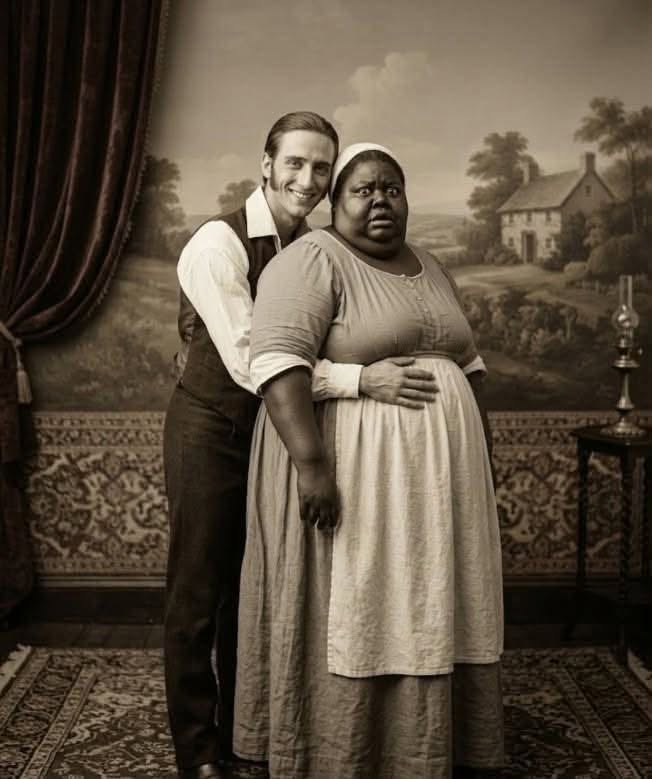
He looked at Benedita.
For the first time, she looked directly at him.
There was no gratitude in her expression.
There was no fear, either.
There was only suspicion.
She had learned long ago that promises were easy and that kindness could disappear the moment someone wanted something from her.
Joaquim understood that.
He didn’t reach for her.
Instead, he stepped aside and pointed toward his horse-drawn cart.
“You can walk beside it,” he said.
Benedita stared at him.
“Why?”
“Because I don’t want to force you into the cart.”
Her eyebrows lifted slightly.
It was such a small gesture that Joaquim almost missed it.
But he noticed.
She had expected something else.
They left the square without another word.
Behind them, the men who had laughed continued discussing the strange purchase.
None of them suspected that the woman they had dismissed that morning would eventually become one of the most capable people on the entire property.
The first night at Santo António was quiet.
Joaquim showed Benedita a small room beside the stable.
There was a bed, a blanket, a pitcher of water, and a plate of food.
She stood in the doorway.
“What do you want me to do?”
“Nothing tonight.”
She looked confused.
“Tomorrow?”
“We’ll talk tomorrow.”
She remained still.
Then she asked:
“Why did you buy me?”
Joaquim hesitated.
“Because everyone else refused.”
“That doesn’t answer my question.”
He looked at her.
“You’re right.”
He thought for a moment.
“I noticed the way you watched the horses.”
Benedita’s expression changed.
“You noticed?”
“Yes.”
“They were frightened.”
“Most people didn’t notice that.”
“You did.”
“I noticed you did.”
For a moment, neither spoke.
Then Benedita entered the room.
She closed the door.
Joaquim walked away.
He had no idea that the following morning would change everything.
The Horse Nobody Could Handle
At sunrise, Joaquim found Benedita standing beside the stable.
One of his strongest horses was pulling nervously against its reins.
Three workers had already tried to calm it.
None had succeeded.
Benedita watched from several meters away.
“What’s wrong with him?” Joaquim asked.
She didn’t answer immediately.
Then she said:
“He doesn’t trust the man holding the reins.”
The worker looked offended.
“I’ve handled horses for twenty years.”
Benedita looked at the animal.
“That doesn’t mean he trusts you.”
Joaquim raised a hand.
“Let her try.”
The worker reluctantly stepped away.
Benedita didn’t grab the reins.
She simply stood nearby.
The horse continued moving nervously.
She waited.
Then she took one slow step forward.
Another.
She stopped.
The horse stopped too.
After several seconds, it lowered its head.
Benedita extended her hand.
The animal approached.
Joaquim stared.
“How did you know?”
“I watched him.”
“That’s all?”
“That is usually enough.”
Joaquim smiled.
From that day forward, he began paying attention to what Benedita noticed.
And Benedita noticed almost everything.
The Woman Who Remembered Everything
She remembered which horses preferred which feed.
She noticed when a fence post was beginning to rot.
She could recognize which workers had moved equipment without being told.
She remembered quantities after seeing them once.
One afternoon, Joaquim asked her how many sacks of coffee had been stored that morning.
“Forty-six.”
He checked the records.
Forty-six.
The next day, she warned him about a storage building.
“The roof is going to fail.”
Joaquim looked upward.
“It looks fine.”
“The beam near the eastern wall is cracked.”
He inspected it.
She was right.
A repair was made that same afternoon.
Two weeks later, a violent storm passed through the valley.
Several buildings were damaged.
The storage building remained standing.
Joaquim began to understand something.
Benedita’s greatest strength wasn’t physical.
It was observation.
She saw details other people ignored.
The Secret Training
Joaquim began spending time with her in the evenings.
He showed her numbers.
Benedita learned quickly.
Then he showed her letters.
She struggled at first.
But she refused to give up.
“Why do you want to learn?” he asked.
“So nobody can lie to me with paper.”
Joaquim had no response.
He continued teaching her.
Soon, Benedita could recognize names and numbers.
Then short sentences.
Eventually, she began reading simple records.
One evening, she looked at a page of accounts and frowned.
“This number is wrong.”
Joaquim looked over.
“What?”
“This payment.”
She pointed to a line.
“You were charged twice.”
Joaquim checked the receipt.
She was right.
The discovery saved him a significant amount of money.
For the first time, he realized the seven cents he had spent were irrelevant.
He had not purchased strength.
He had discovered intelligence.
The Question That Kept Joaquim Awake
But something continued bothering him.
Every evening, he saw Benedita working.
He saw her learning.
He saw her becoming more confident.
And he knew that no matter how kindly he treated her, she was still living inside a system that denied her freedom.
One night, he sat alone in his office.
The auction receipt was still in his desk.
Seven cents.
He looked at it for a long time.
Then he closed the drawer.
The next morning, he called Benedita into the office.
She entered cautiously.
“You asked for me?”
“Yes.”
Joaquim placed a document on the desk.
“What is that?”
“Your freedom.”
She stared at him.
For several seconds, she didn’t understand.
Then she looked at the paper again.
“You’re letting me go?”
“You were never something I should have been allowed to own.”
Benedita’s eyes narrowed.
“Then why did you buy me?”
Joaquim answered honestly.
“Because I thought I could give you a better life.”
“And now?”
“Now I know you should choose your own life.”
She looked down.
The room became silent.
Then she asked:
“If I’m free, what happens to the people still here?”
Joaquim didn’t answer.
That question changed him.
He had been thinking about one person.
Benedita was thinking about everyone.
A Different Kind of Leader
Benedita didn’t leave immediately.
She stayed because she wanted to help the people she had come to know.
She began teaching practical skills.
She helped organize the stable.
She trained workers to recognize signs of illness in animals.
She taught those who wanted to learn basic reading and numbers.
She became someone people trusted.
Not because she demanded authority.
Because she earned it.
Joaquim noticed something remarkable.
People who had once been afraid to speak began asking Benedita for advice.
She listened before answering.
She never forgot what it felt like to be ignored.
One evening, Joaquim said:
“You’ve become a leader.”
Benedita shook her head.
“No.”
“Why not?”
“Because leaders don’t need people to fear them.”
Joaquim smiled.
“Then what are you?”
She thought about it.
“Someone who remembers.”
The Day the Past Returned
Several years later, one of the men who had laughed at Joaquim during the auction arrived at Santo António.
He recognized Benedita immediately.
He looked surprised.
“I heard you were still here.”
“I am.”
“I thought Joaquim bought you because nobody wanted you.”
Benedita looked at him calmly.
“He bought me because nobody else saw what I could do.”
The man laughed awkwardly.
“And what exactly did you become?”
Benedita looked toward the stable.
Then toward the workers.
Then back at him.
“Someone who knows her own worth.”
The man’s smile disappeared.
Joaquim had heard the conversation from a distance.
He didn’t interrupt.
He didn’t need to.
Benedita had finally found the words for something she had understood long before anyone else.
The Seven-Cent Question
Years passed.
The world around them changed.
The institution that had allowed human beings to be treated as property eventually came to an end in Brazil.
Benedita’s life changed with it.
She had already been making her own decisions for years.
She eventually left the farm on her own terms.
She built a life outside Santo António.
She kept in contact with people she had met there.
And she never forgot the auction.
Not because of the humiliation.
Because of the lesson.
One afternoon, someone asked her about the seven cents.
“Did you ever think about how little they paid for you?”
Benedita smiled.
“They didn’t pay for me.”
The person looked confused.
“They paid for a system that claimed it could put a price on a human being.”
She paused.
“They were wrong.”
The Truth Joaquim Finally Understood
Joaquim lived long enough to see Benedita become independent.
One of their final conversations took place beneath an old tree overlooking the fields.
“You know,” he said, “people still talk about the seven cents.”
Benedita laughed.
“People like simple stories.”
“What would you tell them?”
She thought for a moment.
“I would tell them the seven cents were never the interesting part.”
“What was?”
She looked toward the horizon.
“That everyone in the square thought they knew my value.”
Joaquim nodded.
“And they were wrong.”
“They were completely wrong.”
He smiled.
“I suppose I was wrong too.”
Benedita looked at him.
“You were.”
He laughed.
“I thought I was buying someone who needed saving.”
“And?”
“I discovered I was meeting someone who had already survived more than I could imagine.”
Benedita smiled.
“That is closer to the truth.”
The two sat quietly for a while.
Neither needed to say anything else.
The story of Benedita had begun with a crowd deciding that she was worthless.
It ended with something very different.
She had never needed someone to tell her that she mattered.
She needed the opportunity to make her own choices, develop her abilities, and live with dignity.
And perhaps that was the real lesson hidden behind the strange auction that morning.
The most dangerous mistake people can make is believing that another person’s worth can be measured by appearance, money, strength, or the opinion of a crowd.
Joaquim had paid seven cents.
But the real discovery was priceless.
Benedita had never been the bargain.
The bargain was the chance to see a human being as a human being.