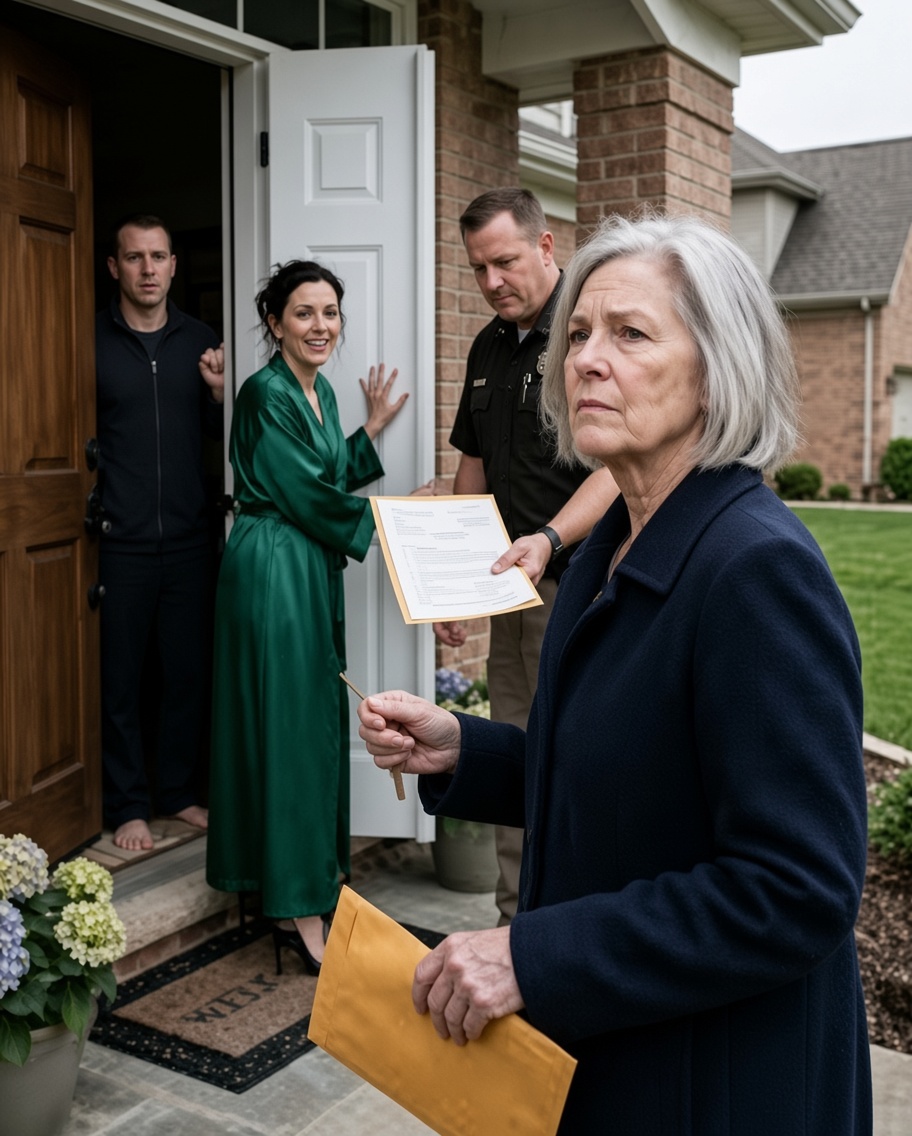
Mark stared at the envelope as though he couldn’t quite believe it existed.
His name was written across the front in Raymond’s unmistakable handwriting.
FOR MARK — ONLY IF HE FORGETS WHO HIS MOTHER IS.
He ran his thumb over the letters.
For a moment, he didn’t open it.
Then he looked at me.
“Did Dad write this before he died?”
“Yes.”
“When?”
“Three months before.”
His expression tightened.
“Why?”
“Because your father knew that life could become complicated.”
Mark shook his head.
“Knew what?”
“That one day, you might have to decide how you wanted to balance your responsibilities to your family with your responsibilities to yourself.”
Alicia immediately interrupted.
“That sounds dramatic.”
Thomas remained quiet.
I looked at Mark.
“Open it.”
He carefully unfolded the paper.
His eyes moved across the first lines.
Then he stopped.
His lips trembled.
“What does it say?” Alicia asked.
Mark didn’t answer.
He folded the letter against his chest.
“I need a minute.”
Alicia stepped closer.
“I need to know.”
Mark looked at her.
“Please don’t.”
It was the first time that morning he had asked her to stop.
She stepped back.
He looked at me.
“Mom, did Dad know about Alicia?”
“No.”
His shoulders relaxed slightly.
“Then what did he know?”
I leaned back.
“Your father understood people. He knew that even good families could face difficult decisions.”
Mark looked down at the letter.
“Can I read it?”
“Yes.”
He unfolded it again.
His voice was quiet.
“Mark,
If you’re reading this, something may have happened that I hoped never would.
Your mother will probably defend you even when you make mistakes.
That’s who she is.
She will remember the little boy you were and may sometimes forget that you are now responsible for your own choices.
So I’m writing this because I won’t be here to say it later.
Don’t ever confuse your mother’s kindness with weakness.”
Mark stopped.
His eyes filled with tears.
He continued.
“A house is more than wood and brick.
It is where your mother waited for you.
It is where we built our family.
It is where you celebrated birthdays, learned lessons, and grew into the man you became.
If you are ever sitting at your mother’s table discussing papers that affect her home or finances, stop and make sure she understands every decision.
Don’t allow anyone to rush her.
Don’t make choices for her.
And if you are the one doing it, Mark, remember who taught you to respect other people’s choices.
Your mother.”
Mark couldn’t continue.
He lowered his head.
The room remained quiet.
Finally, he whispered,
“I forgot.”
I looked at him.
“You made a mistake.”
He nodded.
Alicia wiped her eyes.
“This is emotional manipulation.”
Thomas calmly replied,
“No. It is a letter from a husband to his wife and son.”
Alicia looked at me.
“You’ve been preparing for this.”
I frowned.
“Preparing for what?”
“This whole situation.”
I shook my head.
“I’ve been preparing to protect my future.”
I lifted the notepad.
“I didn’t make anyone say these things.”
She looked away.
Mark was still holding Raymond’s letter.
He finally looked up.
“Mom gave us forty thousand dollars.”
Alicia said nothing.
“She bought our house.”
“Mark—”
“She paid the taxes.”
“That’s not the point.”
“What is the point?”
Alicia struggled to answer.
Mark took a breath.
“What were you planning?”
She looked at me.
Then at the folder.
Finally, she sat down.
“I thought we needed a different arrangement.”
“What kind?”
“I thought Mom might be safer somewhere with more support.”
“And her house?”
“We thought it could help with the costs.”
“And the money?”
Alicia hesitated.
Mark understood.
“You were thinking about using the money for other expenses.”
She looked down.
“We were trying to manage our future.”
Mark shook his head.
“We should have discussed it with Mom first.”
I could see the regret on his face.
Then Alicia said something none of us expected.
“I have financial problems.”
Mark went still.
“What kind?”
She looked at the table.
“I made some poor investment decisions.”
Thomas asked calmly,
“How serious?”
Alicia hesitated.
“About eighty-six thousand dollars.”
Mark stared at her.
“How?”
“I was trying to increase our savings.”
“With what money?”
Alicia remained quiet.
Mark’s voice softened.
“Please tell me the truth.”
She finally admitted that she had used some household savings and borrowed money while trying to cover the losses.
Mark sat down.
I closed my eyes.
For a few moments, nobody spoke.
Then Mark asked,
“Where did the rest come from?”
Alicia explained that she had borrowed from someone she knew professionally.
Thomas asked several practical questions.
The more we learned, the clearer the situation became.
Alicia had made a series of poor financial decisions.
Instead of telling Mark immediately, she had tried to solve everything herself.
That had led to more complicated choices.
And eventually, she had begun considering my house as a possible source of funds.
I looked at her.
“How did you think this would end?”
Her voice broke.
“I don’t know.”
“Did you think you could replace everything before anyone noticed?”
She nodded.
“I thought I could fix it.”
Mark covered his face.
“Why didn’t you tell me?”
“I was embarrassed.”
That answer changed the room.
For the first time, I saw less defensiveness and more fear.
I still disagreed with her choices.
But I understood that poor decisions often become worse when people are too embarrassed to ask for help.
I stood.
“Thomas.”
He looked at me.
“Could you take Mark outside for a few minutes?”
Mark looked confused.
“Mom?”
“I need to speak with Alicia privately.”
He hesitated.
Then nodded.
Before leaving, he looked back.
“I’m sorry.”
I nodded.
“I know.”
When the door closed, Alicia and I were alone.
She looked exhausted.
“How serious is your situation?” I asked.
“I don’t know anymore.”
“Then that’s where we start.”
She looked at me.
“You’re still helping me?”
“I’m willing to listen.”
I pointed toward the documents.
“But I’m not giving you access to my property or finances.”
She nodded.
“I understand.”
I picked up the folder she had brought.
The first document involved residential care.
The second concerned financial authority.
The third involved property.
I looked at Alicia.
“These are not decisions you can make for me.”
“I know.”
“Then why bring them?”
She looked down.
“I thought I was solving a problem.”
“You were trying to solve your problem.”
She didn’t argue.
I closed the folder.
“That’s the difference.”
She nodded.
“You should leave for now.”
She stood slowly.
“I am sorry.”
“I believe you.”
“But you’re still angry.”
“Yes.”
She looked at me.
I continued.
“Being sorry doesn’t mean everything is immediately fixed.”
She nodded.
“That makes sense.”
When she opened the door, Mark was standing on the porch.
He had clearly heard enough.
He looked at his wife.
“I spoke with the bank.”
Alicia froze.
“What?”
“I reviewed our accounts.”
She looked down.
“I can explain.”
Mark shook his head.
“I don’t want an argument. I want the truth.”
She nodded.
They stood there quietly.
Then Mark said,
“We need professional advice.”
Alicia looked at him.
“About what?”
“Everything.”
She nodded.
It was the first practical conversation they had had all day.
They left together.
I watched them walk toward the car.
I didn’t know what would happen to their marriage.
That wasn’t my decision.
But I knew what I needed to do next.
Protect my home.
Protect my finances.
And give my son the opportunity to take responsibility for his own choices.
PART 5
I held Raymond’s second envelope in both hands.
For four years, I had wondered about it.
And for four years, I had been nervous about what it might contain.
Raymond never wrote anything without a reason.
During the last year of his life, he had become especially organized.
He labeled drawers.
He sorted insurance documents.
He created lists of important contacts.
He even wrote instructions for the furnace.
One afternoon, I teased him.
“Raymond, I’m not helpless.”
“I know.”
“Then why are you writing instructions for the furnace?”
“Because someday you’ll forget.”
“I can still hear you.”
“I know.”
Then he smiled.
That was Raymond.
Even when life was difficult, he wanted to make things easier for me.
I looked at the envelope.
Mark sat across from me.
Thomas stood near the window.
“Do you want me to leave?” Thomas asked.
I shook my head.
“No.”
I opened the envelope.
Inside was one sheet of paper.
Raymond’s handwriting was less steady than usual.
I unfolded it.
And began reading.
Dot,
If you’re reading this, something happened that I hoped wouldn’t.
Maybe Mark made a mistake. Maybe someone made a mistake with him. Maybe your family simply reached a point where difficult decisions became necessary.
Whatever happened, don’t blame yourself.
You loved him. You raised him. You taught him.
But helping someone doesn’t mean making every difficult decision disappear for them.
There comes a time when people need the opportunity to take responsibility for their choices.
Don’t sell the house because someone tells you that you are too old to manage it.
Don’t leave it because someone tells you that another place would be better.
Stay as long as you want.
Leave only when you want to.
And there is one more thing.
The land by the lake isn’t what Mark thinks it is.
Don’t make any decisions about it because someone asks you to.
Wait until you are certain you understand what you want.
If Mark finds his way back to you, let him earn your trust through time and consistency.
Not through money.
Love,
Raymond
I stopped reading.
The kitchen was quiet.
Mark’s eyes were wet.
“The land,” he said.
I folded the letter.
“What about it?”
“You said Dad left something.”
“Yes.”
“What?”
I looked at Thomas.
He nodded.
I reached into the drawer and removed another folder.
“This.”
Mark opened it.
His eyes moved across the documents.
Then he looked up.
“Mom…”
“What?”
“This is more than land.”
“Yes.”
Thomas explained that Raymond owned a significant portion of the shoreline.
Mark stared at the papers.
“How much is it worth?”
I smiled.
“Your father didn’t buy it because he wanted to become wealthy.”
Thomas nodded.
“He purchased it as a long-term investment and because he loved the lake.”
Mark closed the folder.
“Why didn’t Dad tell me?”
“Because he wanted you to build your own life.”
Mark looked down.
“And he never wanted me to have it?”
“That isn’t what he said.”
I smiled.
“He wanted you to understand that an inheritance is a gift, not a substitute for hard work.”
Mark nodded.
“I understand.”
Thomas gathered the documents.
“I think that’s enough for one morning.”
Mark stood.
“Mr. Reed?”
“Yes?”
“Can I ask you something?”
“Of course.”
“If Mom hadn’t heard that conversation, could the house have been sold?”
Thomas considered his answer.
“Not without Dorothy’s authorization. But there were several documents that should never have been presented to her without a proper explanation.”
Mark nodded.
He looked at me.
“Mom, I need to make things right.”
I shook my head.
“You need to take responsibility.”
He frowned.
“Isn’t that the same thing?”
“Not quite.”
I looked directly at him.
“Making things right starts with accepting that your choices have consequences.”
He nodded.
“I understand.”
Then he hugged me.
I hadn’t realized how much I needed that hug.
For a moment, he was the little boy I remembered.
Then I stepped back.
“There are some boundaries.”
He smiled sadly.
“Of course.”
“First, you don’t make decisions about my property.”
“I won’t.”
“Second, you don’t ask me for money.”
“I won’t.”
“Third, you tell me the truth.”
He nodded.
“And fourth?”
“You don’t come here because you need something.”
He looked at me.
“You come because I’m your mother.”
He nodded.
“I will.”
He left shortly afterward.
Thomas stayed for a few more minutes.
Eleanor came through the back door soon after.
She took one look at me.
“Well?”
I smiled.
“They’re gone.”
Eleanor dropped her purse on the counter.
“Good.”
“You heard everything?”
“Not everything.”
She pointed toward the street.
“But I saw enough.”
I laughed.
She poured herself some coffee.
“You know what I kept thinking?”
“What?”
“Raymond would have appreciated how organized you were today.”
I smiled.
“He always thought I was too trusting.”
“No,” Eleanor said.
“You were trusting. That’s different.”
I looked toward the window.
Mark’s car disappeared around the corner.
For the first time that day, I felt calm.
Three days later, Bruce came to my door.
He wasn’t smiling.
I was trimming the roses when I saw his car.
He walked toward the house carrying a folder.
I opened the door.
“Good afternoon, Dorothy.”
“Bruce.”
“I was hoping we could talk.”
“About Alicia?”
His expression changed.
“Yes.”
I stepped aside.
“Come in.”
He sat in the same chair where he had once discussed the house.
“I should explain something,” he said.
“Please do.”
Bruce explained that Alicia had been dealing with financial problems connected to an investment.
She had borrowed money while trying to cover the losses.
Eventually, she had begun looking for ways to solve the situation quickly.
I listened.
I didn’t excuse her decisions.
But I understood that fear and embarrassment had contributed to them.
Thomas later reviewed the paperwork.
There were several issues that needed professional attention.
Mark learned that some financial documents had been prepared without his full understanding.
That became a serious matter requiring legal advice.
I stayed out of the details.
This was Mark’s responsibility now.
That evening, he came to my house.
He looked exhausted.
“Mom.”
I opened the door.
“I know.”
He nodded.
“I don’t know what to do.”
“Tell me the truth.”
He sat down.
“I don’t trust Alicia anymore.”
I was quiet.
“I love her,” he continued. “But trust has to be rebuilt.”
“Yes.”
“I have children.”
“I know.”
“I don’t want them growing up thinking financial secrecy and dishonesty are normal.”
I sat beside him.
“Then teach them something different.”
He looked at me.
“What would Dad have done?”
I smiled.
“He would tell you to stop asking what he would do.”
Mark laughed.
“That sounds like him.”
“It does.”
I placed my hand on his shoulder.
“Your father believed that people can make serious mistakes and still choose to become better.”
Mark nodded.
“But they have to accept responsibility first.”
He took a deep breath.
“I’m going to tell the truth.”
“Good.”
“Even if it changes my marriage.”
I looked at him.
“Sometimes difficult truth is the beginning of healthier choices.”
The next several months were challenging.
There were meetings.
There were bank statements.
There were lawyers.
There were long conversations.
Alicia eventually accepted responsibility for the financial decisions she had made.
She moved out for a while so that everyone could have some space.
Mark and Alicia began working through their situation with professional guidance.
Eventually, they decided to separate.
It wasn’t a dramatic ending.
It was a difficult, thoughtful decision made after months of conversations.
Alicia also entered an agreement to repay what she could.
She sold several expensive items and changed her spending habits.
I didn’t involve myself in the details.
That was important.
I could care about her without taking responsibility for her choices.
Mark changed too.
Not overnight.
But steadily.
He started visiting every Wednesday.
Then Sundays became longer.
Our old eleven-minute calls became forty minutes.
Sometimes we talked for two hours.
Sometimes he simply sat in the kitchen with me.
He helped repair the porch.
He fixed a leaky faucet.
He planted tomatoes.
One Saturday, he arrived carrying a toolbox.
“I watched three videos,” he announced.
“About what?”
“How to repair your sink.”
I laughed.
“Your father would be proud.”
Mark smiled.
“I hope so.”
Then he looked at me.
“Mom?”
“Yes?”
“Do you think I’ll ever become the man Dad wanted me to be?”
I looked at him.
“You’re already working toward it.”
“How?”
“You’ve finally understood that love isn’t about what you receive.”
He nodded.
“It’s about what you respect and protect.”
“Yes.”
That spring, something unexpected happened.
A development company made an offer for part of my lake property.
Thomas brought me the paperwork.
“You don’t have to sell,” he reminded me.
I looked toward the lake.
Raymond had loved that place.
We had spent decades enjoying summers there.
But I realized something.
Raymond had never told me I had to keep every property forever.
He had simply wanted me to make decisions for myself.
So I sold part of the property.
I kept the shoreline.
I kept the cabin.
And I used some of the proceeds to establish something Raymond would have appreciated.
A scholarship.
The Raymond Bennett Scholarship Fund.
The first year, we helped six local students.
The second year, twelve.
Mark helped review applications.
He never asked for money.
One afternoon, I found him sitting on the porch reading essays.
“You’re enjoying this,” I said.
He looked up.
“I am.”
“Your father would be surprised.”
“Why?”
“He thought you disliked paperwork.”
Mark laughed.
“I still do.”
I sat beside him.
“What changed?”
He looked toward the lake.
“I finally realized that money matters most when it creates opportunities.”
I smiled.
“Your father taught you that.”
“No.”
He shook his head.
“You did.”
I didn’t argue.
PART 6 — CHRISTMAS
Christmas arrived eight months after the morning of the phone call.
I sat in my kitchen.
The same kitchen.
The same table.
The same window.
But everything felt different.
There were lights around the doorway.
A Christmas tree stood in the living room.
The good cups were on the table.
Banana bread was baking in the oven.
Then I heard a knock.
I opened the door.
Mark stood there holding a wrapped box.
Behind him were his twins.
“Grandma!”
They ran toward me.
I laughed as they hugged me.
“Slow down!”
Mark smiled.
“Mom.”
“Merry Christmas.”
“Merry Christmas.”
He handed me the box.
“What is this?”
“Open it.”
I sat down.
I removed the paper.
Inside was a framed photograph.
Raymond.
Me.
Mark.
Taken thirty years earlier beside the lake.
I turned it over.
Mark had written a message on the back.
For the woman who taught me that home isn’t just a place. It’s where people respect one another and make room for you to come back.
My eyes filled with tears.
Mark looked nervous.
“Too much?”
I shook my head.
“No.”
I hugged him.
“It’s perfect.”
We had dinner that evening.
The children laughed.
Mark told stories.
Eleanor arrived with a pie.
Thomas came later with his wife.
At one point, Mark stood and raised his glass.
“To Dad.”
Everyone raised their glasses.
“To Raymond.”
Mark looked at me.
“And to Mom.”
I smiled.
Eleanor raised her glass.
“To Mom.”
I looked around the table.
A year earlier, I had worried that my family relationships were falling apart.
Instead, I had learned something important.
A home can be protected by legal documents.
Finances can be protected through careful planning.
Property can be protected through clear agreements.
But relationships require something different.
They require honesty.
Respect.
Patience.
And the willingness to take responsibility.
After dinner, the children went outside.
Mark stayed behind.
“Mom?”
“Yes?”
“I need to tell you something.”
My heart jumped.
“What now?”
He smiled.
“Nothing bad.”
“Then go ahead.”
He pulled out his phone.
“I deleted the old Sunday reminder.”
I laughed.
“What old reminder?”
“The five o’clock eleven-minute call.”
I smiled.
“And?”
“I replaced it.”
“With what?”
He showed me his screen.
Call Mom — No Time Limit.
I laughed until I cried.
Then he hugged me.
“I love you.”
“I love you too.”
He started toward the door.
Then stopped.
“Mom?”
“Yes?”
“Do you remember what you told me that morning?”
“Which part?”
“You said I had to decide what kind of man I wanted to be.”
“Yes.”
“I decided.”
I looked at him.
“And?”
He smiled.
“I want to be the kind of father who teaches his children to respect their family members, even when things are complicated.”
My heart filled with emotion.
I reached for him.
He hugged me again.
And for the first time in years, I felt completely at peace.
EPILOGUE
I’m seventy-four now.
I still live in the same house.
The mortgage is paid.
The roses still grow beside the kitchen window.
Eleanor still notices everything happening on the street.
Thomas still sends me Christmas cards.
The scholarship fund continues to grow.
The lake property remains partly in my name.
And every Sunday at five, my phone rings.
Not for eleven minutes.
Sometimes it’s an hour.
Sometimes it’s three.
Sometimes Mark calls to tell me something funny his twins did at school.
Sometimes he asks for a recipe.
Sometimes he doesn’t have much to say.
He simply stays on the phone.
And I stay on the other end.
Because now I understand something Raymond tried to teach me.
People sometimes look at an older woman and see her house.
They see savings.
Property.
Possessions.
They may even start thinking about what they believe she should do with those things.
But they can forget something important.
That woman has spent decades building a life.
She has raised children.
Paid bills.
Worked through difficult years.
Built friendships.
Lost people she loved.
Forgiven mistakes.
Started again.
She has learned things that cannot be measured by a bank account.
And sometimes the greatest mistake anyone can make is assuming that kindness means someone has no boundaries.
That morning, Alicia thought I might simply agree with her plans.
She was mistaken.
Mark thought he needed to solve everything immediately.
He was mistaken too.
And I thought I had lost my son.
I was wrong about that.
Because sometimes people don’t need someone else to solve their problems.
They need the opportunity to take responsibility for their choices.
Sometimes love means saying no.
Sometimes forgiveness requires time.
And sometimes rebuilding a relationship begins with a simple decision to tell the truth.
I still have the grocery notepad from that morning.
The ink has faded slightly.
The first line still says:
7:19 — “She’ll sign.”
Underneath it, in my handwriting, I eventually wrote:
She did not.
Years later, I added one more sentence:
She never had to.
Because the house was never really the most important thing I was protecting.
I was protecting my right to choose.
My independence.
My memories.
My home.
And, in the end, the possibility of rebuilding my relationship with my son.
Raymond was right.
I didn’t need to punish Mark.
I simply needed to give him the opportunity to grow.
And on Christmas morning, when I woke to the sound of my grandchildren laughing downstairs and smelled coffee brewing in the kitchen, I looked toward the chair where Raymond used to sit.
For just a moment, I imagined hearing his familiar voice.
“Dot, you all right?”
I smiled.
“Yes, Raymond.”
I looked around my home.
At the photographs.
At the Christmas tree.
At the people I loved.
And whispered,
“I am now.”
THE END