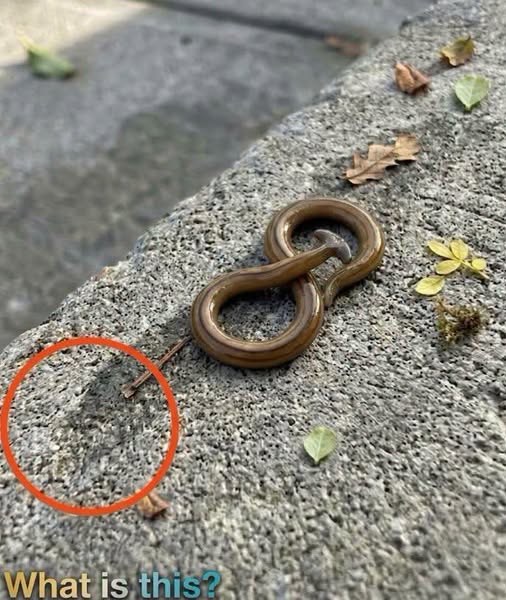
The morning conditions probably helped make the encounter possible. Damp soil and cool temperatures can bring many small invertebrates closer to the surface, where they become easier for people to notice.
After observing the creature for several minutes, I took a photograph.
That turned out to be the easiest way to investigate the mystery without disturbing it.
The Photo Provided the Clue
Later, I compared the photograph with reliable nature references and discovered that the unusual animal was not an ordinary earthworm at all.
Its distinctive flattened head and smooth movement were important clues to its identification.
This is a good reminder that unfamiliar wildlife can sometimes look surprisingly different from the creatures we’re accustomed to seeing.
A strange appearance doesn’t necessarily mean that something is dangerous or unusual in a dramatic sense. Nature contains an enormous variety of animals, many of which most people rarely encounter.
Why the Creature Looked So Unusual
Some ground-dwelling invertebrates have evolved body shapes that are very different from the familiar worms found in gardens.
A flattened head, for example, can be an important identifying feature. Movement is another useful clue. Rather than relying on color alone, naturalists often consider several characteristics together, including body shape, texture, habitat, and behavior.
That’s why taking a photograph can be so useful when encountering an unfamiliar species.
Instead of guessing from one striking feature, the image can be compared with trusted identification resources later.
An Unexpected Lesson From an Ordinary Morning
The encounter lasted only a few minutes, but it changed the way I looked at the ground around my home.
What initially appeared to be an ordinary worm turned out to be something much more interesting.
It also demonstrated how quickly assumptions can shape what we think we’re seeing. At first, my brain categorized the creature as something familiar. Only after slowing down and paying attention to its movement and unusual head shape did I realize that my first impression was probably wrong.
That kind of observation is one of the enjoyable parts of exploring nature.
You don’t necessarily need a remote wilderness or an elaborate expedition. Sometimes the most interesting discoveries are sitting quietly in the soil, beneath leaves, or beside a garden path.
Look, Observe, Then Identify
When encountering an unfamiliar creature outdoors, the simplest approach is often the best one: observe it without disturbing it, take a photograph if appropriate, and consult a reliable identification guide.
Avoid handling an animal when you don’t know what it is. Many species are harmless, while others may have characteristics that make direct contact undesirable.
Most importantly, an unfamiliar creature doesn’t have to be frightening to be fascinating.
That early-morning discovery started with a simple question—What am I looking at?
A few minutes of careful observation turned an ordinary walk outside into a small lesson in how much wildlife can be hiding in plain sight.