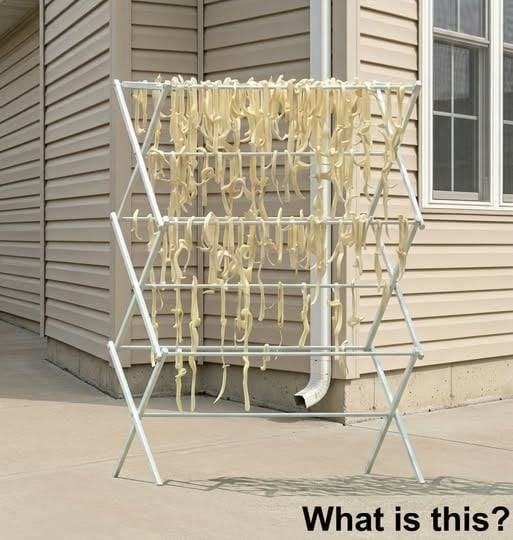
The strands were homemade pasta, carefully prepared and left outside to dry.
What had looked strange at first suddenly made perfect sense.
An Old-Fashioned Way to Prepare Pasta
Drying homemade pasta is a traditional practice that can be used to reduce moisture before storing it. Before modern kitchen appliances became common, people relied on air, sunlight, and time for many food-preparation tasks.
Fresh pasta contains considerable moisture. Allowing suitable pasta shapes to dry can change their texture and make them easier to store for later use.
The process can look surprising to someone who has never seen it before, especially when long strands are arranged across racks, rods, or other supports.
What appears unusual from a distance may simply be a familiar household practice viewed from an unfamiliar perspective.
Why Does Homemade Pasta Need to Dry?
Freshly made pasta contains flour, eggs in many recipes, and water. Because of its moisture content, it is generally intended to be cooked relatively soon unless it is prepared for storage using an appropriate method.
Drying removes moisture from the pasta.
Commercial dried pasta undergoes controlled drying processes designed to produce a stable product. Homemade pasta can also be dried, but the process requires attention to cleanliness, humidity, ingredients, and storage conditions.
The goal is not simply to leave food outside and hope it dries. Proper food-handling practices remain important.
Why the Backyard Made the Scene Look Mysterious
The setting played a major role in creating the initial confusion.
Most people associate a backyard with plants, outdoor furniture, laundry, gardening equipment, or children’s activities. Seeing rows of pasta hanging there does not necessarily fit that familiar picture.
As a result, the brain searches for an explanation.
This is a common feature of human perception. When we encounter something unfamiliar, we often compare it with things we already understand. If the object does not immediately fit a familiar category, it can appear much more mysterious than it really is.
Once someone explained that the strands were pasta, the entire scene became easier to understand.
Traditional Food Practices Can Look Unusual Today
Modern kitchens have changed the way many people prepare and preserve food.
Refrigerators, freezers, packaged foods, food processors, dehydrators, and other appliances have made many traditional techniques less common in everyday life.
That means practices that were once familiar can appear unusual to people who have never encountered them.
Air-drying food is one example.
Across different cultures and generations, people have developed methods for preserving ingredients using drying, salting, fermenting, smoking, and other techniques.
These methods reflect the resources, climate, traditions, and culinary habits of different communities.
A Simple Explanation Can Change the Entire Picture
The most interesting part of the backyard mystery was not the pasta itself.
It was how quickly the interpretation changed.
Before the explanation, the hanging strands looked strange.
After the explanation, they looked completely ordinary.
The physical scene had not changed.
Only the context had changed.
This happens in many areas of everyday life. A sound coming from another room can seem mysterious until we discover its source. An unfamiliar object can look complicated until someone explains what it is used for. A strange-looking arrangement can become perfectly logical once we understand the purpose behind it.
Context has a powerful effect on how we interpret what we see.
The Value of Looking Twice
The story is also a useful reminder not to rush to conclusions.
When something looks unusual, there may be a simple explanation that has not yet occurred to us.
Instead of immediately assuming the most dramatic possibility, taking a moment to observe the details and ask questions can often reveal what is really happening.
In this case, the answer was surprisingly ordinary.
Someone was simply making pasta.
The experience may even have introduced a few neighbors to a traditional food-preparation technique they had never seen before.
A Backyard Becomes a Small Lesson in Curiosity
What started as an unusual sight became a small lesson in how easily context can influence perception.
The hanging strands were never mysterious in themselves. They only seemed mysterious because the people observing them did not initially know their purpose.
Once the explanation arrived, the scene became almost charming: homemade pasta being prepared patiently, using a simple technique that connects modern kitchens with older culinary traditions.
Sometimes curiosity leads us toward complicated explanations.
But sometimes the answer is much simpler.
A strange-looking sight may turn out to be nothing more than an everyday activity viewed from a different perspective.
And that may be the most interesting part of the story: before deciding that something is unusual, it can be worth taking a second look.